
in brief
- Chinese President Xi Jinping has reiterated China's preparedness to fight for its strategic aims.
- Experts say US President Donald Trump is in a "weakened position" due to the war in the Middle East, and it could be China's gain.
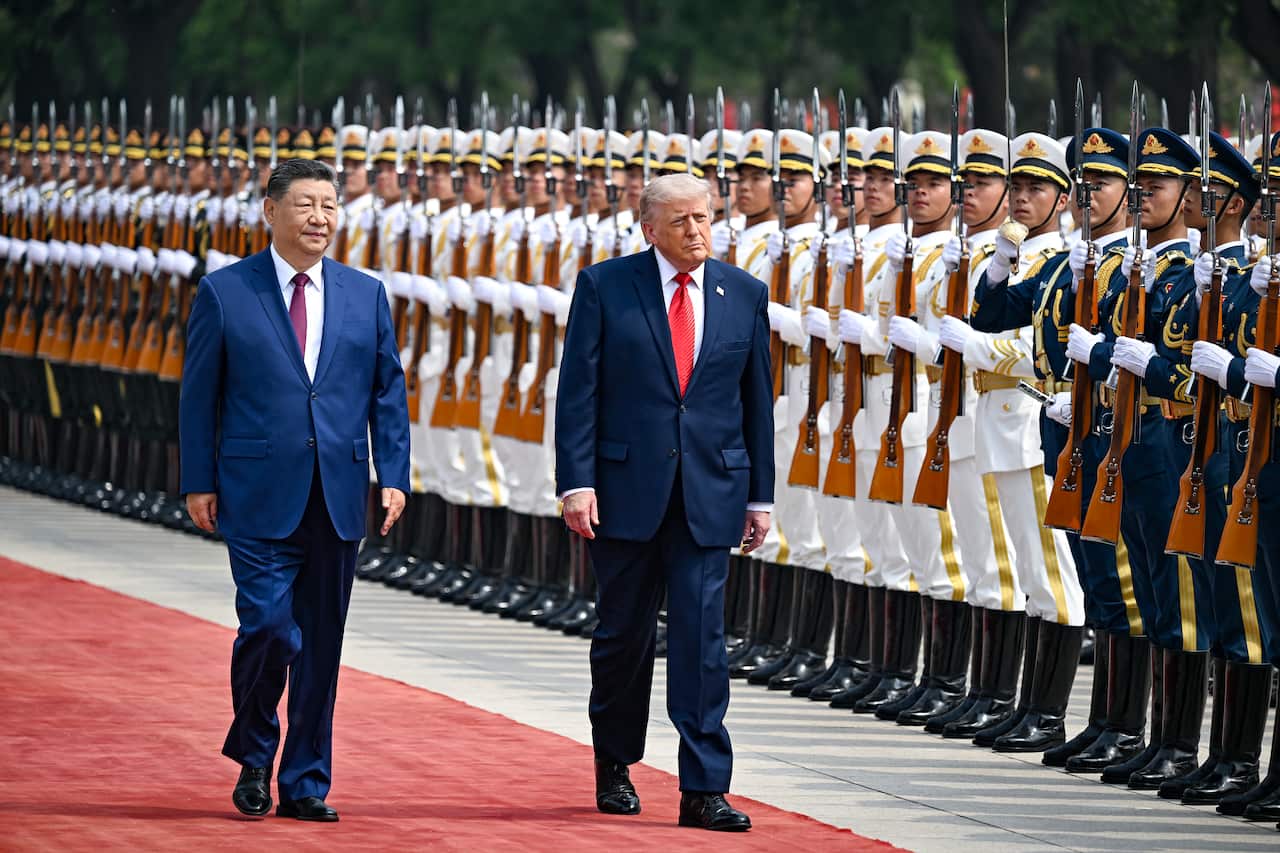
As Donald Trump heaped praise on Xi Jinping during a meeting in Beijing, it was not reciprocated by the Chinese president. Instead, Xi invoked an ancient Greek concept, signalling there could be trouble ahead.
The United States president is on a three-day state visit to China — the first by an American president since his own in 2017 — where he's hoping to secure assistance from the Iranian ally over opening the Strait of Hormuz, among other objectives.
On Thursday, before their two-hour private meeting at the Great Hall of the People, Trump lavished praise on Xi, saying he is a "great leader" and that "it's an honour to be your friend".
Xi, on the other hand, implied that the US was on the way out as global hegemon while China was quickly taking its place, with a subtle warning that its rivals ought not to stop its ascendance.
"Currently, a transformation not seen in a century is accelerating across the globe, and the international situation is fluid and turbulent," he said.
News that makes sense
Your trusted source for staying up-to-date with the world around you. Get free daily news updates and analysis, straight to your inbox.
"The world has come to a new crossroads. Can China and the United States overcome the Thucydides trap and create a new paradigm of major country relations?"
That concept, referencing the Greek historian's assessment of the second Peloponnesian War of 431 BC to 404 BC, posits that a rising power strikes fear into a regional leader, making war inevitable.
According to Chinese foreign ministry spokesperson Mao Ning, Xi told Trump that "the Taiwan question is the most important issue in China-US relations".
"If it is handled properly, the bilateral relationship will enjoy overall stability. Otherwise, the two countries will have clashes and even conflicts, putting the entire relationship in great jeopardy," Xi is alleged to have said.
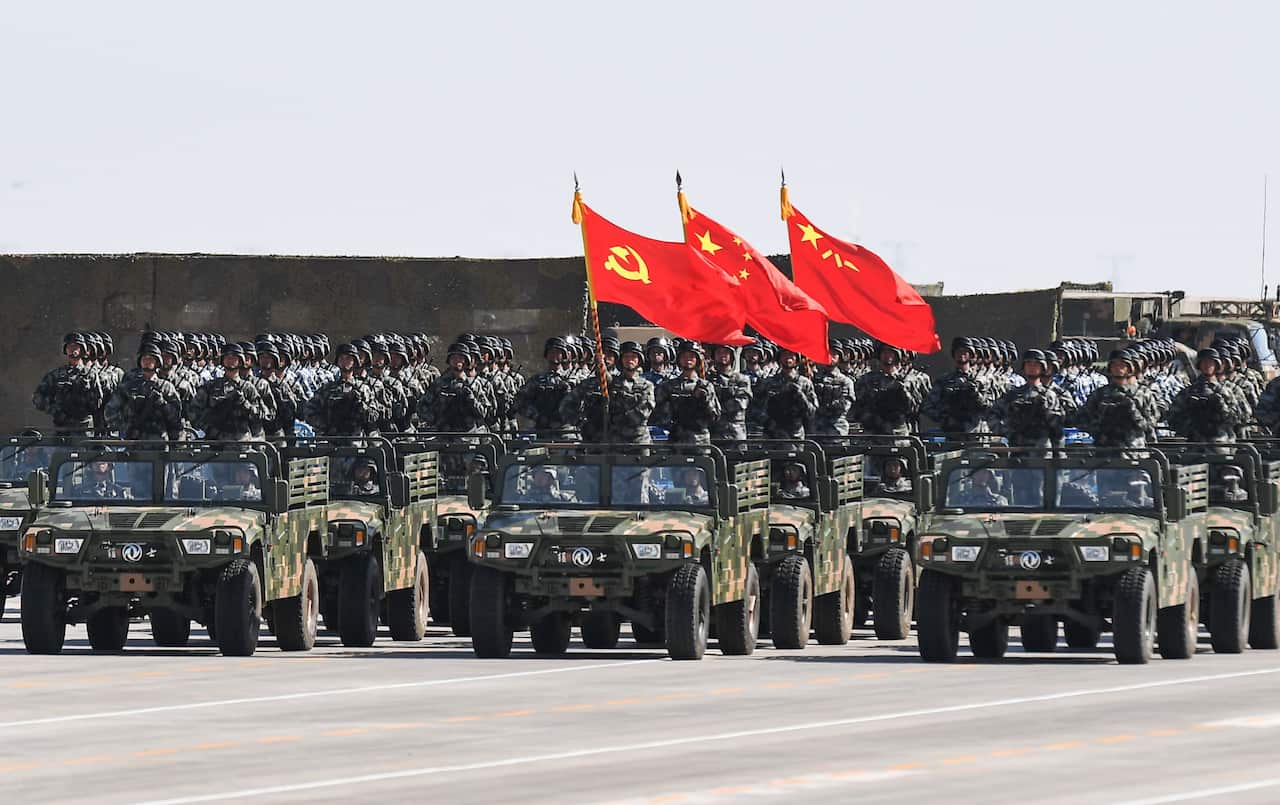
Such militaristic posturing is nothing new from China, according to Bethany Allen, head of China investigations and analysis at the Australian Strategic Policy Institute (ASPI).
"It's all very, very similar language to what we've seen before," she told SBS News. "China is always firm on Taiwan."
Marco Rubio, the US secretary of state who is with Trump in Beijing, has said that such remarks are routine for China.
“They always raise it on their side," he told NBC News. "We always make clear our position, and we move on to the other topics.”
However, Allen warns that this time, things are materially different.
The conflict in the Middle East has seen US allies — including Australia — refuse to respond to requests for assistance in opening the Strait of Hormuz. The strategic waterway's closure has driven up fuel costs around the world and impacted Trump's approval ratings domestically in the US.
"Trump is coming into this in a significantly weakened position, then I would say we have ever seen from the US before," she said.
"He's turning to China to ask for help, but that puts Xi Jinping in this much stronger negotiating position."
What is the US position on Taiwan?
China could use that leverage to further its aims in the Pacific, but Marina Zhang, associate professor of the Australia-China Relations Institute at the University of Technology Sydney, says that seems unlikely, at least in the short term.
"I don't see any immediate need for China to take any concrete actions, especially to capitalise on this so-called 'window of opportunity' by the US," she told SBS News. "That's not what China is looking for."
The Asian power has a long-term goal of reunification with Taiwan, but is unlikely to jeopardise its increasingly central role in global trade by taking highly disruptive military action, Zhang said.
A victory for China in this summit would be a loosening of language around US commitments to Taiwan's defence and a subduing of its continuing supply of arms, outside of whatever business deals might be made.
These changes may be subtle — such as the fact that the White House summary of events on Thursday made no mention of Taiwan — and could even be decided behind closed doors, but Zhang argues that China has already demonstrated that this meeting is happening on its terms.
"China waited until just two days before the summit to make the announcement [that it would be a three-day trip instead of two]. That's very unusual," she said.
The official US position on Taiwan, a self-governing island which China claims as part of its own territory, is to acknowledge Beijing's position that there is only one China and that Taiwan is a part of it. However, it does not explicitly endorse it, maintaining a policy of 'strategic ambiguity'.
The US is also overwhelmingly the largest supplier of arms to Taiwan, and the US' Taiwan Relations Act mandates that the US maintain the capability to repel any hostile action against Taiwan.
While the US has often been ambiguous about what that might mean, former president Joe Biden was overtly more pro-Taiwan than Trump has been so far.
On both sides, for now, maintenance of the status quo appears to be the most beneficial course.
Peace in the Pacific
When China and Taiwan are mentioned, it can raise discussion in Australia about the implications of a potential conflict and how it might affect this country.
Dialogue between the US and China is stronger now than it has been in the past, something furthered by Trump's visit. Allen argues this can only be a good thing for the world and Australia.
"It's not necessarily enough to prevent [conflict], but I would suggest that this is definitely a positive step, if at a very baseline level," she said. "Right now, I do not see any signs of concern for Australia."
A report last year by ASPI found that most Australians have very little understanding of Taiwan and mixed feelings about whether or not Australia should "step in" if there were ever conflict with China.
A separate 2023 report from the Lowy Institute found that if China invaded Taiwan, just 42 per cent of Australians would support sending military personnel to defend the island.
More than 60 per cent, however, believed Australia should use its navy to prevent a Chinese blockade of Taiwan.
Experts have, however, warned that such a conflict would have disastrous impacts on Australia, with serious shortages of fuel, pharmaceuticals, and technology likely.
"Where Australia could perhaps be concerned would be if there were a significant escalation in the US-China trade war, because the downstream effects of that on Australia could be hard to predict, or could be negative," Allen said.
"Any escalation in sabre-rattling would bring greater uncertainty to the region, and that would be negative for Australia.
"Right now, I would say the indicators are neutral, if not slightly positive."
Iran assistance unlikely
Trump entered his trip saying he would request China's assistance in opening the Straight of Hormuz and has since told Fox News that Xi assured him the country "would like to be of help".
"He's not going to get commitment from Xi Jinping for China to expend its real diplomatic capital to call on its relationship with Iran to get Iran to reopen the Strait of Hormuz," Allen said. "He is not going to get that."
She argues China has been developing its reputation as a mediator between nations that operates in a very low-touch manner, and it is not about to dispel that image for the US.
That is because, Allen says, the old strategic maxim "never interrupt your enemy when they are making a mistake" applies here.
With its unconfirmed but rumoured-to-be vast strategic fuel reserves that the country has been building for years, as well as its expenditure on renewable energy and electric vehicles, China is in a fairly strong position to weather the fuel crisis gripping the rest of the world.
"Countries that sent their own soldiers to die for the US in Iraq and Afghanistan have not been willing to do anything remotely similar, so why would China rush in to rescue its greatest adversary when they don't have to?" she asked.
For the latest from SBS News, download our app and subscribe to our newsletter.







