
In Brief
- New Zealand has a similar plan to Australia for dealing with the fuel crisis.
- However it appears unlikely to cut its fuel excise.
One of Australia's closest neighbours is looking across the Tasman Sea when determining its fuel crisis response and has questioned the government's move to cut the fuel excise.
Fuel fears have gripped global economies as strikes near the Strait of Hormuz — through which around 20 per cent of the world's oil passes — continue.
The fragility of New Zealand's fuel supply, which has been solely reliant on imported products since its Marsden Point refinery closed in 2022, has been laid bare during the crisis.
Unleaded petrol has gone past NZ$3.40 a litre ($2.85), with protests erupting on Auckland's Waiheke Island last week after a petrol station's prices jumped to NZ$4.23 per litre ($3.51).
News that makes sense
Your trusted source for staying up-to-date with the world around you. Get free daily news updates and analysis, straight to your inbox.
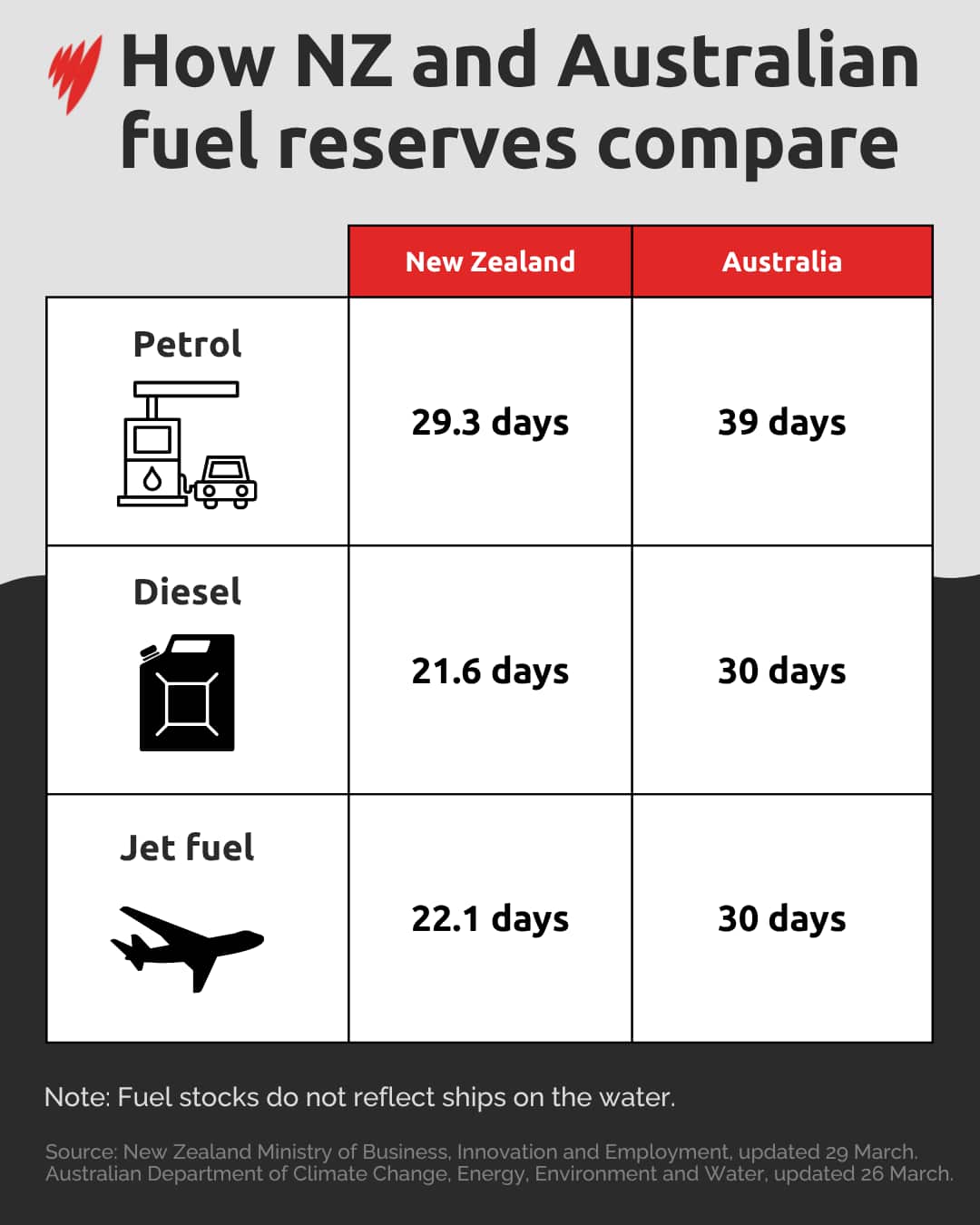
Based on daily reported fuel reserves figures — 53.9 days of petrol, 54.5 days of diesel and 50.4 days of jet fuel — New Zealand appears better prepared than Australia; however, this figure includes ships on the water.
Compared with New Zealand, Australia has roughly 9 days more of each fuel product in reserve, based on each nation’s daily consumption.
New Zealand's Prime Minister Christopher Luxon has unveiled a similar four-phase plan to Australia, although it is still in the initial phase, with his government noting that what Canberra does next will impact its own response.
New Zealand's National Fuel Plan states six criteria items to escalate or de-escalate the crisis level, including "any significant policy changes in Australia or from the International Energy Agency".
So reliant is the plan on Australia's response that when Prime Minister Anthony Albanese announced a three-month halving of the fuel excise to 26.3 cents per litre on Monday, there were questions whether it would prompt a phase escalation in Auckland.
New Zealand finance minister Nicola Willis determined a meeting on the matter unnecessary, arguing her country's government had "opted for a different, targeted approach".
She said Australia's fuel excise cut, expected to relieve price woes at the bowser, will largely benefit those on higher incomes and doesn't leave room to pull similar levers if the crisis worsens.
"It gives a price signal that increases use at a time when you may need to restrain it," Willis told the New Zealand Herald on Tuesday, echoing economist concerns that the move would fuel panic buying in Australia.
New Zealand's fuel excise is just over 70c a litre.
Why is NZ's strategy linked to Australia's?
Dr Murat Üngör is a senior lecturer in the University of Otago's economics department.
He said the integrated nature of the supply chain means that "Australia’s disruptions become New Zealand’s shortages".
Just like Australia, New Zealand's petrol, diesel and jet fuel is largely sourced from refineries in Singapore, South Korea and China.
"New Zealand’s crisis level does not hinge on politics. It hinges on supply chains and the reality that New Zealand is the downstream island in a shared fuel system," he told SBS News.
He explained that the supply chain is "closely integrated with Australia’s through shared shipping routes, wholesale markets, and, as of last week, aligned fuel specifications".
After the Albanese government reduced petrol and diesel standards to boost supply, the New Zealand government confirmed that its fuel standards would be temporarily aligned with Australia's.
"Our fuel specifications are already very similar to Australia's. Fuel refined to Australian standards is compatible with New Zealand vehicles and meets safety and quality expectations," associate energy minister Shane Jones said.
Following Albanese's statement that the global economic situation could worsen over the coming months, Australia's neighbour across the Tasman will surely be keeping a close eye.
For the latest from SBS News, download our app and subscribe to our newsletter.







