
Watch Vienna: A Renters' Paradise now on SBS On Demand.
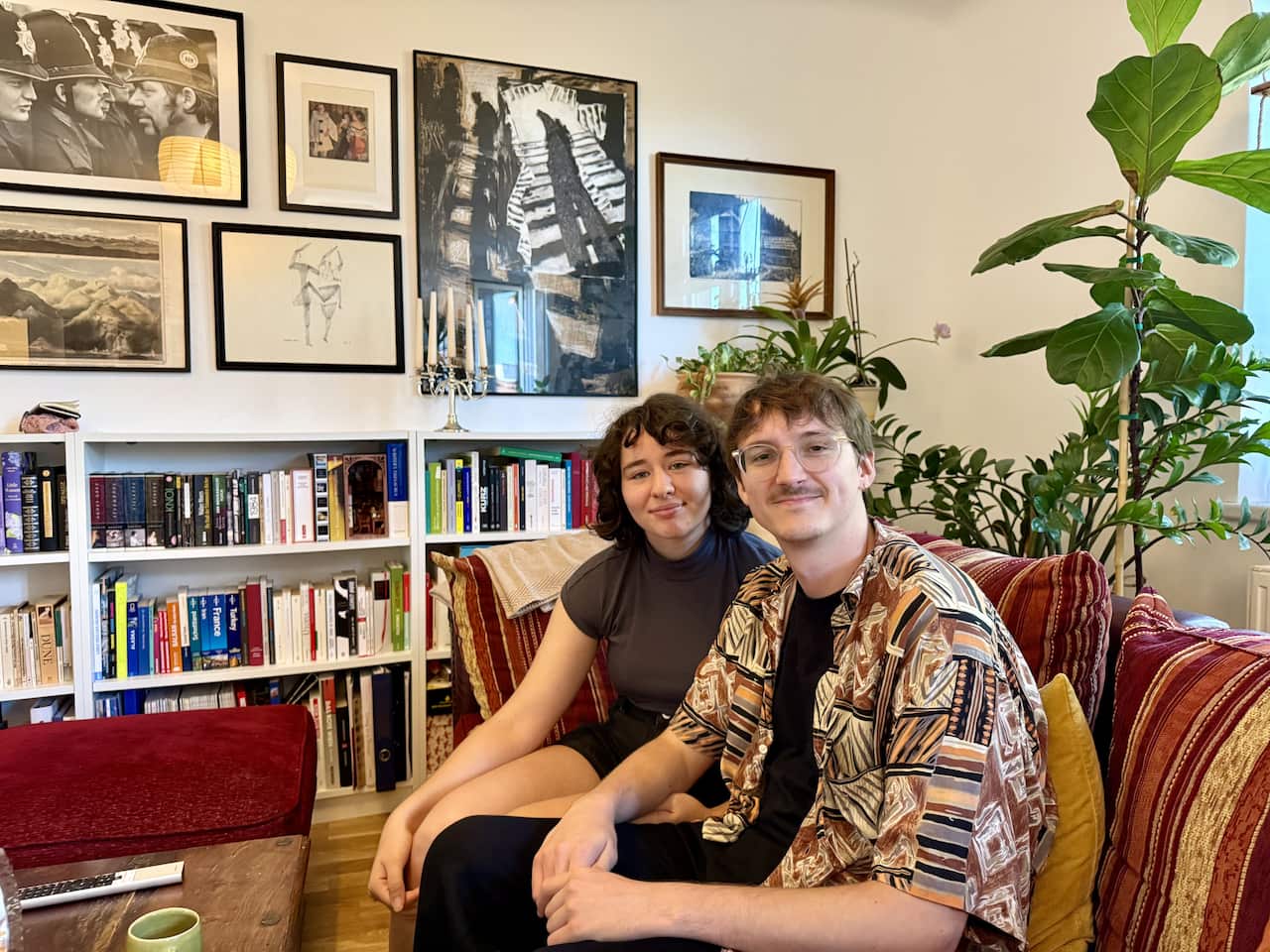
Anthony and Alex's one-bedroom, one-bath apartment — with a balcony — costs them around €400 ($658) a month. Not per week, which is what you might expect if you saw their apartment on an Australian real estate website.
That's because Anthony, who is Australian, and Alex, an Austrian, live in Vienna's social housing system, along with approximately half of Vienna's population of just over 2 million people.
"I think the rent we pay now is what I was paying in a sharehouse in Brisbane 24 years ago," Anthony told SBS Dateline.
News that makes sense
Your trusted source for staying up-to-date with the world around you. Get free daily news updates and analysis, straight to your inbox.
Alex has lived in the apartment since his 20s, when he became eligible through a Viennese municipal housing scheme.
Now, he can live there for the rest of his life.
Anthony moved in around nine years ago, and the pair have completely renovated the place.
The couple have been able to paint walls, renovate the kitchen (including installing a new countertop and oven), and decorate to their hearts' content: something practically unheard of in Australia's rental market.
"It's definitely different from Australia because I mean, you would never even think replacing an oven or something in a rental," Anthony said.
If the couple leaves, they can take the appliance with them, "or pass on the price to the new person coming if they want to keep it".
So could this system — which may look to some like a renter's paradise — ever work in Australia?
How Vienna's social housing system works
Vienna has multiple forms of social housing, stemming back to the period between World War One and Two, when the city was governed by the Social Democratic Workers' Party.
One type, Gemeindebau – meaning community or municipality building — is owned by the city of Vienna and is open to anyone whose income is below a specific level and who meets certain criteria. They form around 22 per cent of the city's total housing stock.
Other social housing requires a deposit. Subsidised homes that require a deposit are largely run by non-profits or co-operatives with government subsidies. Often, the initial deposit is returned at the end of tenancy.
Some of Vienna's affordable housing schemes are designed to help people in their twenties access the housing market.
Local Maximilian Schranz, 28, lives with his girlfriend Lisa in a one-bedroom social housing apartment, which they accessed through an under-30s scheme. They pay around €640 ($1,055) per month.
Max could stay in the apartment "however long I wanted to, theoretically".
"The leases are without any term limits and then there's even ways to give the lease to your immediate family if they wanted to and they're eligible."
He says the programs designed to encourage young Viennese people to live in apartments like these has "changed the image" of social housing.
"Now, I think, [there is] a kind of 'cool feeling' to it often in younger circles."
The affordability of Vienna's system
A single person who wants to get into one of Vienna's social housing dwellings can't be earning more than €61,280 (around $100,800).
For a couple, combined income can be no more than €91,320 (around $150,300) per year. Approximately 75 per cent of the city's population earn less than these limits.
On its website, the City of Vienna says these relatively high income limits are so the "middle class" can also access social housing.
This helps create communities where people from a range of different backgrounds live together in the same building.
As well as being able to stay in apartments indefinitely, Anthony and Alex also aren't subject to inspections.
"It's your place. You don't have inspections — it's just really like your own," Anthony said.
There are limitations to the system, though. Not everyone is entitled to social housing.
The requirements include living in Vienna for at least two years, and having either Austrian citizenship or equivalent status. This can make it difficult for asylum seekers to find affordable accommodation.
How does Australia's social housing system work?
Around 4 per cent of Australia's housing stock is social housing, compared to around 40 per cent in Vienna and 24 per cent in Austria generally.
In Australia, social housing is primarily divided into public housing, managed by state or federal governments, and community housing managed by non-profits.
Hal Pawson is an emeritus professor at the University of New South Wales who has researched housing for more than 30 years.
"The main difference [to Australia] is that the Viennese social housing sector has been established for a hundred years and has been well funded for a big part of that time," he told SBS Dateline.
A significant factor, Pawson said, is the obligations placed on developers to include social housing.
Because this system has been funded so consistently, social housing providers have "[built] up financial resources". This has allowed them to build their own housing, adding to the existing social housing stock.
In contrast, community housing providers in Australia often manage state government-owned homes.
"They don't benefit from the uplift of land values or anything like that, and they don't have the capacity to redevelop or make better use of the sites because they don't own the sites."
Pawson said Australian public housing was consistently funded for a 50-year period after World War Two. But it has decreased significantly under Australian governments since the mid-1990s, starting when the Howard government decided to prioritise funding the Commonwealth Rent Assistance program.
"During the 2010s, somewhere between 2,000 or 3,000 social homes were being built a year, which is barely enough to compensate for the ones that are so worn out and out of date you have to knock them down," Pawson said.
In the 2020s, investment in social housing has increased. Pawson cited the Victorian government's Big Housing Build plan launched in 2020 as a key benchmark, and Queensland and NSW have launched similar self-funded programs. He said Tasmania has also consistently invested in social housing.
Across Australia, though, there is still high demand for social housing. Pawson said those who are not deemed 'high priority' can be waiting for more than 10 years.
At a federal level, the Albanese government's Housing Australia Future Fund aims to fund around 30,000 social homes over five years. However, the funding is not guaranteed beyond that timeframe.
Could a Viennese system ever work in Australia?
Pawson said something Australia could copy from Vienna is adding social housing requirements for private developers buying government land.
Independent ACT senator David Pocock introduced a private senator's bill on 2 July that would require federal land sold or leased for residential development to have a default level of 30 per cent affordable housing built on it.
Both the bill and Pawson pointed to a $3 billion sale of land by the defence department.
"They've made no … requirement on people who buy that land to say that some of that must be social and affordable housing," Pawson said.
"That's something that all governments could do straight away. Of course, it wouldn't have an immediate effect, but it would change the system."
Another important element of the Viennese system is the way it reduces stigma.
Anthony said back in Australia, living in social housing wouldn't have occurred to him.
"But I think in Vienna, it's such a huge percentage of the housing market that it's quite normal to live there," he said.
"I guess there's always a bit of stigma … but yeah, I think you can't even compare it with Australia."
Pawson said Vienna's approach "absolutely" helps to destigmatise social housing.
"This is one reason why social housing in Australia has become a sort of shrivelled version of its old self," he said.
"The stigmatisation of a sector which is highly rationed — we have really strict, restrictive rules for who can get a tenancy — just almost inevitably means it becomes a very stigmatised tenure."
Australia's housing obsession
Vienna isn't a perfect city: high cost of living and inflation are still issues, though Austria's inflation rate is lower than Australia's at 3.2 per cent compared to 4 per cent.
But its approach to housing may make people more comfortable being long-term renters, placing less value on owning homes, particularly compared to Australia’s competitive market.
German speaking countries, including Austria, generally have lower rates of home ownership. Pawson said they don't "fetishize [it] in the way that we do". And these countries also incentivise investment in property less.
As an Australian living in Vienna, Anthony thinks people have a different perspective on housing, including treating it as an investment.
"If they're going to buy something, they're buying it to live in …. They're not even really thinking about 'How can I make an extra buck?'"
It's also reflected in the way he sees people back in Australia discuss property and housing affordability.
"When you hang out with friends at a barbecue or whatever, there's lots of talk about how you're going to get into the property market, or get your next apartment," Anthony said.
"Here, I don't think it's a big topic."
Watch your favourite Dateline episodes around the clock on SBS On Demand's dedicated Dateline channel. For the latest from SBS News, download our app and subscribe to our newsletter.

Dateline is an award-winning Australian, international documentary series airing for over 40 years. Each week Dateline scours the globe to bring you a world of daring stories. Read more about Dateline

Have a story or comment? Contact Us







