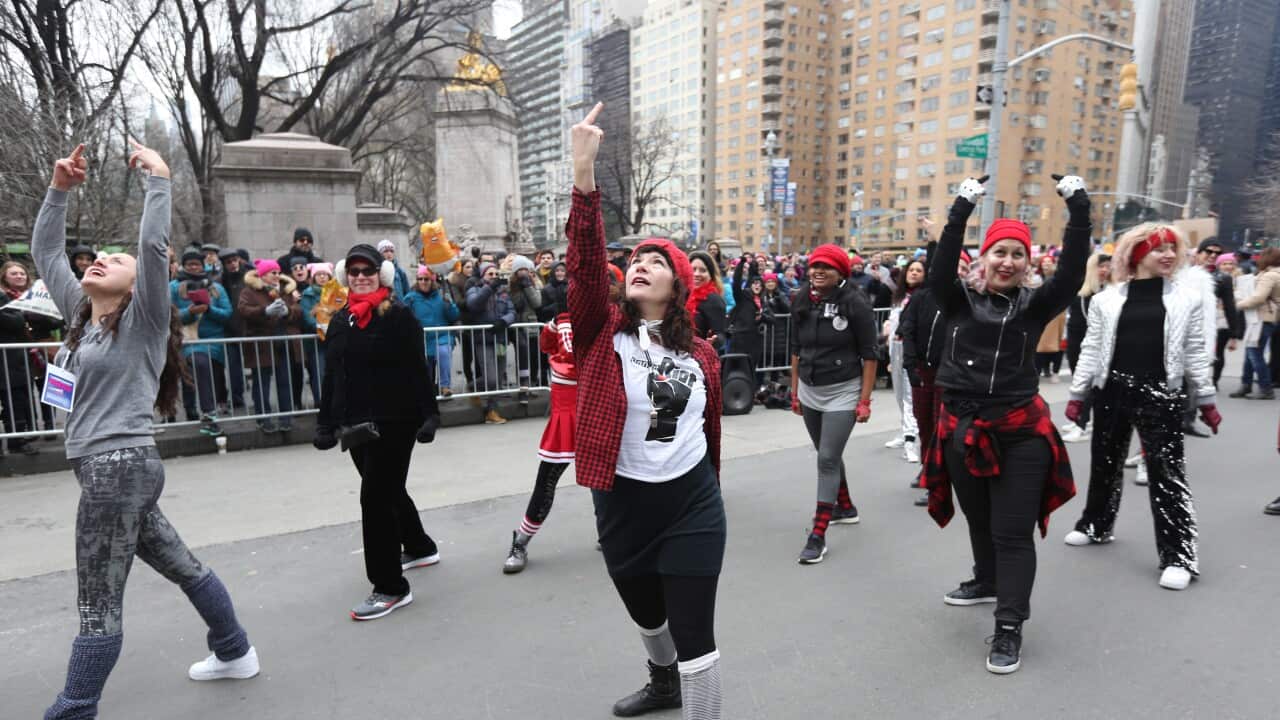
Several thousand people have marched through Sydney's streets on Sunday, demanding they be made safe for women following the murder of international student Aya Maasarwe in Melbourne.
The rally was part of a global Women’s March movement and in the same weekend women around the world called attention to key issues, Australia's Minister for Women Kelly O’Dwyer announced she will be leaving parliament ahead of the upcoming election. In response prime minister Scott Morrison has suggested changes could be made to boost the number of Liberal women in parliament.
While women marched through subzero temperatures in some areas of the world, men’s rights groups threatened to boycott razor manufacturer Gillette after its latest ad campaign challenged masculinity.
The New York Times reported on the Women’s Marches from around the globe below.
News that makes sense
Your trusted source for staying up-to-date with the world around you. Get free daily news updates and analysis, straight to your inbox.
Women of all ages, and some men, took to the streets in a dozen cities around the world Saturday, the anniversary of the 2017 Women’s March that served as a strong rebuke of President Donald Trump’s policies.
The annual marches and rallies have taken on wider themes since then, such as challenging the rise of the far right, while also calling for an end to inequality, the gender pay gap and violence against women.
Some events were organized in response to a call from the United States to create a “Women’s Wave.” But others were held independently, and in many cases, the core message was that women’s rights are about more than Trump.
In cities across the United States, women braved subzero temperatures in some parts of the country to march even as accusations of anti-Semitism have rocked the movement and prompted questions about its future.
The rallies in European countries like Germany and Italy included warnings of bleak times because of the rise of populism and the far-right. In London, women marched against punishing austerity measures. But the turnout fell shy of the many thousands that had filled the streets two years ago.
In Rome, women met in a downtown square, where they took aim at Italy’s populist government, which has been accused of whittling away at measures that protect women and migrants.
They chanted against fascism, against the “Italians First” mentality promoted by the government’s main political parties — the League and the Five Star Movement — and they blasted Italy’s grim record of violence against women.
According to a parliamentary report issued last year, 1 in 3 women have reported being “subjected to some form of physical or sexual abuse.”
“We are channeling our rage, once again,” said Kiersten Pilar Miller, founder of an association that assists pregnant women in Rome. “We want all our anger turned into usable action.”
There were speeches, chants and songs, and even a demand for the government to lower taxes on tampons and menstrual pads.
Travel to The Best Place To Be A Woman via SBS On Demand.
Warning that the rise of the right in Europe and the United States puts at risk rights that affect women, as well as migrants, Raffaella Palladino, president of D.i.Re, a network of women’s centers and shelters, said women were not going to “give up 1 millimeter” in defending their rights.
“This was a country that used to assist women who were victims of human trafficking, and exploitation. Now, we are erecting walls and closing ports to ships that rescue migrants at sea,” she told participants, referring to Italian policy under Interior Minister Matteo Salvini to no longer participate in sea rescues outside the maritime border and to bar ships carrying rescued migrants from docking.
In an interview, Palladino said women in Italy faced a difficult time. Violence is prevalent, and if women denounce their aggressors, she said, they do not get “sufficient protection.”
Although a report by Istat, the national statistic agency, said that 43 percent of working Italian women had been subjected to some form of harassment at least once during their life, the MeToo movement has not taken hold in Italy.
“MeToo was nonexistent in Italy because women were afraid of speaking out, and those who did were revictimized and condemned,” said Luisa Betti Dakli, a journalist and one of the speakers.
Carlo Cosenza of Sentinelli di Roma, an association that describes itself as “lay and anti-fascist,” got one of the biggest cheers of the day when he held up a poster showing Salvini and Trump.
“These people are trying to build a future that is not open to all. Let’s stop them now,” he said.
In London, organizers chose “Women Demand Bread & Roses” as a slogan this year to protest the government’s squeeze on essential services. It drew inspiration from the American “Bread and Roses” protests for working women’s rights in the 1910s.
The march across the heart of London drew around 3,000 people. They held signs reading, “Men of Quality Don’t Fear Equality” and “Brexit Wrecks It,” reflecting the political deadlock before the March deadline for Britain to leave the European Union.
In Berlin, around 2,000 protesters marched from the Brandenburg Gate to the Alexanderplatz along the famous Unter den Linden. Organizers called for scrapping a Hitler-era law that makes it a crime for doctors to advertise that they perform abortions.
Marchers in Frankfurt, Germany, met at two spots at 5 minutes to 12, in a reference to the urgency of women’s issue. Roughly 1,200 people marched, according to Frankfurt police, many wearing the pink knit hats emblematic of the movement.
They waved flags and held signs saying, “Teach girls to be somebodies, instead of Somebody’s,” and others spoke of racism, gay rights and abortion issues. Members of Green and Social democratic parties showed up with party banners.
Is there an attack on masculinity? Learn more via SBS On Demand.
Women in Spain held rallies this past week that were independent of the Women’s March movement but that denounced the return of the far-right in Spanish politics. On Tuesday, they protested against the right-wing coalition government taking office in Andalusia, led by the Popular Party but supported by Vox, a far-right party that secured its first parliamentary seats in elections last month.
Vox is nationalist and anti-immigrant, but has also angered women’s associations because of its call for Spain to abolish its abortion law and to overhaul another law covering gender violence. Vox has also questioned official data about domestic violence and wants to unwind gay rights in a country that was among the first to allow same-sex marriage, in 2005.
The protests involved about 45 women’s associations and took place in 50 cities. Protesters held signs that read, “Not a step backward,” in defense of abortion and other rights.

Dateline is an award-winning Australian, international documentary series airing for over 40 years. Each week Dateline scours the globe to bring you a world of daring stories. Read more about Dateline

Have a story or comment? Contact Us







