
This audio is voiced by AI and may occasionally mispronounce words.
Share your feedback and help us improve this feature. Read more about how we use AI at SBS here.
What are the issues, risks and ethics that arise when making money and making a baby mix? Watch Insight episode Baby Business on SBS On Demand.
When Kenedi Hyler was growing up, she watched her mother go through three surrogate pregnancies.
Now, Kenedi has been a surrogate three times herself in the 10 years since she gave birth to her son at the age of 21.
News that makes sense
Your trusted source for staying up-to-date with the world around you. Get free daily news updates and analysis, straight to your inbox.
"I became a surrogate because I grew up with surrogacy ... I really just wanted to help people the way my mum did," she told Insight.
However, she has faced plenty of judgement along the way — from people who say things like she's playing God, doing a disservice to her son, or selling her body.
Kenedi lives in the United States, where commercial surrogacy is legal, and has earned over US$200,000 ($297,000) across three surrogate pregnancies.
"Commercial surrogacy has benefited me a lot. I was able to purchase a house [in California] on my own ... a reliable car ... and pay off some debt," she said.
"It's not all about the money, but it's definitely helpful."
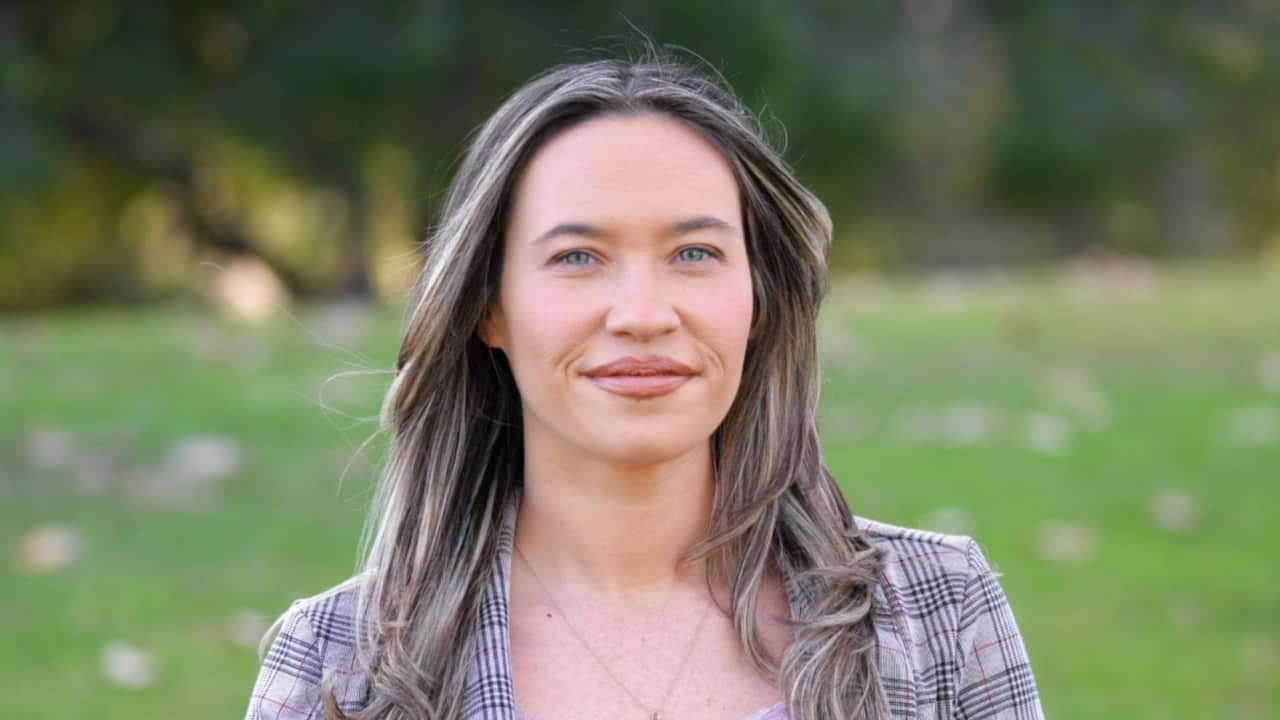
The American surrogate says she wouldn't have pursued surrogacy so often if there was no compensation.
"I consider surrogacy more compensation than I do profit," Kenedi says.
"In our contracts, it states you are being compensated for your pain, labour or suffering, anything that happens like that."
One of the families Kenedi carried a baby for lives in Australia, where a nationwide review is currently examining the state of our surrogacy laws, policies and practices.
The state of surrogacy in Australia
The Australian Law Reform Commission (ALRC) refers to surrogacy as involving "a person carrying and giving birth to a child for another person or couple". Laws surrounding surrogacy vary across Australia's states and territories.
However, throughout the nation, only altruistic surrogacies are legal. A surrogate can have their expenses covered but receive no other personal payment or make a profit.
Commercial surrogacy is prohibited in Australia to protect people from exploitation.
Critics of commercial surrogacy believe permitting such payments leads to the exploitation of vulnerable people through economic coercion, while promoting power imbalances and the commodification of bodies and children. They say it opens the potential for poverty-driven consent, inadequate pay versus health risks, and emotional trauma from separation.
A 2016 House of Representatives Standing Committee report recommended that commercial surrogacy remain illegal in Australia, concluding that "the risk of exploitation of both surrogates and children remains significant".
But the ALRC is reviewing this standpoint and has been asked by the attorney-general to make recommendations for regulating surrogacy.
Exact figures for surrogacy in Australia are hard to find, but those that are available suggest the number of Australians using surrogacy is increasing.
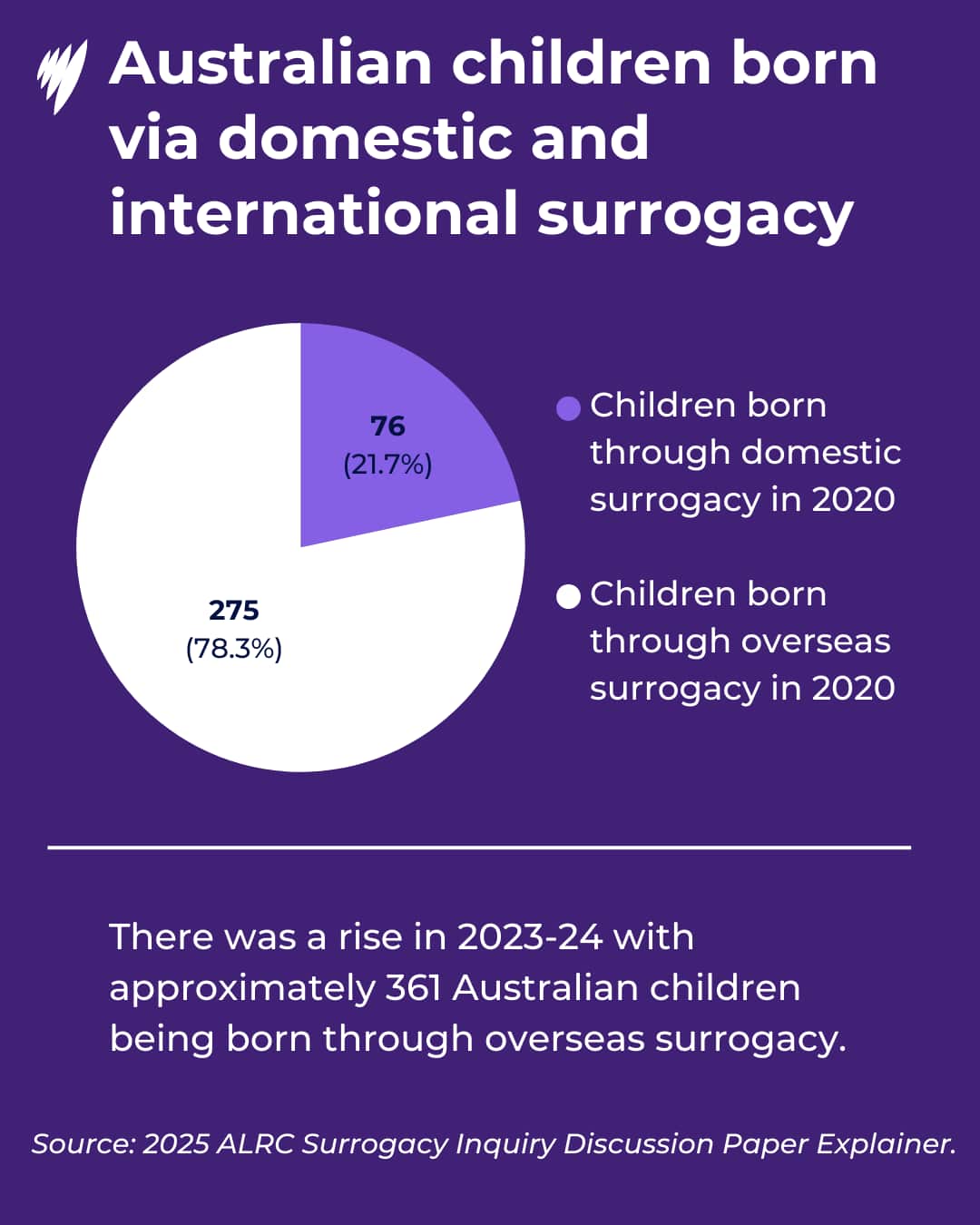
In 2020, approximately 76 children were born through domestic surrogacy, while around 275 children were born through overseas surrogacy, according to the ARLC's 2025 Surrogacy Inquiry Discussion Paper Explainer.
There was a rise in 2023-24, with approximately 361 Australian children being born through overseas surrogacy. The private Facebook community Surrogacy Community Australia has over 3,000 members, many of them Australians exploring surrogacy both domestically and internationally.
Some Australian couples have felt forced to seek surrogacy overseas due to its lack of accessibility in Australia, where there is an unmet demand for altruistic surrogates.
Surrogacy in any form is illegal in several countries, including Italy, France, Spain and Germany. But countries including Georgia, Ukraine and most of the US allow commercial surrogacy — and in some cases, to foreigners.
However, navigating commercial surrogacy abroad has its own difficulties. Foreign laws regarding commercial surrogacy can change quickly — meaning that surrogacy activity previously considered legal can become a criminal offence.
Anthony Fisk and his partner experienced this firsthand.
Seeking commercial surrogacy abroad
As a gay couple, Anthony and his partner Joseph couldn't legally access altruistic surrogacy in their home state of Western Australia, so they looked abroad.
"It was obviously a big decision to make to go overseas, and we considered all those barriers: Cultural, language, distance, legal, medical — it's huge," Anthony told Insight.
They paid surrogates in Thailand and then Cambodia to carry their three children in 2014 and 2016, respectively.
However, they faced difficulty in both countries when the governments cracked down on foreign commercial surrogacy, largely over concerns about human trafficking and exploitation.
"We had a lot of issues in terms ... of the law just changing almost overnight," Anthony said regarding Thailand's passing of a law that banned foreigners from seeking surrogacy.
"We went into a legal environment and exited an illegal environment."
This ban happened when their surrogate was six months pregnant. However, their first-born Celeste was able to leave the country for Australia under an amnesty.

"We went again to Cambodia, where it was also legal ... but this time was even harder," Anthony said.
The Cambodian government announced a ban on all forms of surrogacy while Anthony and Joseph's twins were in the womb.
"They cracked down even more savagely, particularly on the surrogate mothers and on the dads that came back to get their children."
The couple were able to take their surrogate mother to Thailand, where she safely gave birth to their twins — before bringing the babies home to Australia.
Last month, Western Australia passed legislation removing discriminatory barriers for people seeking surrogacy. This means that same-sex couples such as Anthony and Joseph could seek altruistic surrogacy in the state — although not until mid 2027.
Reviewing Australian surrogacy laws
While WA has reinforced its support for altruistic surrogacy, the ACT updated its laws in July 2024 to also expand access to altruistic surrogacy, removing some requirements, and permitting advertising for altruistic arrangements — explicitly keeping commercial surrogacy criminalised.
The ALRC is currently looking at law reform for Australian surrogacy, with its final report due by 29 July this year.
Two of its main policy objectives include promoting the best interests of children and preventing exploitation of everyone involved, according to the Surrogacy Inquiry Discussion Paper.
While Australian surrogacy laws differ across states and territories, the ALRC says that state laws rely on similar approaches, which "unnecessarily prohibit the extent to which surrogates can be reimbursed, resulting in surrogates being unable to fully recover financial and non-financial costs and losses".
This financial consequence likely contributes to the lack of surrogates available in Australia, according to the ALRC paper.
A key reform idea the ALRC has put forward is the full coverage of surrogates' costs and losses. The independent government agency, which provides recommendations on law reform to government, does not refer to this idea as "commercial" — describing the binary of 'commercial' and 'altruistic' surrogacies as an "incorrect and unhelpful" way to conceptualise the issue.
"A commercial surrogacy arrangement can be primarily motivated by altruism; and altruism is no guarantee that the arrangement will not be exploitative," the ALRC said.
Additional ideas proposed by the ALRC regarding Australian surrogacy reform include establishing a nationwide legal and regulatory framework, implementing safeguard screenings and providing legal advice at the outset of a surrogacy arrangement, and establishing an administrative pathway to legal parentage.
Are the current surrogacy laws effective?
Dr Tammy Johnson, who specialises in health law, welcomes the ALRC's review into surrogacy laws as she believes the current laws do not serve Australia effectively.
"Rather, they fail intended parents, who often must go overseas; fail surrogates, whose rights are not clearly protected under altruistic-only models; fail children, whose legal parentage is often delayed or complicated ..."
She also says that the voices of surrogates in Australia are often absent from debate, "yet empirical research shows many surrogates are motivated by a mix of altruism and practical compensation needs — and do not view themselves as exploited".
The Bond University assistant professor of law believes that proper regulation, instead of "blanket prohibition" is a better path for commercial surrogacy in Australia.
Prohibition does not prevent commercial surrogacy — it externalises it.Dr Tammy Johnson
She argues that current Australian laws surrounding commercial surrogacy criminalise conduct that could be safely regulated.
She says that instead of addressing risks associated with commercial surrogacy (such as coercion, unsafe clinics, contract disputes), the law prohibits the entire practice.
"Prohibition does not prevent commercial surrogacy — it externalises it," Johnson said.
"Australia's approach exports risk to other countries rather than managing it locally."
Exploitation concerns
Meanwhile, Australian Catholic University ethicist Dr Xavier Symons says that, while he's also concerned about risks involved with commercial surrogacy overseas, he doesn't believe Australians should be allowed to source overseas surrogates.
In NSW, Queensland and the ACT, it is a criminal offence for residents to engage in international commercial surrogacy.
The ethicist specialising in biological medical sciences believes the possibilities for exploitation are very high, "particularly where surrogates are being sought in developing countries".
"However, I also am not convinced that domestic commercial surrogacy would be a better arrangement necessarily, insofar as I think that there are still possibilities for exploitation even when it's regulated in Australia."
The sorts of people who would be involved in the market are not necessarily willing participants, but rather because of situations of social disadvantage.Dr Xavier Symons
Symons compares his commercial surrogacy concerns to bioethics debates over legalising organ sales for transplants.
He says that in that case, those involved "would most likely be people who come from backgrounds of disadvantage who otherwise wouldn't do this, but have felt, I think, compelled to do it because of their financial situation".
Symons says he is concerned that commercial surrogacy arrangements in Australia might end up being something similar.
"And the sorts of people who would be involved in the market are not necessarily willing participants, but rather because of situations of social disadvantage."
Reproductive autonomy
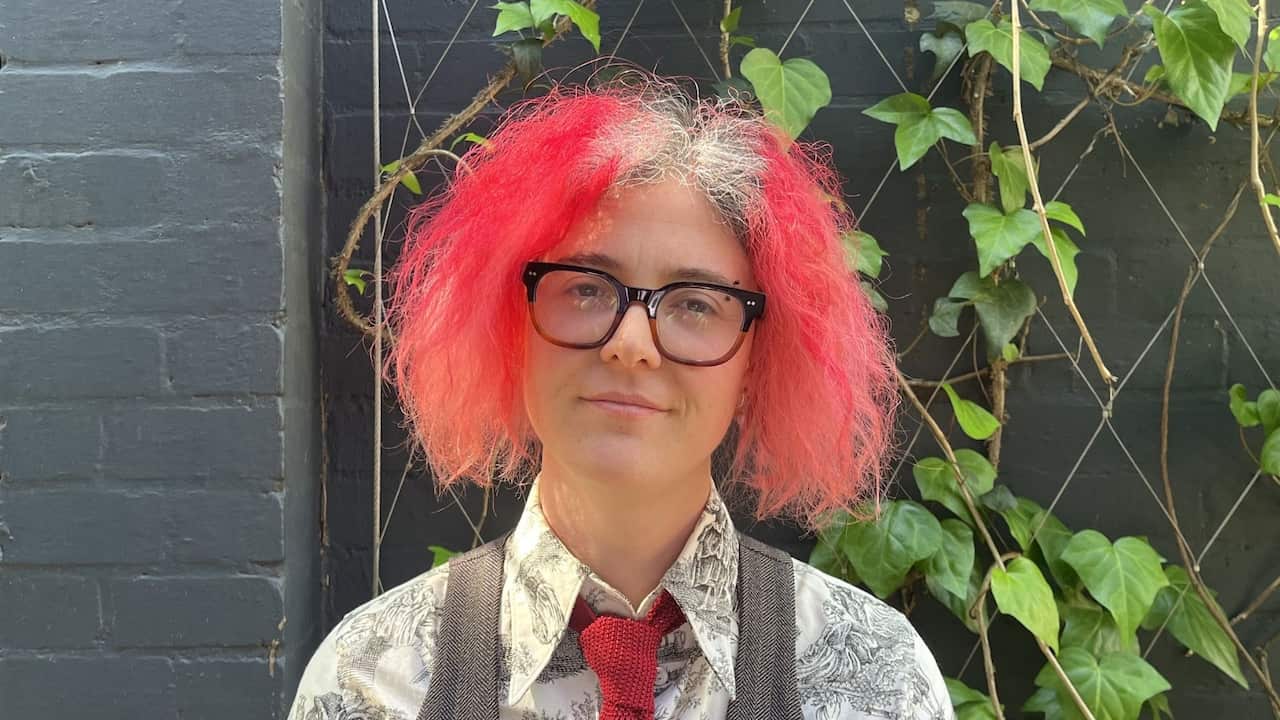
Alice Clarke was the first IVF surrogacy-conceived person in the country and the second in the world. Like Dr Johnson, she believes there should be more reproductive autonomy afforded to surrogates in Australia.
The Melbourne-based 36-year-old says that if somebody wants to give birth to a baby for somebody else, they should be able to.
"I think that in the situation where everybody is getting paid except for the person who could literally die from what's happening ... even when it goes perfectly, it's still horrifying ..."
"As well as the clinic getting 15 or 20 grand, why can't she also pay her bills and look after herself if something goes wrong?"
'I hate that it is called commercial surrogacy'
In the US, three-time commercial surrogate Kenedi is taking a break from surrogacy as she decides her next life move.
While she was financially compensated for her surrogate pregnancies, she says it's still altruism.
"I hate that it is called commercial surrogacy and altruistic surrogacy. Surrogacy is all altruistic," she said.
"Some of us do get compensated, and some of us don't. And that's based off of country laws, state laws ... But we all come from the same place in our hearts."
Watch your favourite Insight episodes around the clock on SBS On Demand's dedicated Insight channel. For the latest from SBS News, download our app and subscribe to our newsletter.
For the latest from SBS News, download our app and subscribe to our newsletter.

Insight is Australia's leading forum for debate and powerful first-person stories offering a unique perspective on the way we live. Read more about Insight

Have a story or comment? Contact Us







