
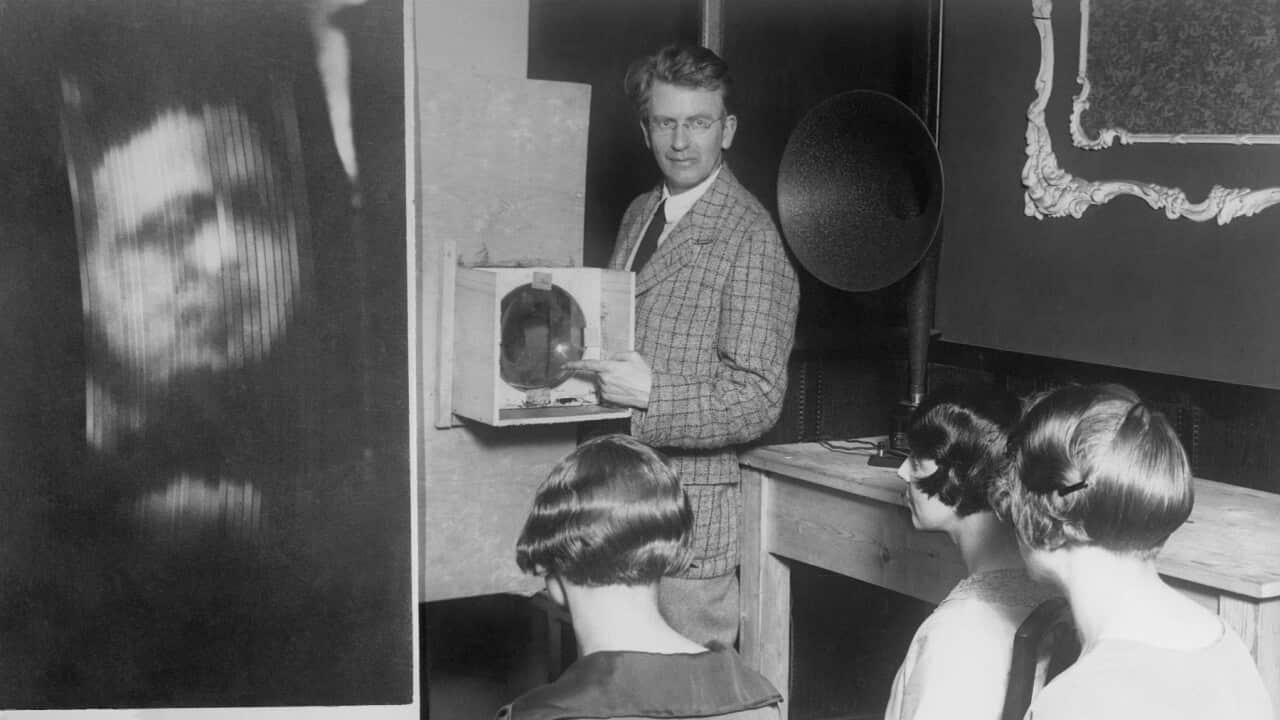

100 years ago Scottish inventor John Logie Baird revealed the first television, called the Televisor, to the world. Those first pictures, flickering images of the head of a ventriloquist's doll, sparked a revolution in social entertainment and culture.
Listen to Australian and world news and follow trending topics with SBS News Podcasts.
TRANSCRIPT
Today, human beings spend a great deal of time in front of their televisions.
Australians spend between two and a half and three hours watching broadcast and on-delay TV every day.
If you add in streaming services, some studies suggest that figure could be as high as six hours a day.
Which is quite an impact when you consider that it's only a hundred years since TV was invented.
The name John Logie Baird is synonymous with the history of television.
He was a businessman, but above all an inventor and he gave the first public demonstration of what would become known as television in January 1926 at his Soho Laboratory in Frith Street in London.
Unlike the electronic systems that would follow, Baird's Televisor was mechanical.
Lewis Pollard is the Curator of Television and Broadcast, Science and Media Museum in the United Kingdom.
He says it was a breakthrough but extremely difficult to operate.
"It was very technical, very complicated and because Baird was such a pioneer in what he was doing, he had to be essentially making a lot of his equipment from scratch or using whatever you might have had around the lab. So the apparatus we have on site in the museum has parts of an old hatbox, a bicycle lamp, and it was very DIY because you couldn't just go to a shop and buy the pieces you needed because television didn't exist."
The BBC launched the world’s first regularly scheduled TV service in 1936 in the UK, but as this newsreel footage suggests, it was viewed as a bit of a novelty, and a distraction from the serious work of radio.
"The BBC's first regular television broadcasts began on the 2nd November 1936, introduced by Leslie Mitchell. There was no colour of course, pictures were strictly black and white or, as some cynics suggested, black and dark grey. But definition improved with usage. Transmission was limited to two hours a day."
In 1938 Logie Baird spoke to British Movietone newsreel audiences in Australia and New Zealand, where television did not start until 1956, nearly two decades later.
"It is now 12 years ago since I produced the first little flickering television image. Today we have in London a regular television service twice daily with thousands of lookers-in (viewers). Television has grown from a scientific novelty to a commercial service. At present the range is limited to 30 miles in and about London. In this connection it is interesting to note that as far back as 1928 I spanned the Atlantic with television. That was of course purely experimental but who can foretell the future."
Certainly there had been huge improvements since those early days.
Logie Baird had to use a ventriloquist's dummy as a subject for that first broadcast as the lighting employed was so intense, anything being lit had a tendency to catch fire.
By 1953, the technology had improved so much that the BBC felt confident enough to launch its biggest outside broadcast to date - the coronation of Queen Elizabeth the second, with their program being recorded on film as it was broadcast, and sent around the world.
Lewis Pollard again.
"Any TV camera in the UK that could be mobilised was mobilised for use during the coronation. It was such a large media event that's why so many people remember it. We talk, here the museum about, the millions of people who watched, but one thing that people might not be so familiar with is the televisions in the 1950s were larger than Baird's Televisor, but still very small and the records say something like 17 people watched each television set, which would be half the size of a contemporary TV, maybe even smaller than that. So, for people watching at home, you know, it was such a big moment that it really helped, I'd say it really helped cement television as part of people's everyday lives. It went from this novelty that some people might have to, oh, I should have this in my home as well. And that's what really made television go as big as it did in the UK."
The next revolution came with the ability to record television programs in high quality for later broadcast.
The first broadcast quality video recorder was the Ampex VRX-1000, a gigantic machine which American broadcaster CBS first used in earnest in 1956.
It was the size of a piano, and cost $50,000 US - the equivalent of 900,000 Australian dollars today.
Logie Baird had already foreseen the importance of being able to record video, and had come up with his own system many years earlier.
"He was also really, experimenting with the idea of being able to record television signals, because in those days, all television as it went out was live. There was no way of recording such vast amounts of data in any way, shape or form. And Baird was working with a system he called Phonovision, which was recording both the image and sound components of a television broadcast onto essentially like a vinyl disc and the really interesting story behind that is we have some of those discs in our collection, and they weren't essentially translated until much, much later, until after Baird had passed away, because he had a way of encoding the information onto a disc. We had no way of decoding it. So as far as he was aware, that system may or may not have worked. And it was until much later that we proved that actually, yes, it did work."
From a flickering black-and-white novelty to cinema-quality colour in the palm of our hand, visual media has come a very long way in a hundred years.