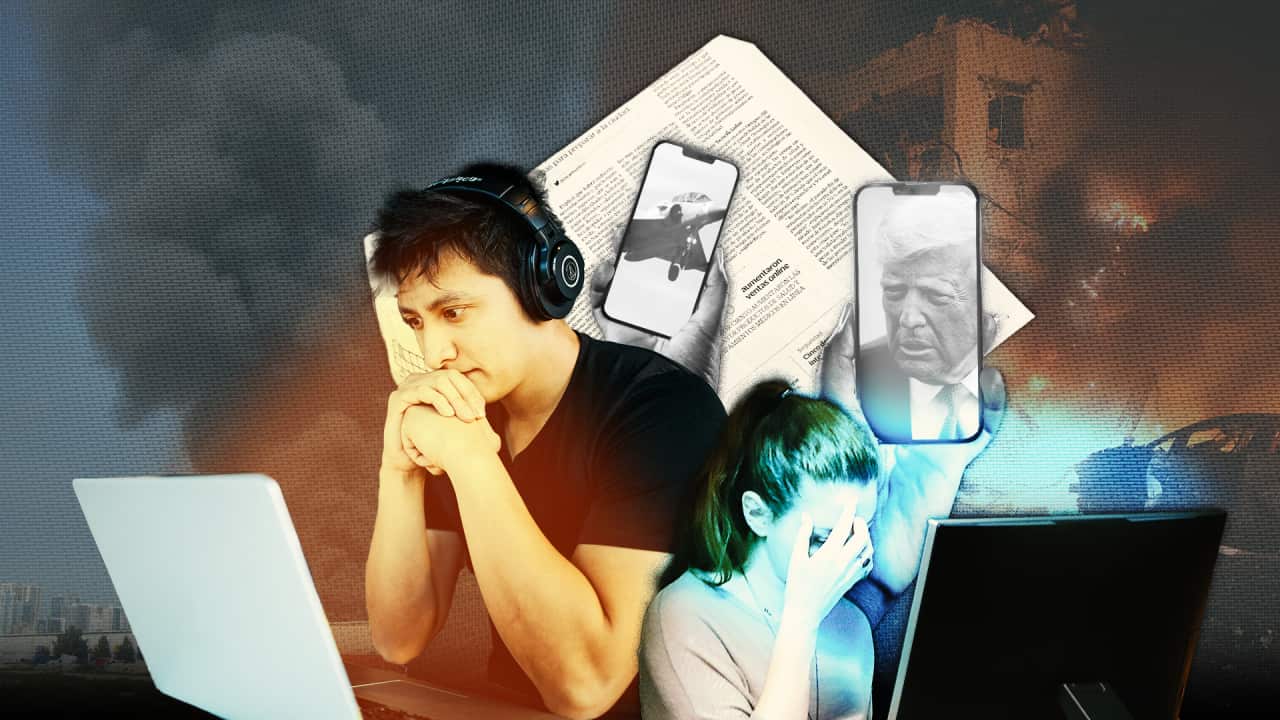

The recent conflict in Iran and across the Middle East is yet again exposing news audiences to atrocities and human suffering on a large scale. So, what impact does news consumption have on audiences, and how can people stay informed, without becoming distressed?
Listen to Australian and world news and follow trending topics with SBS News Podcasts.
TRANSCRIPT
As the world confronts yet another conflict, the news cycle continues to rapidly evolve.
Following the US and Israeli attacks on Iran at the end of last month, the war has escalated into a wider Middle East conflict as Iran retaliates with strikes on several Gulf Nations, including major travel hubs like Dubai.
But how are audiences responding to the influx of imagery and stories of conflict and atrocity?
The 2025 Reuters Digital Report found news avoidance was on the rise globally, particularly among younger people and those without a university degree.
The research has been tracking a group of 17 countries since 2015, including Australia, and found the most prominent reason for news avoidance was in fact the negative effect of news on an individual's mood, as well as too much coverage of conflict and war.
So is this avoidance a case of compassion fatigue, or 'atrocity fatigue' as one expert puts it, or avoidance resulting from vicarious trauma?
Perhaps, it's both.
Dr Ayesha Jehangir, a Lecturer in Journalism and Communication specialising in war and conflict reporting at the University of New South Wales, says there is a concern about desensitisation to atrocities.
But she says it's not simply a matter of people not caring.
"Susan Sontag argues that repeated exposure to images of suffering can gradually dull the initial shock. When audiences see destruction or injured civilians or bodies being pulled out from rubble as we have been witnessing those or grieving families again and again, the images do start to become blurred. And this is also connected to the spectatorship of violence, how violence is presented to us as something extraordinary, but the extraordinary aspect of violence slowly fades away when it's not extraordinary anymore."
Dr Jehangir uses the term 'atrocity fatigue' to explain this phenomenon.
"I use the word atrocity fatigue because stories form war zones, some stories the way they are presented can be heartwarming as well and can carry hope and solidarity. But particularly stories about atrocity, after another, after another, and then the normalisation of those atrocities, can cause atrocity fatigue. There's a gradual emotional numbing that occurs when audiences are repeatedly exposed to news and images of conflict, crisis and human suffering."
At the same time, repeated exposure to such horrors can lead to vicarious trauma.
The American Psychiatric Association describes trauma as witnessing or experiencing an extreme stress that overwhelms a person's ability to cope or contradicts one's worldview.
It's a definition Dr Susan Rees - professor in psychiatry and mental health from the University of New South Wales - applies in her various research into trauma-affected populations; and conflict and trauma.
"So people who are repeatedly exposed to violent imagery and narrative stories accounts, particularly I guess through this 24-hour news cycle that we had, this social media, if we're present, this can produce, and the research has shown this is secondary or vicarious trauma. And this can even happen for people who are geographically distanced from those events."
She says her recent research into the psychological impact of conflict in the Middle East on the Australian population shows people with particular geographical, familial or cultural ties to a place affected by conflict can suffer significant psychological distress.
The research examining mental health outcomes on Australian resident women over a period during the 2023-2025 Middle East conflict, primarily involving Israel, the Occupied Palestinian Territories and Lebanon, found an increase in panic disorder symptoms among the group during the conflict when compared to beforehand.
But Dr Rees says anyone witnessing repeated atrocities can experience vicarious trauma, referencing research conducted following September 11 and the Boston marathon bombing.
"When you have all that media exposure, it can create acute stress symptoms in people, anxiety, sleep disturbances, intrusive imagery, and this just heightened perceptions of threat."
So what is contributing to this vicarious trauma and atrocity or compassion fatigue?
Social media certainly appears to be playing a role.
The Reuters Digital report notes an accelerating shift towards consumption via social media and video platforms, contributing to a fragmented alternative media environment which can threaten fact-based reporting.
Alexandra Wake is a professor in journalism at RMIT University, with expertise in trauma-informed journalism.
She says traditional broadcast journalism typically edits stories to remove the most graphic imagery and details, while social media is completely unfiltered.
"But since live streaming became a thing on people's phones that everyone in the world now has the ability to pick up the phone and start filming, we now through social media are exposed to the most horrific unedited events that happen around us and all over the world. At any point, you can just open up your phone and watch the most awful footage of anything you really wanted to find, you can find it on the internet. And I think that that's a tremendous problem for society."
This social media inundation can also lead to a sense of helplessness, Professor Wake says, causing people to turn away.
"What's happening in Iran, again, with this sort of situation of schools being bombed and children being killed and the terrible things that are happening in our world right now, there's two things. One is people are tired of watching conflicts. And the other thing is just the whole desensitisation to it. There's so much of it out there and it's just always there. And also, I think sitting here in Australia, for many of us, we have no capacity to do anything or to influence the events. And I don't know about you, but I certainly feel like I don't want to watch it. Some days I just don't want to watch it because there's nothing I can do to stop it happening."
Dr Jehangir references the Canadian philosopher Marshall McLuhan, who argued that the medium is the message.
In other words, the technology or platform through which information is delivered to the public, changes how people perceive and experience that information.
Dr Jehangir says when you apply this to social media, medium is no longer the message because most of our consumption is occurring digitally.
"So what then happens is the message that we are receiving, which is a message of violence, a message of life that yes, it's inevitable to find lifeless or wounded children being pulled under the rubble. It is okay that some people will have to die, that some schools will have to be bombed. What then happens is that violence becomes the message itself. And so this violence that is being, of course, conveyed to us hours and hours again and again, starts to affect us in a way where we start normalising these things."
Dr Rees says colleagues in psychology and psychiatric research typically use the term compassion fatigue in reference to people directly impacted by or working in traumatic circumstances.
But now, she says, it's affecting more of the general public in a digital media environment of relentless exposure to war and suffering.
"So this produces this sort of empathic distress where over time it can produce this emotional numbing effect, this withdrawal, this avoidance. And I think it's often a protective coping response to this endless exposure. And the person becomes emotionally exhausted by it, especially when, and this is really important, they're not able to enact change or take any action to help those being harmed. So there is this deep sense of powerlessness as well."
So is the solution to simply turn away from the news cycle?
Experts say there are ways to manage this feeling of helplessness and fatigue when it comes to news consumption.
As a journalist who conducts research and work in the trauma space, professor Wake advises people refine their consumption to a particular platform and organisation to prevent overwhelm.
"I truly believe that just one half-hour news bulletin a night is more than enough for people or a daily newspaper or even one radio current affairs program, or even looking online. Lots of people want to look online, find your favorite traditional news outlet, trusted news platform, and just read that. You can get a really good understanding of what's going on in the world from one source. I used to tell people to do two, to go to two different sources, but if you're not feeling great about the world, going to multiple news sources is not going to help."
The news industry can also play a role.
Dr Jehangir says language matters, and that news organisations have a responsibility to centre the human consequences of conflict and atrocities, and provide context around violent incidents.
"If they do it collectively, can begin by reporting war and conflict and suffering that comes with it in ways that foreground human consequences rather than sanitised military language. And of course, carefully choosing who is speaking on behalf of whom, who has the true agency to speak; and not fogging these realities for the public further. Because it's already, especially in the age of AI, it's very difficult to find that information, reliable information. So this means providing context that explains why violence occurs, why certain images are published and why others are not."
Dr Rees agrees that the answer is not necessarily to turn away from the news cycle entirely, but to manage the amount and type of consumption.
"I think it's really important for media, and this is from a mental health perspective, because I'm not a media expert, but I can see that this graphic imagery that is sort of superficial - the stories are superficial without context, it's more based on the imagery and the impact - I think that should be really guarded against. And I think also examples of stories where people are trying to make sense of the enormity of human suffering, need stories in context. And I also think it's true to say people need to limit time, set aside time for watching it. But don't let yourself become, it become an obsession or become compulsive where you're watching or listening all the time, because that's not healthy."
She also suggests individuals find tangible ways to respond to conflict and atrocities, which provide a healthy sense of agency.
"But what can you do to become more empowered? What sort of actions can you do to actually help your mental health and help you to feel like you have agency? So things like joining or being engaged with humanitarian responses, maybe fundraising, getting people together in groups to share information in a constructive way. Being able to take social action, lawful social action, even attend rallies and things like that where you feel like you're part of a group that really care and that you really feel like you're doing something and that's really empowering and really good for mental health."