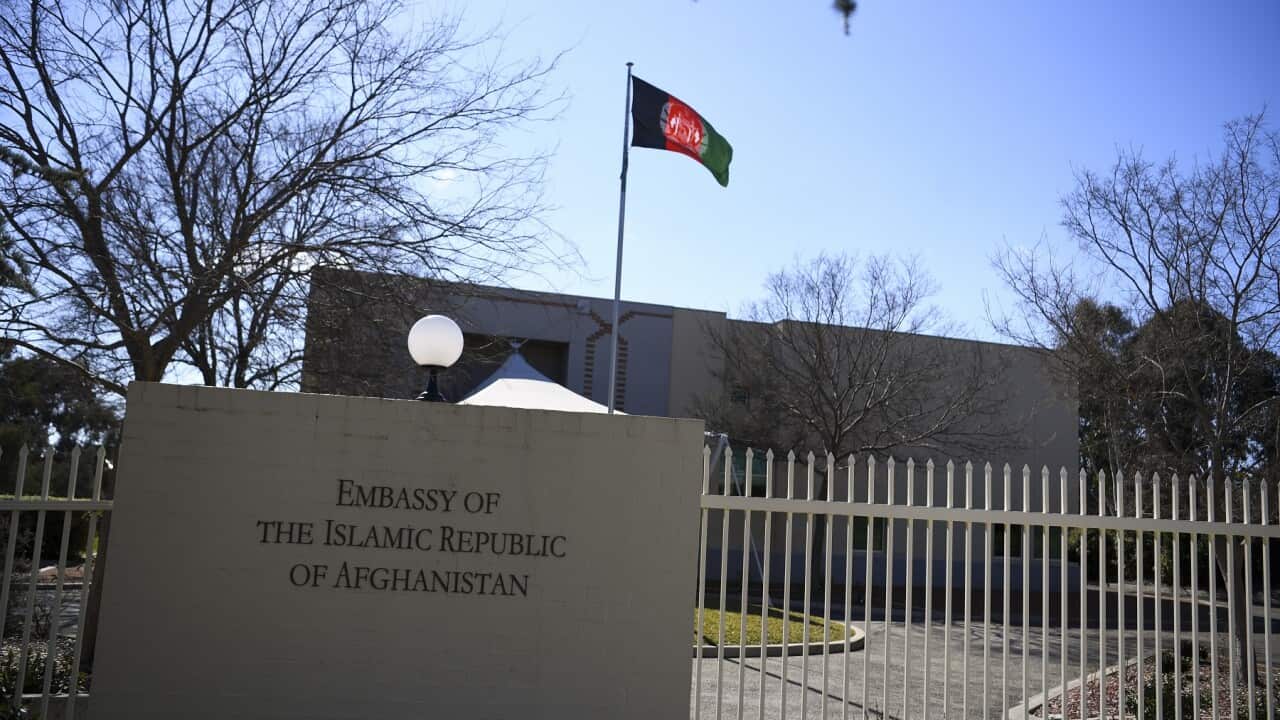

The Department of Foreign Affairs and Trade has confirmed plans to close the Afghan Embassy in Australia, leaving many members of Australia's Afghan community on edge. Experts say the decision follows a demand from the Taliban that all embassies under the control of an anti-Taliban ambassador be closed. While some members of the Afghan diaspora in Australia say they expect the closure to have little impact, for others, it's a deeply concerning development.
Listen to Australian and world news and follow trending topics with SBS News Podcasts.
TRANSCRIPT
The closure of the Afghan embassy in Canberra, in the pipeline for some time, has now been confirmed with a timeline.
The embassy will officially shut on the 30th of June this year.
The decision comes after reports late last year that the Australian government advised the embassy's ambassador, Wahidullah Waissi, that his diplomatic credentials would not be renewed.
CEO of the Afghan Women on the Move organisation, Maryam Zahid, says it's a substantial loss for the Afghan diaspora in Australia.
"This announcement has created a lot of fear, confusion and disappointment. because this embassy for Afghan diaspora here in Australia, it was more than a diplomatic platform, especially for women and elders, it was a place of connection, identity. They could have or they should have worked with Afghan diaspora and ask us what we need and they didn't do that."
The Afghan embassy has served as a diplomatic, cultural and community bridge between Afghan Australians, civil society organisations, schools and universities, plus local, state and federal government.
Ms Zahid says the closure leaves a gap the government is yet to explain how it will fill.
"Because our government here in Australia hasn't offered us something to replace it in terms of having a community platform outside of religious views, community politics, and fights about who is who in the community, that hasn't been given to us, and it hasn't been invested in the Afghan community."]]
The diplomatic mission had been operating as an embassy-in-exile following the Taliban's takeover of Afghanistan in 2021.
It continued to issue official documents such as passports and visas, and to verify IDs for thousands of Afghan citizens living in Australia.
However, its services haven't been operating normally since the Taliban announced in July 2024 that it would no longer recognise consular documents issued by 14 embassies related to the former republic, including the Canberra facility.
Director of the Afghan Cultural Association of Newcastle Sami Zakhil told SBS Pashto for this reason, he doesn't expect the closure to have a significant impact.
"The embassy has largely operated in a symbolic capacity and, by its own admission, has not been in contact with the current government in Kabul. As a result, it has not been able to meaningfully assist Afghans with consular or official matters."
Professor of Diplomacy at Australian National University, William Maley, says the decision to close the embassy follows a demand from the Taliban that all embassies under the control of an anti-Taliban ambassador be closed.
"Even though Australia might deny a connection between the letter and the decision, this really dents, if not fatally, Australia's credibility when complaining about the human rights performance of the Taliban. It's a terrible blow not only to the Afghan community, but also to Australian service personnel who served in Afghanistan, they really would feel like the government has spat in their faces."
The Department of Foreign Affairs and Trade said the government doesn't intend to accept a Taliban-appointed representative in a statement which in part reads:
"We do not recognise the Taliban as the legitimate representatives of the Afghan people. We strongly condemn the Taliban’s persistent systematic abuses of human rights, particularly against women and girls, and voices of dissent. We reaffirm our shared commitment to human rights and the dignity of the people of Afghanistan."
A spokesperson for the foreign minister told SBS the Albanese government "will not accept a Taliban representative."
But Professor Maley says DFAT's official statement doesn't rule it out as an option in future .
"If one looks at the statement that was put out of the Foreign Affairs Department, it's rather slippery on that particular point. It didn't say that Australia will never accept a Taliban diplomat representative or honorary consulate, it said Australia has no intention of doing so. And of course that's the kind of wording that people use if they want later to be able to say, oh, well we didn't intend it at the time, but we changed our minds."
Ms Zahid says she's firmly against the prospect of Australia accepting a Taliban representative as a diplomatic figurehead.
“I'd be more than upset and women like me in communities that are very much against having that kind of mind-set and ideologies to represent us. That would be a big no for us. And I'm sure we can at least rust this promise from our government, that our embassy will not be controlled or represented by those views."
However, not everyone is opposed to the idea.
Fazal Katawazai, a former Afghan diplomat in Australia, says a relationship should be established to avoid further practical issues for Afghan Australians.
"The closure will create significant practical hurdles for Afghan Australians planning to visit Afghanistan. And also the travel documents, passport problems. In some extent, I think Australia need to have some kind of consular relationship as an honorary consular in Australia with the existing Taliban government."
Neither the Australian government nor the embassy have outlined how Afghan citizens will receive essential consular services.
Erfan Abidi is the founder of an underground network of schools for girls in Afghanistan, and an active member of the Afghan community in Adelaide.
He told SBS Pashto for his community, the decision to close the embassy is about much more than being able to travel back to Afghanistan.
"For many Afghans in Australia, the Afghanistan embassy is more than an office. It is a wider symbol of identity, dignity, and connection to your homeland. It has also been the only official space where Afghans, particularly Afghan women, could raise their voices, share their concerns, and advocate for their rights. The panned closure feels like another fall of Afghanistan, but this time in exile, not in Afghanistan."