
As the humanitarian and energy crisis in Cuba worsens, US President Donald Trump has announced he plans on "taking" the Caribbean island. Desperate for relief from a US-imposed blockade, Cuban citizens and members of the diaspora say that while they're hopeful for change, they're fearful of the US agenda.
Listen to Australian and world news and follow trending topics with SBS News Podcasts.
TRANSCRIPT
Most Cubans are used to power outages.
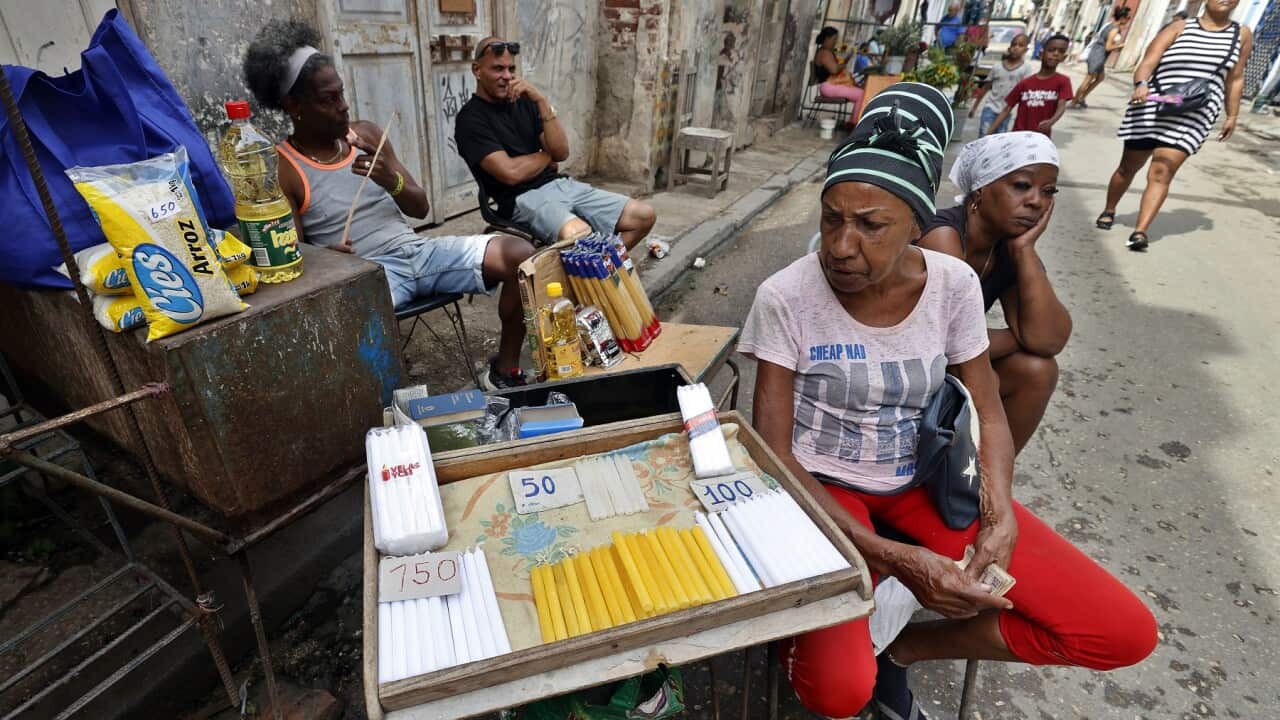
Sometimes lasting 20 hours a day, sometimes even longer, the past few years have seen blackouts become a frequent occurrence on the island.
This March, three months after the United States imposed measures to choke Cuba's oil supply, the island's already antiquated power grid collapsed, leaving around 10 million people without power for more than 29 hours.
Ary Guerrero grew up in Cuba but has lived in Australia for eight years.
She told SBS that many Cubans have become numb to the suffering.
"So they are just struggling with every daily task, like everyday tasks. Like, imagine not having power for 20 hours, up to 20 hours. They kind of seem like, I feel like the situation in Cuba had made people numb. So they kind of, they don't react anymore. They're just like, okay, well, I have to deal with this.”
After the US abducted the president of Venezuela, previously Cuba's largest oil supplier, the humanitarian crisis on the island rapidly deteriorated.
In language similar to that used around Venezuela, President Donald Trump is now calling Cuba a failed nation.
“It's a failed nation. They have no money. They've no oil. They haven't nothing. They have nice land. They have nice landscape. You know, it's a beautiful island. I think they have great people. You know, I know so many people from Cuba that were treated terribly and they're over here and they became rich.”
This is not the first time the United States has sought to isolate Cuba.
In 1959, when Fidel Castro took control, US attitudes towards communism were expanding to foreign containment efforts.
As Fidel Castro nationalised Cuba's foreign assets, hiked taxes on US imports and aligned Cuba with the Soviet Union, the US began to cut ties and imposed a trade embargo.
Since then, Cuba has been subjected to multiple US intervention attempts and stronger and stronger trade embargoes, choking the islands economy.
Dr Tom Chodor is a senior lecturer in politics and international relations at Monash University.
He told SBS that the US has a long history of pushing for regime change in Cuba.
“The Americans have tried to overthrow the Castro regime and the revolutionary regime through various means. So this is a continuation of that long, long tradition, but I guess an escalation of it. You know, usually the sort of means they've tried to get rid of the Castro regime was, you know, to usually they tried to poison Fidel Castro through various quite ridiculous schemes. Or you know, they sponsored an expedition of exiles to try to retake the island, which ended very badly in the famous Bay of Pigs incident in 1961.”
Dr Flavia Bellieni Zimmermann is an international relations analyst and lecturer at the University of Western Australia.
She told SBS that while US intervention is not new, Donald Trump's approach is different in its overtness.
“What Trump is doing is very overt. He's openly interventionist, openly aggressive, and, some commentators are even framing that we are witnessing the rise of the Donroe Doctrine. So it is different. It is significantly different because it is proud of being interventionist, and we haven't seen it before.”
By 2014, when then-President Barack Obama normalised relations with Cuba, hundreds of thousands of Cubans had already left the country, and congress had mandated an embargo in law.
With the embargo still mandated, U-S Secretary of State Marco Rubio says the only thing that will change the situation there is new leadership.
“But the bottom line is, their economy doesn't work. It's a non-functional economy. It's an economy that has survived. That revolution, it's not even a revolution, that thing they have, has survived on subsidies from the Soviet Union and now from Venezuela. They don't get subsidies anymore. So they're in a lot of trouble. And the people in charge, they don't know how to fix it. So they have to get new people in charge.”
Conditions for Cubans have worsened since the latest blockade.
By late February, black market petrol prices in Cuba leapt from around $2000 pesos per litre to $6000 pesos.
Official data in Cuba puts the average state employee salary at 6,500 Cuban pesos per month.
In the unofficial - but commonly used - exchange rate on the island, that's equivalent to around $21 Australian dollars a month.
With food running out and blackouts becoming longer and more frequent, Cuban President Miguel Diaz Canel announced that he had opened talks with Washington.
"Cuban officials have recently held conversations with representatives of the United States Government. These conversations have been aimed at seeking solutions through dialogue to the bilateral differences we have between the two nations. There are international factors that have facilitated these exchanges.”
In attempts to revive the collapsing economy, the Cuban government says it is removing impediments to US investment, while noting the US embargo still prevents such investment.
On the same day as Cuba's announcement, Donald Trump told reporters that he could do whatever he wants with Cuba.
TRUMP: "You know, all my life I've been hearing about the United States and Cuba. When will the United States do it? I do believe I'll be the honour of, having the honour of taking Cuba, that'd be a good honour. That's a big honour."
REPORTER: "Taking Cuba?"
TRUMP: "Taking Cuba in some form, yeah. Taking Cuba, I mean, whether I free it, take it. I think I can do anything I want with it. You want to know the truth. They're a very weakened nation.”
When the Venezuelan President was abducted, many in Venezuela were hopeful of a regime change.
However, after the regime chose a new leader and agreed to comply with US demands, the US administration instead settled for regime compliance.
Dr Bellieni Zimmermann says the Trump administration would be mistaken to think Cuba will be the same as Venezuela.
“I have serious doubts that if they go to Cuba and just remove the leader, it's gonna work because of the structures, because it's so deeply entrenched in the Cuban, political ethos and the Castro family. It's going to be way more complex. If they're thinking that what, because they were successful in Venezuela, they will be successful in Cuba, that would be a big mistake. “
While the Cuban government has indicated a willingness to allow more investment and open talks with the US, a Cuban envoy has said it is not willing to discuss changing the political system.
With Donald Trump saying Cuba is next after Iran, Dr Tom Chodor says there is no legal basis for US intervention.
“The short answer is there is no legal basis for it. And, you know, it would be an illegal invasion under international law, just like Venezuelan operation was, just like the Iran war currently. You know, there's no clear and imminent threat that Cuba poses to the United States, so this is just something that, um, you know, the US administration may choose to do out of its own whim, but it's not a legal basis for it.”
With the US gaining leverage over Venezuela's oil reserves, questions have arisen about what the Trump administration wants from Cuba.
Both Dr Chodor and Dr Bellieni Zimmermann say they believe Marco Rubio, himself the child of Cuban exiles, is playing a major role in pushing interest in the region.
Dr Chodor says Mr Rubio has been campaigning on this issue throughout his political career.
“On other issues, Marco Rubio is a bit more sidelined. You know, on China, for example, you know, he doesn't seem to be calling the shots. But on issues like Latin America, he really is the main guy. He's the one who's pushing Trump to, you know, to... He sort of apparently is the one that pushed Trump to intervene in Venezuela. He is the one that is going to Latin America and saying, you know, "You need to kick China out. You need to toe the line with us on, you know, drugs, immigration, and so on." So I think he's got a big part to play there.”
But while large parts of the Cuban American population may be pushing for intervention in Cuba, broader public appetite for US operations abroad may not be so strong.
So, what are the US strategic interests in Cuba?
Dr Bellieni Zimmermann says beyond Donald Trump's broader push for influence in the region, there may be other strategic benefits in Cuba.
“Cuba is very, very strategic for US ports and logistics infrastructure in the Caribbean region. And also, if we think about, prospective tourism to Cuba, because Cuba before the revolution was a place where Americans would go for tourism and very well-known sexual tourism. So they want Cuba back as their backyard, a place where they go there for fun. And on top of all this also there are nickel reserves in Cuba. Well, you need nickel reserves for battery technology and renewable energy, so it's quite strategic.”
But, with the ongoing US-led war in the Middle East, Dr Bellieni Zimmermann says the US may be overconfident and underprepared for what political change in Cuba entails.
“History tells us that the Americans are not very good thinking long term. Think about what happened in Iraq, think what happened in Afghanistan, and fighting too many wars at once proven to be an absolute disaster. So the Americans are engaging in too many wars at the same time, going through the same road they navigated before, and they failed. So now they're engaging in another war and going overconfident, not really thinking through on the consequences of going to Cuba, the complexity of the Cuban society, how absolutely anti-American the Cuban people are.”
Ary Guerrero says while there is support for the regime in Cuba, many also want regime change, but fear what US intervention entails.
Despite those fears, however, she says it's difficult to see how things could be any worse than they are.
“That kind of language reminds me of past foreign interventions in so many other countries around the world, right? So I feel like um, It makes people wonder what kind of agenda comes with that. Even though you can be critical of the situation on the island. Like Cubans don't want to see our country just losing its sense of autonomy or dignity. But many people see this as the only chance uh, of getting some kind of a breakout.”
As a member of the Cuban diaspora, with family still living there, Ary says she feels helpless to the situation.
“I feel like many immigrants, some people who are living abroad, I feel like very helpless. Like sometimes you, there's only so much you can do from outside Cuba, right? And I feel like at the end, as I said before, what I want is a better future in Cuba and a better future for the Cuban people because they are the ones who have been enduring so much pain and suffering for so many years.”