
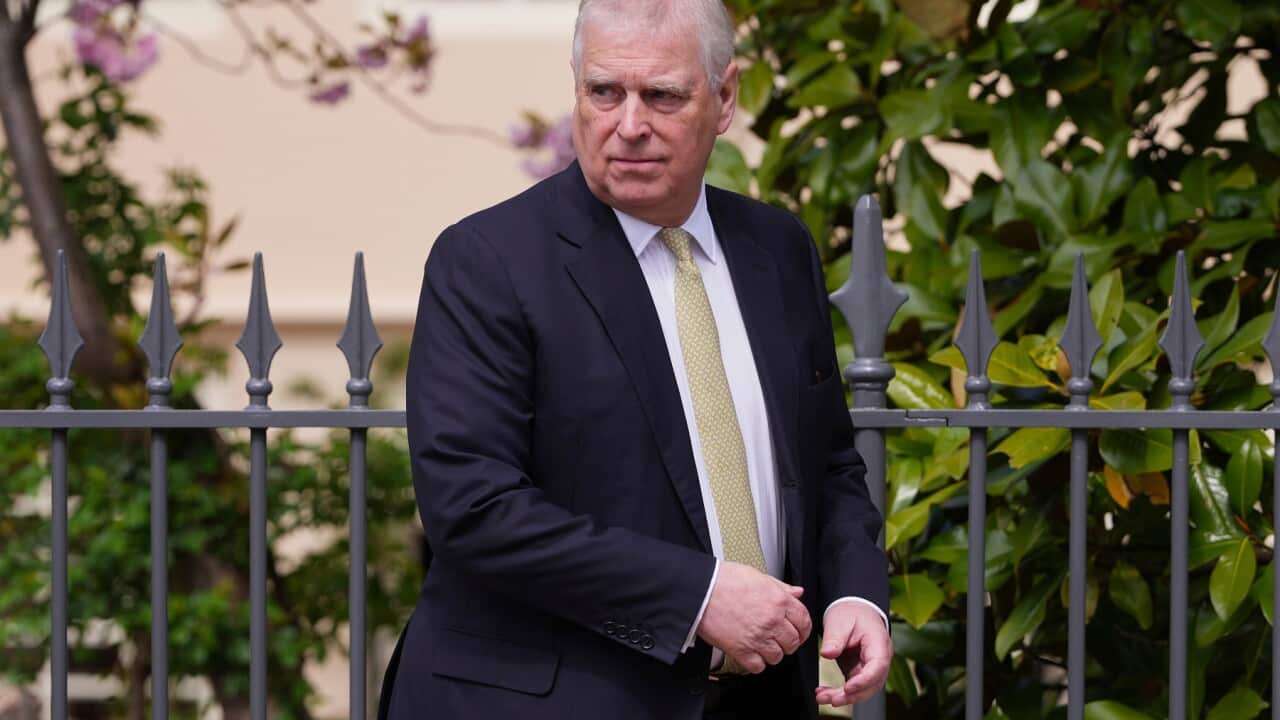

Questions over the British Royal line of succession are emerging after the UK government pledged to introduce laws to remove ex-prince Andrew Mountbatten-Windsor from the line. However, as the potential future King of 14 Commonwealth countries, the process to remove the former prince is not as simple as stripping his title.
Listen to Australian and world news, and follow trending topics with SBS News Podcasts.
TRANSCRIPT:
It's unusual for British politicians to criticise the Royal family, especially in the House of Commons.
But after house speaker Lindsay Hoyle made clear that there was no rule against it, several Members of Parliament took the opportunity.
Labour M-P and Trade Minister Chris Bryant did not hold back on the former prince Andrew.
"I doubt there is anyone in this house who is not shocked and appalled by the recent allegations. Colleagues and many civil servants have told me their own stories of their interactions with Mr Mountbatten-Windsor. A man on a constant self aggrandising and self enriching, hustle. A rude, arrogant and entitled man who could not distinguish between the public interest, which he said he served and his own private interest."
On Tuesday [[24/02]], the U-K government committed to releasing documents on ex-prince Andrew Mountbatten-Windsor's past role as trade envoy, following his arrest last week on suspicion of misconduct while in public office.
Stripped of his royal titles last year, Mr Mountbatten-Windsor is being probed over allegations he shared sensitive documents with disgraced sex-offender Jeffrey Epstein.
Files released by the United States Justice Department show the former prince and trade envoy sent Jeffrey Epstein officials documents and internal materials, and they also include evidence alleging his involvement in Epstein's sexual abuse, including testimony from Epstein's former house manager alleging Andrew spent weeks at a time at the estate, receiving "daily massages".
Mr Bryant says publishing the documents was "the least we owe the victims" of Epstein.
"Frankly, it is the least we owe the victims of the horrific abuse that was perpetrated by Jeffrey Epstein and others, the abuse that was enabled, aided and abetted by a very extensive group of arrogant, entitled and often very wealthy individuals in this country and elsewhere."
While the former prince denies any wrongdoing and claims he had no knowledge of Epstein's wrongdoing, photographs and email correspondence indicate a close involvement with the sex-offender.
He was reported to police by anti-monarchy campaign group 'Republic', with lead campaigner Graham Smith saying the amount of evidence emerging means a proper investigation is in order.
"For Andrew, it's very, very serious. He stands accused of many different accusations, and only some of them are currently the subject of this particular arrest. So, it's likely that other things are going to come up. So, yeah, I think that... I mean, it's hard to... you don't want to prejudge these things and he says he's innocent, but, you know, there's so much out there that, you know, unless it's a very thorough investigation, people are going to think that it's a bit of a whitewash. So it really needs to be a proper job done. And that puts him in quite a lot of hot water."
It has been 90 years since a British royal was removed from the line of succession.
Currently eighth in line for the throne, the likelihood of Mr Mountbatten-Windsor becoming the monarch is extremely rare.
Despite this, the UK Government now says it IS considering introducing legal changes to formally remove him from the succession line, in what many consider a symbolic rejection of the former royal.
Stripped of his royal titles last year, Dr Richard Johnson from Queen Mary University London says removal from the line of succession is a more complicated process.
"To remove Andrew from the line of succession is much more complicated than taking away his titles because he is not merely in the line of succession for the British crown, but also for over a dozen more Commonwealth realms as well. And so there are complications to changing the line of succession that have to be addressed individually in each of the different parliaments of those Commonwealth realms."
When David Cameron was Prime Minister in 2013, the UK government changed the line of succession rules to end male primogeniture and allow women to be in the line of succession on an equal basis to men.
Dr Johnson says it's likely the monarchy would prefer Andrew to abdicate the position himself.
"That took a Commonwealth heads of government meeting, and it took legislation to be worked through all of the different parliaments of the Commonwealth realm. The monarchy does not want to invite debate on Andrew Mountbatten-Windsor in the different Parliaments in the Commonwealth Realm, particularly at this moment. So really, I think the ideal scenario from the perspective of the royal family is if they want to remove Andrew from the line of succession, he has to abdicate his position himself."
There are 14 Commonwealth countries where the British Monarch is head of state, including Australia, New Zealand and Canada.
Australian Prime Minister Anthony Albanese has stated that Australia would support the removal of Andrew, as did New Zealand's Prime Minister Christopher Luxon.
"Obviously the investigation needs to close out before they would then pass legislation to remove him from the line of succession. The bottom line is no one is above the law, and once that investigation is closed, should the UK government decide they want to remove him from the line of succession, that's something we would support."
Unofficial royal biographer Andrew Lownie, who spent years researching the royals for his book Entitled, says the royal family will want to avoid as much scrutiny as possible.
"I think this is why they don't want I mean, I think they'll push through the succession changes in a way that doesn't really allow much time for parliamentary debate. But the last thing they want is any sort of, as I say, oversight and scrutiny. You know, it's it's one of the reasons I think, that they were getting nervous, that people were asking questions about royal finances and indeed about other members of the royal family and some of their activities. And of course, we've got the public accounts committee looking at the Crown Estates. So, you know, suddenly a light has been shown on the royal family, which they don't like, and they are trying to, I think, cauterise this and keep the focus on Andrew to kind of protect themselves.”
Responding to his brother's arrest, King Charles issued a rare statement saying "the law must take its course", and that police have the Palace's full and wholehearted support and cooperation.
But Graham Smith says the royal family can't distance themselves from Andrew forever.
"William and Charles should not be distancing themselves from Andrew. They're all part of the same institution. They need to sort of own it and say, look, yes, this is part of what we are, and it happened on our watch, and we have known about whatever it is they've known about for how many years. This is a very cynical move on their part to try and suggest that this has nothing to do with them. It's absolutely to do with them. And I think people will continue to think that."
He says that if the King is found to have known anything about the alleged misconduct of his brother, it could mark deep troubles for the future of his reign.
"I think it will be very damaging if it is revealed that King Charles knew about this. And, you know, I think he needs to come clean on what he knew, when he knew it and what he did about it. Because if he's been covering this up, then I think his position will become very difficult."
Prime Minister Keir Starmer's leadership has also been under pressure over his decision to hire Peter Mandelson, a known close friend of Epstein, as his ambassador to the United States.
Mr Mandelson and Mr Mountbatten-Windsor have now both faced arrests over their alleged misconduct and ties to Jeffrey Epstein, but neither has been charged with an offence.
While arrests have been made and resignations tendered over revealed ties to Epstein, Andrew Lownie says many of Epstein's associates in the United States have thus far been avoiding the consequences.
“There's a sort of culture of fear in the States about doing anything. But, you know, we're very lucky that this was initiated by the police. And, you know, they said they would do it without fear and favour. No one's above the law. And I'm afraid that that feeling doesn't exist yet in the States. But I think as more names emerge and it's seen that people are being held to account in this country, we may see some of the people in the states being brought to justice.”









