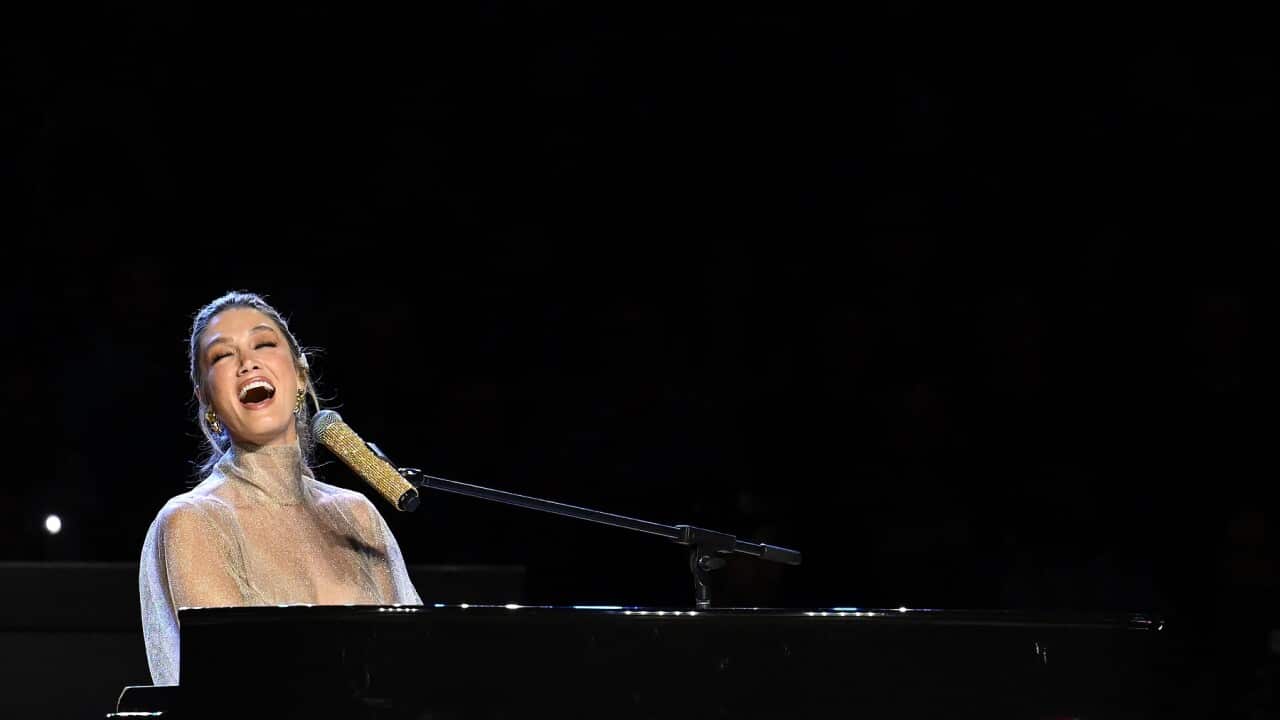

One of the country's most commercially successful and globally recognised performers has been chosen to represent Australia at this year's Eurovision song contest in Vienna. Delta Goodrem will take centre-stage at the 70th edition of the contest. It's a milestone year for the competition, and one which has become clouded by controversy.
Listen to Australian and world news, and follow trending topics with SBS News Podcasts.
TRANSCRIPT
UPSOT SONG EXCERPT- Play for 5 seconds then dip below vo
Over her three-decade career, Delta Goodrem has sold over 9 million records, amassed five number one albums, and achieved international chart success.
UPSOT SONG EXCERPT- Play for 5 seconds then dip below vo
Eurovision has long been in her orbit, even writing for contest winner Celine Dion, an artist she's long-admired.
Now, the stars have aligned for one of the country's brightest.
Ms Goodrem told SBS it was an article suggesting she should represent Australia that set the ball rolling.
"And I was working on my album and as fate had it, there was an article written about Eurovision with me and I started getting these calls from different people, songwriters, from producers, from manager friends that I knew. And all of a sudden I was like, "Why is everyone talking about this to me? " And that kind of was an organic moment that it sort of kept. It was signs. There was people were reaching out to me about it. And so I took those signs and saw them and said, "All right, I think this is our moment. Let's go to Eurovision."
The song she hopes to take all the way to the grand finals in Vienna is called 'Eclipse'-- a pop power ballad, sprinkled with classical influences.
UPSOT SONG EXCERPT- Play for 5 seconds then dip below vo.
The song was written by Ms Goodrem with Ferras Alqaisi, Jonas Myrin and Michael Fatkin — who also produced the single.
The pop star says she and the other song writers hope people can find their own meaning in Eclipse.
"We all got together and kind of talked about what it meant to us, like connection, about alignment, about timing, your own time. This song could mean a few different things. You could take it as a love song. You could take it about the timing of love or your time in your own life that aligns when time is meant to be. And that's when eclipse happens."
She says it does hold significant personal meaning, too.
"I would definitely say that it was really important that I represented how I also, my writing and what my DNA is as an artist. And I feel that I hope that this song would represent a part of me that I feel people are familiar with and that the song could also still be their own. That's what you make songs for. It's not just mine. Once it's in the world, it's everybody else's song too."
Associate Professor of Humanities at the University of Southern Queensland, Jess Carniel, says she thinks the song has what it takes to be a Eurovision winner.
"It is one that is really well constructed from the first moments that you hear the notes of that you think this is a Eurovision song. And having a look at some of the social media responses to it, I think people have been really receptive to this and it might be hopefully a return to the grand final, if not to the left side of the board."
After missing out on the grand-final for the past two years, Australia's selection team are hoping the established pop Princess is a safe pair of hands.
Ms Carniel says while previous years have often seen Australia choose emerging musicians, this year the selection team have gone with someone more established for the contest's 70th anniversary.
"The last time it was a big anniversary was the 60th, which was the first time that Australia was invited to participate as the wildcard entry. We sent Guy Sebastian then. He was quite a well-established artist. Over to the 70th anniversary, it kind of makes sense to send somebody like Delta. She's incredibly experienced and professional. And I think also given the climate that's surrounding Eurovision over the past couple of years, having someone like that in the role is a really, really useful thing."
The 2026 contest in Vienna will unfold amid renewed scrutiny of the European Broadcasting Union's decision to allow Israel to compete.
Five countries, including Spain, have all boycotted the competition over Israel's participation, while 34 countries — including Australia, represented by SBS — have indicated they will participate.
SBS issued a statement late last year, saying:
"As a public broadcaster, making a decision to be involved based on the inclusion or exclusion of any country would undermine SBS's editorial independence and impartiality."
Critics, including some former contestants and some European broadcasters, say the contest's governance has become entangled in geopolitical tensions, placing participating networks under public pressure.
Ms Goodrem says her focus is solely on the music, and she hopes the contest can be a source of unity.
"I truly believe in the power of music I have from the day I started. It is what speaks to my heart. It's healing, it's hopeful, it's unifying when I'm on stage and I look out and we're all singing the same song for this moment in time. It is really a special moment that is not about anything else but the here and now and love and connection. So I really focus on what Eurovision stands for and what music stands for."