
Australians have marked Anzac Day across the country and in Gallipoli with ceremonies remembering those who have served. Despite the solemnity of the occasion, dawn services in Sydney, Melbourne and Perth have been marred by heckling. Veterans’ groups and political leaders condemned the incidents as a disrespectful violation of Anzac Day.
Listen to Australian and world news, and follow trending topics with SBS News Podcasts.
TRANSCRIPT
Tens of thousands have marked Anzac Day at solemn ceremonies across the nation - remembering all those who've served and died in war, conflict and peacekeeping operations.
Traditional dawn services - marked by the Ode for the Fallen, the Last Post, and a minute's silence.
In Sydney, Rear Admiral Chris Smith, Commander of the Australian Fleet, delivered the Anzac Day address.
He says April 25 is a day of solemn reflection, enduring gratitude, and national remembrance.
"It is a day deeply woven into Australia's history and identity, and one that connects generations through memory, service and sacrifice. On the 25th of April 1915, Australia and New Zealand forces landed on the shores of Gallipoli. From those rugged beaches emerged the Anzac legend, defined by courage under fire, resilience in adversity, mateship in the harshest conditions, and a willingness to place service before self."
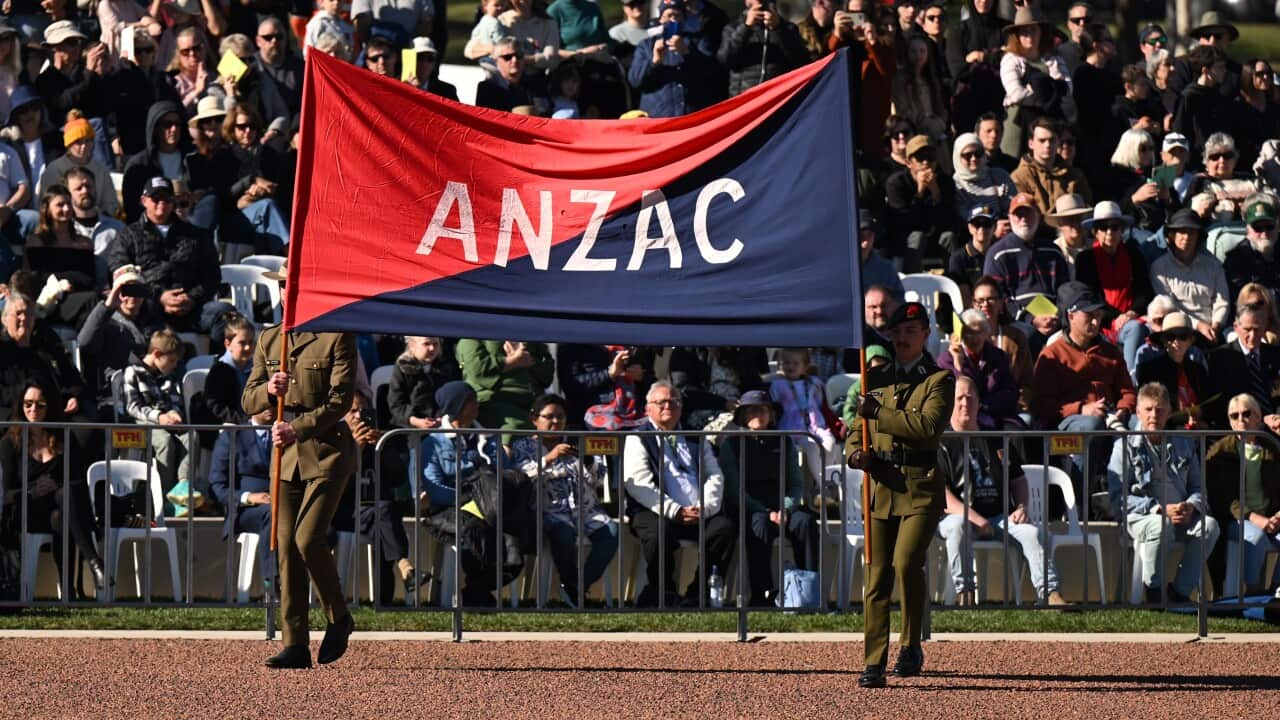
Marches continued throughout the day, including in Canberra, where veterans paraded on the 111th anniversary of the Gallipoli landing.
Contingents representing veterans of conflicts in Korea, Borneo/Malaya, Vietnam and the Middle East were joined by those currently serving, as well as New Zealand and other Commonwealth or allied countries.
Governor General Sam Mostyn watched over the ceremony, as did governors, premiers and political leaders at state and territory commemorations across the country.
Outside the Australian War Memorial, master of ceremonies Scott Bevan welcomed proud Wiradjuri man and flight lieutenant James Evans to the parade ground.
"His tribute acknowledges the proud service of Aboriginal and Torres Strait Islander peoples who have contributed to the defence of Australia, which is part of a long and ongoing tradition of defending Country."
A similar sentiment from Kabi-Kabi and Gurang-Gurang Uncle and pastor Ray Minniecon, who delivered the Acknowledgement of Country at the Sydney dawn service.
"We gather today on land that is sacred. For thousands of years, people have gathered in this place to share stories, to celebrate culture, and to remember our ancestors."
Interrupted by heckling during the official ceremony, which was quickly condemned by Premier Chris Minns and RSL NSW Acting President, Brigadier Vince Williams.
In a statement, Brigadier Williams said the booing was disrespectful, at odds with the sanctity of the occasion, and particularly disappointing given Uncle Ray is a veteran himself.
Police charged a 24-year-old man alleged act of nuisance at a war memorial service and moved others on.
Defence Minister Richard Marles has also condemned the hecklers in an interview with ABC News.
"Well, I think it's disgraceful and it's deeply disappointing. Acknowledgements to Country are just an act of respect, and what characterises today is that it is a day of respect, and to boo in that way goes completely against that."
There were similar incidents in Melbourne and Perth.
Victoria Police say officers moved into the dense crowd but were unable to identify any perpetrators at the time and no arrests have been made.
Western Australia Police say officers issued 14 move-on orders after disruption at the Perth dawn service.
It's not the first time Anzac Day ceremonies have been marred by heckling.
Neo-Nazis also booed during the official ceremony in Melbourne last year.
Mr Marles says it dishonours the service of First Nations veterans.
"We should be acknowledging as well, the contribution that Indigenous Australians have made to the ADF and Australia's military."
The heckling harks back to a complex and difficult history stained by racism within the armed forces.
Despite this, hundreds of First Nations people volunteered to serve overseas during World War One.
Among them was Valentine Hare.
"Well, he's one of the approximately 140 Aboriginal men from Queensland who enlisted. He enlisted at 19 years and eight months. When he enlisted, he enlisted into the Second Light Horse Regiment, the 27th reinforcements."
Michael Bell is the Indigenous Liaison Officer at the Australian War Memorial.
He says the Defence Act at the time prevented Indigenous Australians from entering military service, but doctors often made their assessment based on skin colour.
Valentine Hare was wounded in action, with a gunshot to the leg, and after being medically discharged, he was denied access to many of the rights and supports other veterans received.
"Our men came out of and went back to a desperately unequal society. Our men, who fought in the First World War, were fighting for rights that they weren't allowed to have in their own home country. And they were fighting for freedom when we had segregation. They were fighting for equality, and we didn't have that as an Aboriginal race, they were fighting for a fair and balanced Australia, which we weren't receiving, which we weren't in receipt of."
It's one among so many stories of service honoured on Anzac Day for the last century across Australia and New Zealand.
A contribution given in the spirit fairness, freedom and equality.
"Age shall not weary them, nor the years condemn. At the going down of the sun, and in the morning, we will remember them. Lest we forget."