
The first two days of public hearings for the Royal Commission into Antisemitism and Social Cohesion has heard from 24 witnesses who are Jewish Australians with lived experience of antisemitism. While there is broad community support for a Royal Commission, some argue it should be expanded to include other minority perspectives including Muslim and First Nations Australians' experiences of racism.
Listen to Australian and world news and follow trending topics with SBS News Podcasts.
TRANSCRIPT
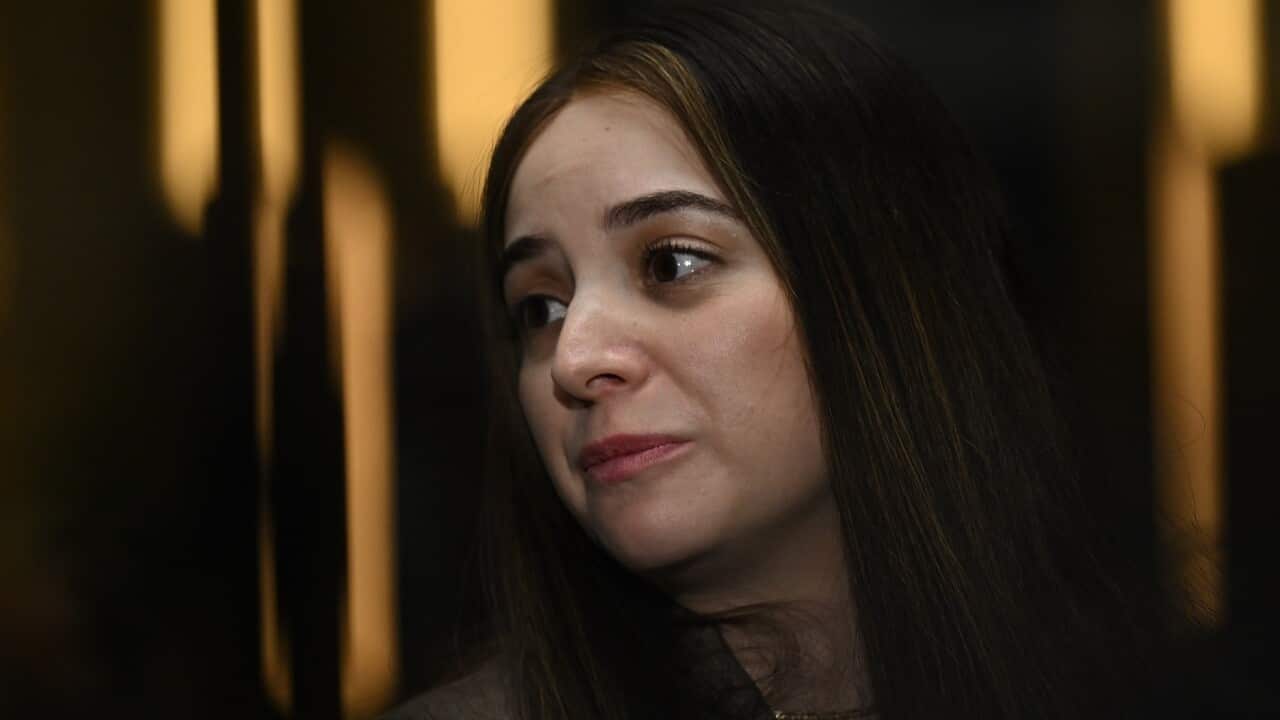
“Bondi holds many complicated and conflicting feelings for me currently. It was somewhere where my parents had started their history together, somewhere where I had spent many days of my childhood, have beautiful memories there with my family. I had actually spent a lot of time there with my children myself during school holidays, and now Bondi holds a really really heavy weight in our community's heart.”
That was Sheina Gutnick - a Jewish Australian who lost her father Reuven Morrison in the tragic Bondi terror attack during a Hannukah celebration on December 14, 2025.
She's one of 12 witnesses who addressed the Commissioner on the first day of hearings for the Royal Commission on Antisemitism and Social Cohesion.
Sheina's father was among 15 people killed and 40 others injured during Australia's worst terror attack in history.
The interim report from the Royal Commission was released last week in response to the mass shooting.
It lists 14 recommendations for the Commonwealth, state and territory governments to adopt, including improvements in Commonwealth and state security and counter-terrorism capabilities.
The Prime Minister last week agreed to adopt all the recommendations relevant to the Commonwealth, saying he will work with states and territories on the implementation of nationally consistent gun reforms.
“It will be up to state and territories, of course, we'll have to give consideration to the very clear recommendations. There are two of the recommendations make it clear that we should progress with nationally consistent gun reform. I certainly hope that that occurs and would continue to engage constructively with state and territory governments to say that this is reform, which is necessary.”
The Commission is headed by former High Court Judge Virginia Bell, who in her opening statement of the first public hearing says it's vital to hear the lived experience of Jewish people in Australia.
She notes a rise in antisemitism in Australia and other Western countries in response to conflicts and events in the Middle East.
“The sharp spike in antisemitism that we've witnessed in Australia has been mirrored in other Western countries and seems clearly linked to events in the Middle East. It's important for people to understand how quicky those events can prompt ugly displays of hostility towards Jewish Australians simply because they're Jews. Displays of hostility that are sometimes expressed in images and sentiments that can sometimes be traced back to the Middle Ages if not earlier.”
Sheina describes one such incident among numerous personal experiences of antisemitism in her address to the hearing.
“In December 2024, I was walking through Westfield Bondi Junction holding my 12 month old baby. A man pointed at my Star of David necklace and called me "an eff-ing terrorist". I felt shocked, exposed and unsafe. There were many people around me but no one intervened. Because I was holding my baby, my first instinct was to avoid any confrontation and get away safely. It left me feeling deeply vulnerable, and so that even in a busy public place I could be targeted for being visibly Jewish and still be completely alone.”
She's calling for early education and awareness of antisemitism as a key recommendation to address its increasing prevalence in Australian society.
“Education around antisemitism, Jewish identity and real world consequences of hatred should be embedded early before hateful attitudes are formed and normalised. This should include building critical thinking skills so students are better equipped to assess information, question sources and recognise misinformation. I would like to add I think that is incredibly important given the rise of social media and misinformation that is very easily presented as fact.”
Another witness, adopting the pseudonym 'A-A-L' describes a classroom incident experienced by his granddaughter.
“She was in the class when I believe a substitute English teacher was giivng a lecture about a book totally unrelated to Israel or Palestinian issues and for some reason this teacher performed several 'Heil Hitler' salutes. My granddaughter was 13, 14 at this stage - left the classroom, was deeply shocked, wrote a very polite email to the Principal and her mother.”
The witness went on to say that his granddaughter moved schools following the incident, adding that to his knowledge there were no significant consequences for the teacher who retained employment.
He describes an Australia very different to the one he fell in love with when he first migrated from South Africa in the 1980s, saying he doesn't feel like it's a safe place for his grandchildren anymore.
“I have to admit things have changed. I really have to think very very seriously whether this is the country for my grandchildren. Hopefully it will still be okay for me, I'm nearly 80. But I don't know what this will mean for my grandchildren.”
As President of the Board at Mt Sinai College in Sydney, Ms Schwartz also says she has seen a rise in antisemitism and subsequent fear among students and parents.
Ms Schwartz became emotional as she recalls one incident on the 30th of January 2025, where the school was subject to an antisemitic graffiti attack, which she says was clearly intended to intimidate students on their first day back at school for the year.
“We obviously wanted to cover it up as soon as possible but we obviously couldn't becuase police were there and treating it as a crime scene. And I remember seeing a photo of another local student, not Jewish, looking at these words on our school gates and going home... and having to ask his parents about 'Jew dogs' and 'Jew terrorists'. And obviously I was devastated for my own children, but also for these Aussie kids growing up in an environment where this was normal and this was happening.”
The hearing is adopting the definition of antisemitism used by the International Holocaust Remembrance alliance which defines antisemitism as "a certain perception of Jews, which may be expressed as hatred toward Jews".
Judge Virginia Bell says the definition will be used on a case-by-case basis to assess whether the incidents and experiences outlined can be determined as antisemitism.
Dennis Altman, Vice Chancellor's Fellow at LaTrobe University, says he accepts the definition but not the examples attached to it.
“In the examples, it is said that it is antisemitic to call Israel a racist society. On the other hand, you can hardly go to a, a- an anti-Australia Day demonstration here without people saying Australia is racist. There is something ironic that nobody says we should punish Australians for saying our country is racist, but somehow if you wanted to call another country, a foreign country racist, that is wrong. Um, equally, it should be possible to talk about potential solutions for the impasse between Israel and Palestine that envisages a redoing, a creation of a secular democratic one state. Now, that isn't necessarily a position I want to argue for here. What I want to argue for is the right of people to say that, and that is being shut down.”
Professor Altman says as a Jewish Australian who also confronts homophobia, he submitted a statement to the commission because he felt it was important to include Jewish perspectives that were different to the views being shared by prominent Jewish organisations.
“There's no question there is an increase in antisemitism at the moment in Australia. But if we think of the trauma that very many Jews carry because we are descendants of Holocaust survivors, there is a parallel I think with what many Indigenous Australians feel, and I think that that shows the way in which we can reach out. If we really are serious about, um, wanting communal interaction and social cohesion, I think we need to address the larger issues that inflame prejudice, discrimination, and hatred.”
Professor Altman says this means including the perspectives of Muslim and First Nations Australians in the Commission, saying there is "huge mourning" among Palestinians and Lebanese Australians which the government and Jewish organisations are largely ignoring.
“We cannot talk about the rise of antisemitism, the undoubted rise of antisemitism, without also talking about the way in which this is part of increasing, uh, and unpleasant examples of racist attitudes in Australia, particularly directed, I think, um, against Muslim communities and against Indigenous Australians. And I would hope that Muslim Australians and Indigenous Australians are called before the commission because I think it's really important that their views on this are included in the final outcomes.”
There have been numerous reports outlining rising incidents of Islamophobia - including incidents involving physical attacks and vandalism on mosques - particularly since October 7, 2023.
The Islamophobia Register's most recent report [2023-2024]] notes a surge in Islamophobic incidents, with 309 in-person incidents reported over that time period, more than double the annual average of previous reporting periods.
At the same time, the 2025 Islamophobia in Australia report demonstrates the highest number of Islamophobic incidents in the report's history.
Gamel Kheir is spokesperson and Secretary for the Lebanese Muslim Association and says he has publicly called for the Royal Commission to address Islamophobia, but has received no response from the government.
“I'm on public record as stating that it's, it's too restrictive, um, from the very outset. Before, prior to the actual government calling for the Royal Commission, we were supportive of a Royal Commission, but we were very, very strongly recommending or adv- or requesting that it should be way more broad in, in the sort of, scope of what it looks at. Um, statistically, Islamophobia has always been a, a more prevalent than any other form of racism in Australia, yet it's not been looked at directly. Look, I think it's far too restrictive. We've gone on public record stating that given that the government is going to be outlaying this sort of money and time and effort, why not look at all forms of racism and the underlying reason behind such a rampant rise in, um, anti-immigration and, and racism in general?”
He adds the government has been silent since the Special Envoy on Islamophobia tabled recommendations to parliament, in stark contrast to their support for recommendations from the Special Envoy on Antisemitism.
“Now, is that a, that, is that a reflection of where the government and the politicians see the importance of the Jewish community and the Muslim community? Not to downplay the Jewish community. They deserve the protection that they're getting. What I'm pl- pleading for is there is also a need for protection of all minorities. Not, it's not as if, uh, uh, antisemitism has happened in a cocoon or a silo.There is a rise in, in sentiment against minority communities, and they are all equally deserving of the attention and the protection of government in, in terms of its policy and in terms of what its recommendations that, and legislations that need to be put in place. And that's not happening at the moment.”
The Albanese government passed a raft of laws combatting hate on January 20, entitled the 'Combatting Antisemitism, Hate and Extremism Act 2026', which included establishing a National Gun Buyback Scheme, and introducing new criminal offences for importing or exporting violent extremist material.
SBS contacted the Attorney General's Department for comment, but at the time of publication has not received a response.