

Top Venezuelan officials say they will remain unified behind President Nicolas Maduro, who remains in custody in New York after he was captured in a US military operation over the weekend. US Secretary of State Marco Rubio has continued to defend the military action, despite mounting domestic and international criticism.
Listen to Australian and world news and follow trending topics with SBS News Podcasts.
TRANSCRIPT:
Venezuela's new interim leader, Delcy Rodríguez, has called for the immediate release of Nicolas Maduro, after US forces attacked Caracas in the early hours of Saturday, bombing military targets and capturing President Maduro and his wife.
The country's Supreme Court issued a ruling on Sunday appointing Ms Rodriguez as interim president for 90 days.
In a speech broadcast on Venezuelan state TV, Ms Rodríguez has condemned the capture of the Maduros as barbaric.
She says the country's defence council has been activated and Venezuela will formally respond.
"Everything within the constitution we learned from commander Chavez in the face of adversities, in the face of coup d'etat, in the face of oil sabotages. We are ready to defend Venezuela. We are ready to defend our natural resources that must be for national development. The extremists who have promoted this armed aggression against our country, history and justice - we will make them pay."
Venezuela's Defence Minister, General Vladimir Padrino López, says many of Nicolás Maduro's security detail were killed during the US mission to apprehend him.
General López has recognised Ms Rodriguez as interim leader, echoing her call for the immediate release of Mr Maduro and his wife.
He says the US strike on Venezuela constitutes a threat to geopolitical stability.
"We activate, throughout the entire national geographic space and in perfect popular–military–police fusion, the Complete Operational Readiness Posture, in order to integrate the elements of the national power in the mission of confronting imperial aggression, forming a single combat bloc to ensure the freedom, independence, and sovereignty of the nation. This represents severely a threat against the global order. If today was against Venezuela, tomorrow it can be against any state, any country."
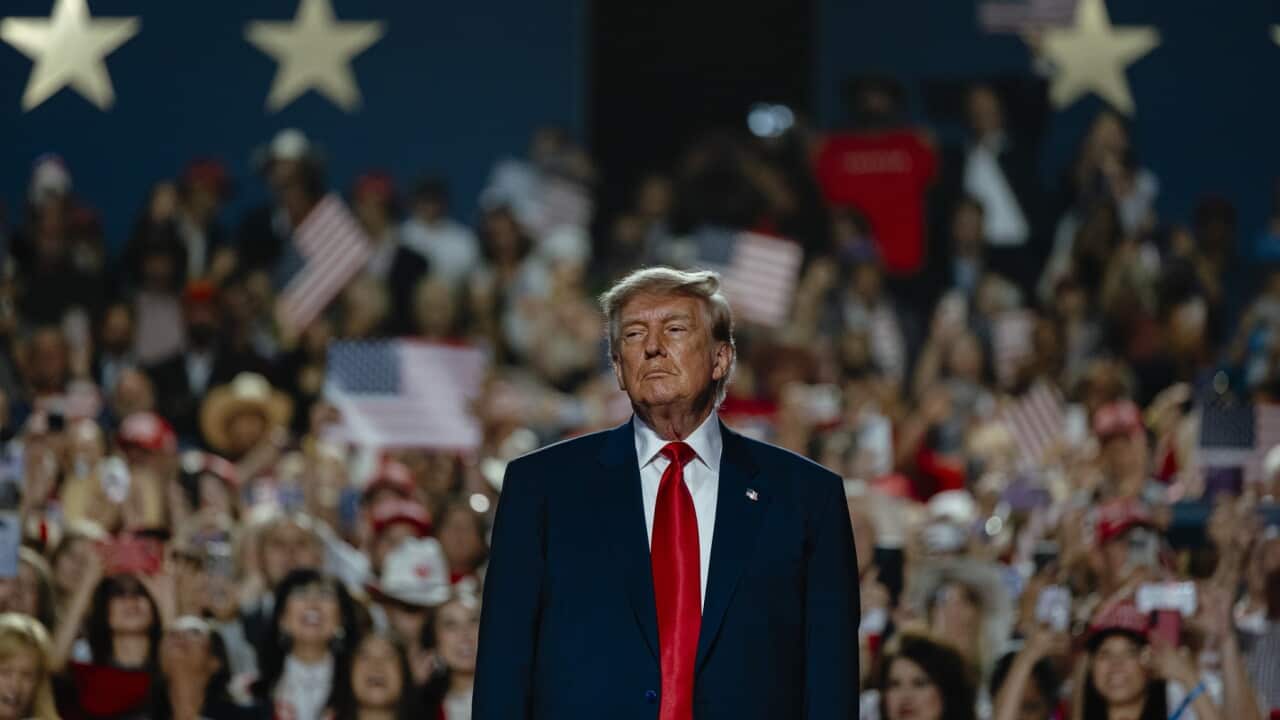
US President Donald Trump says Venezuela's new leader will pay a heavy price if she refuses to co-operate with the United States.
In a telephone interview with The Atlantic, Trump says Venezuela's interim president could pay what he describes as a price "bigger than Maduro" if she doesn't support his administration's goals, including opening access to US investment in Venezuela's oil reserves.
Earlier, President Trump said the US plans to take control of Venezuela and its massive oil reserves, and use private American companies to invest in the oil infrastructure.
"We're not spending money. The oil companies are going to go in. They're going to spend money. We're going to take back the oil that, frankly, we should have taken back a long time ago. A lot of money is coming out of the ground. We're going to get reimbursed for all of that. We're going to get reimbursed for everything that we spend... What's going to happen with Venezuela, I think, over the next period of a year, is going to be a great thing and the people of Venezuela will be the biggest beneficiary."
US Secretary of State Marco Rubio has since toned down President Trump's comments, insisting instead that the US government will use control of the South American country’s oil industry to force policy changes.
"Ultimately, this is not about securing the oil fields. This is about ensuring that no sanctioned oil can come in or out until they make changes to the governance of that entire industry. We have leverage. This leverage we are using and we intend to use - we started using already. You can see where they are running out of storage capacity. In a few weeks, they're going to have to start pumping oil unless they make changes."
He's told CBS Mr Maduro will stand trial in the US, and says Venezuelans will ultimately benefit from his removal.
However, legal experts have raised questions about the lawfulness of the operation, which was done without congressional approval.
Democratic Senate Minority leader Chuck Schumer has joined others in criticising the military intervention as illegal.
"Look, Maduro is a horrible, horrible person. But you don't treat lawlessness with other lawlessness. We have learned through the years when America tries to do regime change and nation-building in this way, the American people pay the price in both blood and in dollars."
Mr Rubio insists the operation was carried out lawfully, and congressional approval was not required.
"It wasn't necessary because this is not an invasion. We didn't occupy a country. This was an arrest operation. This is a law enforcement operation. He was arrested on the ground in Venezuela by FBI agents."
Leaders around the world have responded with a mix of condemnation and support of the U-S military operation.
Israel, Ecuador and Argentina are among those who have congratulated President Trump on the action, while China, Russia, Brazil, Chile, Mexico and Spain have joined others in expressing serious concern over the United States' failure to comply with international law.
The United Nations Charter prohibits the use of force against the territorial integrity or political independence of any state.
Slovakia's Prime Minister, Robert Fico, says the military operation shows a complete disregard for the law.
"Today, superpowers literally do whatever they want. They have completely erased the existence of international law and the necessity of complying with it...We can only watch in disbelief as elite American military units kidnap the president of the sovereign country of Venezuela."
Mr Maduro is in custody in New York and is set to face drug trafficking and weapons charges in Manhattan's federal court.
The US accuses him of being a 'narco-terrorist' but the Venezuelan President denies these claims.