
European Union leaders are facing a critical decision on whether they should use frozen Russian assets to finance more support for Ukraine's war effort.
Listen to Australian and world news, and follow trending topics with SBS News Podcasts.
TRANSCRIPT
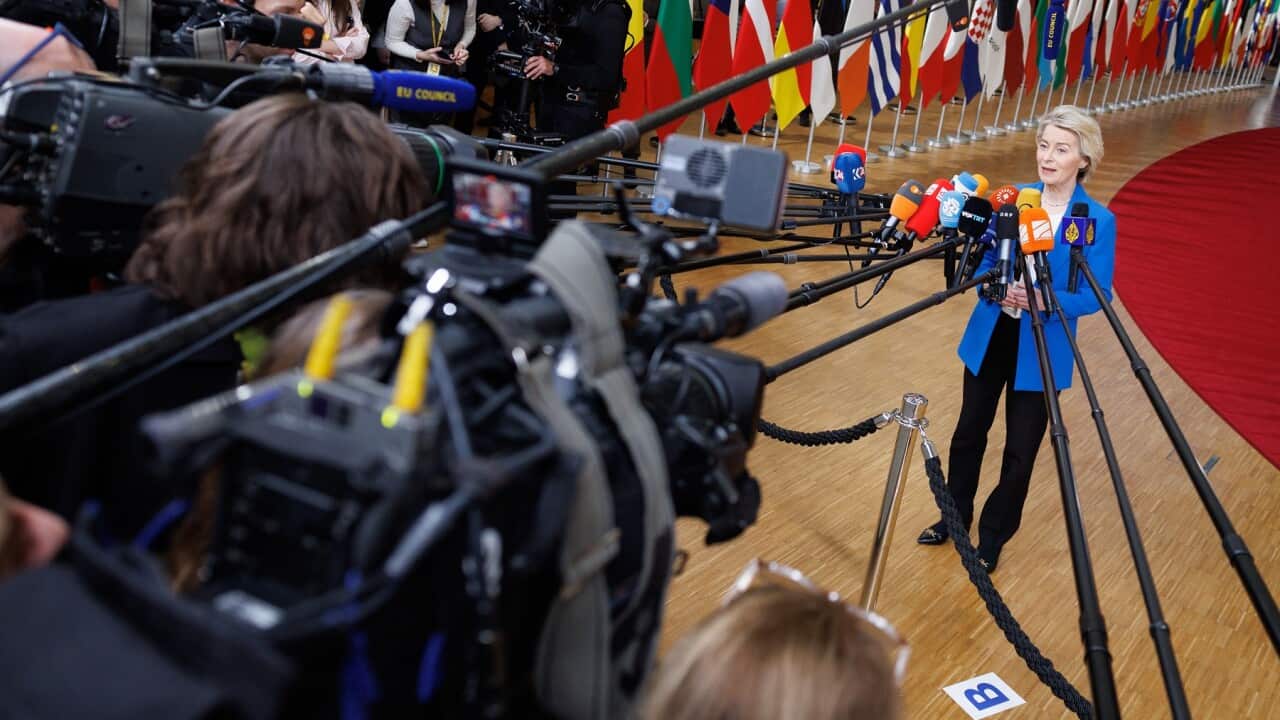
"It is good that the European Council has committed itself last time that we will close the financing gap of Ukraine for the next two years. We are speaking about €137 billion euros that are necessary. So the estimate, our own estimate and the estimate of the IMF and we have committed to cover two thirds of it €90 billion euros."
That's Ursula Von der Leyen, the European Commission President.
She had earlier announced leaders would not leave the European Council without a solution for the funding for Ukraine for the next two years.
European Union leaders say they need to reach an agreement on how to lend billions of euros to Ukraine.
The leaders, gathered at a summit in Brussels are facing a major decision on whether they should use frozen Russian assets - mostly held in the Brussels-based financial clearing house Euroclear - to finance more support for Ukraine.
Russia's central bank has said the EU's plans to use its assets are illegal.
The country has filed a lawsuit in Moscow seeking US$230 billion dollars in damages from Euroclear.
Russia has warned EU leaders not to use its money, but Poland's Prime Minister has urged leaders to step up.
"Either money today or blood tomorrow. And I am not talking about Ukraine on there. I am talking about Europe. And this is our decision to make. And only ours. I think all European leaders have to finally rise to the occasion."
But Belgium and many other states have reservations about the legal risks Russia may pose.
Belgium's Prime Minister Bart de Wever had earlier told his country's parliament he had not yet seen if there's legally binding, and strictly enforceable guarantees.
He hopes - if they do go forward with the decision - for the risks to be shared between states.
"We have three demands. I want the full mutualisation of the risk, because there is a big risk. We will suffer from enormous claims. So if we want to do this, we will have to do this altogether. We want guarantees, if the money has to be paid back, that every member state will chip in. The consequences cannot only be for Belgium. And the third demand is that every country that has immobilised assets moves together with us."
Hungary's Prime Minister Viktor Orban says the EU is asking for an uncalled-for war if the leaders succumb to providing financial assistance.
"Guarantees for what? The whole idea is a stupid one to take away the money of somebody. There are two countries which are in war, yes. It is not European Union. It is Russia and Ukraine and somebody, the European Union would like to take away the money of one of the various parties and then to give it to another one. It's marching into the war. So the Belgian Prime Minister is right. We should not do that."
The EU sees Russia's war as a threat to its own security and wants to keep Ukraine financed and fighting.
European Union Foreign Policy Chief, Kaja Kallas is hopeful the proposal will see the light at the end of the tunnel.
"Now, the proposals that we have been working on, also addressing Belgium's concerns, I think to go for the legislative proposal means that we all take the risk because it's a European proposal. So the risk and the burden is shared equally. So I think the issues that Belgium has raised, we have also addressed. So I hope that we get this over the finishing line."
She says the leaders would stay at the summit as long as needed to find a solution.
German Chancellor Friedrich Merz says he doesn't see a better option than to use the frozen Russian assets for this purpose.
He understands the concerns that some member states have, but is also hopeful they can reach a conclusion.
Ukraine's President Volodymyr Zelenskyy, who was at the summit, urged the bloc to agree on a deal he said would allow Ukraine to keep fighting.
"If this tranche does not arrive, Ukraine's drone production will be reduced significantly. For comparison, if today we, in terms of cheap drones that we use on the battlefield, have an approximately competitive number of such drones with Russia, then (without aid) it will be much lower."
Mr Zelenskyy is calling for the US to put more pressure on Russia's President Vladimir Putin.
He believes Mr Putin doesn't want to stop the war, but says there's hope if Donald Trump makes the call.
As political tensions heighten in Brussels, Ukraine's war effort is at a standstill - in anticipation of a positive decision.