
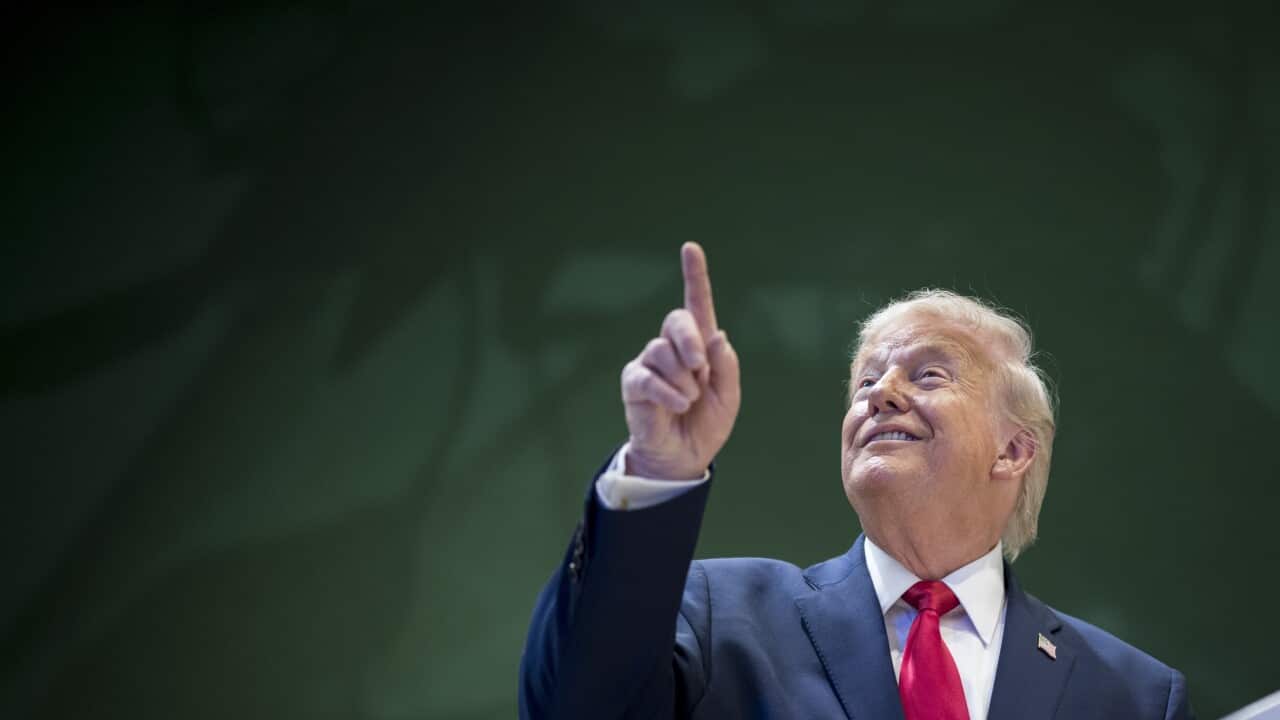

The US President has attacked his European allies at the World Economic Forum in Davos for their ongoing refusal to let the United States takeover Greenland. His 70-minute speech also took broad aim at the continent for other things Donald Trump believes Europe is doing ‘wrong’. His remarks had been widely anticipated amid ongoing tensions over the Arctic Island.
Listen to Australian and world news and follow trending topics with SBS News Podcasts.
TRANSCRIPT
As the United States President flew into the Switzerland city of Davos for the World Economic Forum, the words 'Trump Go Home' were written in the snow and clearly visible from the air.
But Donald Trump was going nowhere until he got his message across - and in his sights for his 70 minute speech was Europe.
"I love Europe and I want to see Europe go good, but it's not heading in the right direction."
The US President spent considerable time ahead of the forum threatening to levy tariffs on Denmark and seven other allies - unless they negotiated a transfer of the semi-autonomous territory of Greenland.
His speech has made it clear that he believes they have been unreasonable in saying no to a US takeover, despite America already having a large military base there.
"It's the United States alone that can protect this giant mass of land - this giant piece of ice. Develop it and improve it and make it so that it's good for Europe and safe for Europe and good for us. And that's the reason I'm seeking immediate negotiations to once again discuss the acquisition of Greenland by the United States."
The President has long said the US will get control of Greenland, no matter what it takes.
At Davos, Mr Trump has taken the same tone.
"They have a choice. You can say yes. And we will be very appreciative. Or you can say no. And we will remember."
But the President says he has ruled out the use of force in order to get his way.
"We probably won't get anything unless I decide to use excessive strength and force where we would be, frankly, unstoppable. But I won't do that. Okay? Now everyone's saying, oh, good. That's probably the biggest statement I made because people thought I would use force. But I don't have to use force. I don't want to use force. I won't use force."
Mr Trump also took a wider hectoring tone in his remarks.
He's chastised the US' European allies for what he has called their insolence, disloyalty and policy missteps in areas ranging from immigration and geopolitics, to the environment and wind power.
"There are windmills all over Europe. There are windmills all over the place, and they are losers. One thing I've noticed is that the more windmills a country has, the more money that country loses and the worse that country is doing.”
On several occasions during his speech, President Trump also mistakenly referred to Greenland as Iceland.
"I don't know that they'd NATO be there for us. They're not there for us on Iceland. That I can tell you. The stock market took the first dip yesterday because of Iceland. So Iceland's already cost us a lot of money."
Reactions to Trump's complaints about Greenland - and the wider European continent - have been swift.
Croatian Prime Minister Andrej Plenković says he's relieved military action appears to have been ruled out.
"What was clear, that if the offer is not accepted, he will not be happy, but he will not use force. So, in a way, this calms down the whole tension that was a little bit visible over the past few days."
But Donald Trump's increasing bluster towards Europe over Greenland has continued to fray transatlantic ties and worry Europeans.
Donald Trump had earlier threatened tariffs on Denmark and any other close European allies that sent troops to Greenland in solidarity, including Britain, France and Germany.
The European Parliament Chair of the International Trade Committee, Bernd Lange says this would have been a breach of a crucial trade deal.
"It's totally clear that there was a breaking of the Scotland deal by President Trump, announcing 10 per cent tariff for European goods starting at the 1st of February and 25 per cent if Greenland is not going to the United States in June."
Some European allies, like Swedish Deputy Prime Minister Ebba Busch, believe Mr Trump has been trying to bully them into doing what the U-S wanted.
"Let's just say in many ways I'm not surprised at all. This follows the line of both a mix of irrational and rational arguments at the same time."
Donald Trump's threats at Davos have even appeared on the verge of rupturing NATO, which was founded by leading European nations, the US and Canada in the aftermath of World War Two.
Amid these concerns, British Defence Secretary John Healey has said Europe must play a key role going forward.
"Recognising the growing threats from Russia, recognising the growing interest from China, and recognising the way that the High North will open up increasingly with climate change and increasingly become an area of competition in which we, through NATO, with the U.S. playing a part, will reinforce the security and the deterrents for the future."
Ultimately, President Trump cancelled the planned Greenland-related tariff.
He says this is because an agreement has been reached with NATO on a framework for a future Arctic deal, though what that looks like remains to be seen.
"The deal is going to be put out pretty soon. We'll see. It's right now a little bit in practice, but pretty far along. It gets us everything we needed to get."
Even so, the concern amongst some European allies isn't going away.
Bernd Lange says Trump's speech made it clear his Greenland ambitions remained unchanged.
"Some of you listened also to the speech of President Trump in Davos, and I guess he didn't revise his position. No, he wants to have Greenland as part of the United States as quick as possible, and he wants to have a table where we could discuss about the price."
Serbian President, Aleksandar Vucic, is among those who suggest more conflict is ahead, no matter what happens with Greenland.
"I am not as smart as all the other politicians in the world to assess it immediately after he delivered his speech, but obviously, we'll be facing bigger tensions between Europe and United States in the time to come, and we'll have to get ready for that."