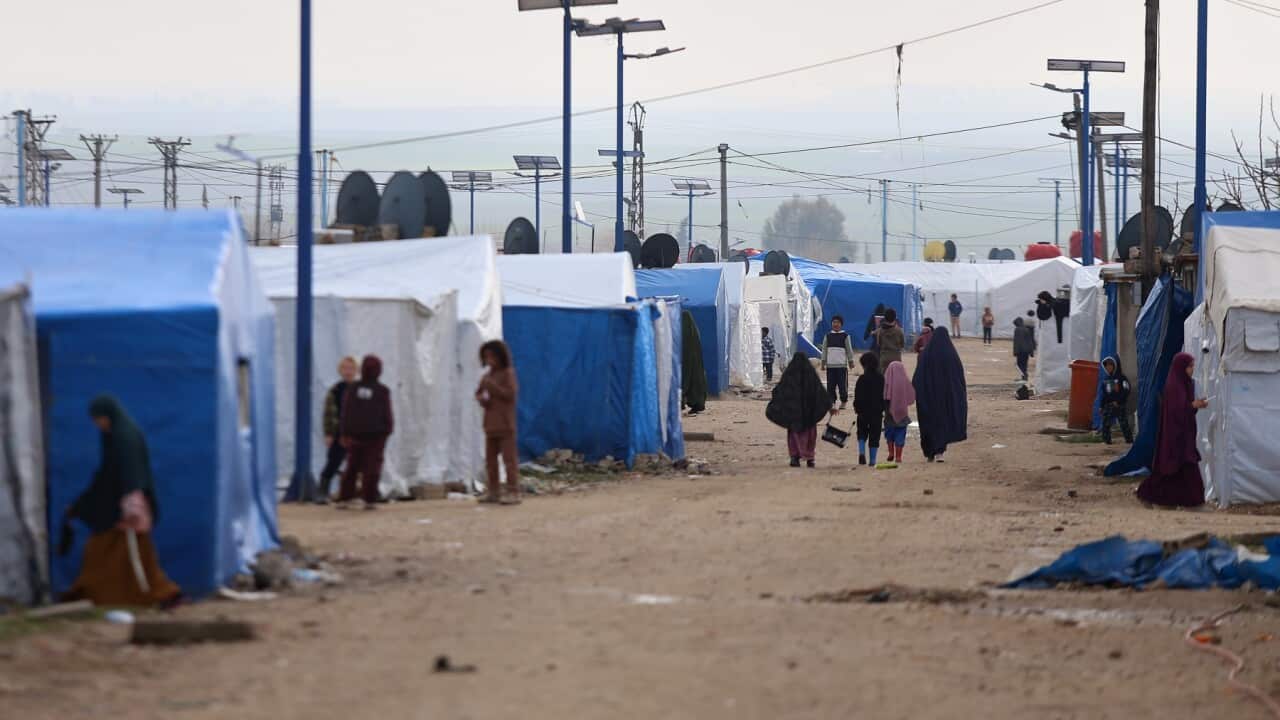

The last remaining Australian women and children with links to the IS Group have been sent back to a Syrian camp after attempting to repatriate themselves home. The group of 34 left al-Roj in the country's northeast overnight - but a communications issue with Damascus forced their return to the camp.
Listen to Australian and world news and follow trending topics with SBS News Podcasts.
TRANSCRIPT:
The last remaining Australian women and children with links to the IS Group have been sent back to a Syrian camp after attempting to repatriate themselves home.
The group have been languishing at al-Roj, in the country's northeast, within one of the few regions still run by Kurdish-led Syrian Democratic Forces.
The camp's director Hakmiyeh Ibrahim said the group departed overnight.
"We have handed over 11 families - 34 Australian nationals - to their families. We can say that this is the first deportation we have made in 2026."
But a communications issue with Damascus forced their return.
The federal government has been adamant it will not help with the group's repatriation.
Prime Minister Anthony Albanese spoke with ABC News Breakfast.
ALBANESE: "My mother would have said, if you make your bed, you lie in it. These are people who went overseas supporting Islamic State, and went there to provide support for people who basically want a caliphate, and you know, it is.”
REPORTER: “Unfortunate for the children, though, caught up in that, isn't it?"
ALBANESE: “It is, but we have a very firm view that we won't be providing assistance, or repatriation."
The Coalition believes they shouldn't step foot back home - as Liberal leader Angus Taylor made clear before announcing his new shadow cabinet on Tuesday afternoon.
"Leaving this to chaotic circumstances overseas is completely unacceptable."
Shadow home affairs minister Jonno Duniam is calling for a more active approach.
"We should be pulling out every stop to prevent from coming back and causing this risk to society. On national security issues is we deal with it appropriately on advice."
Michael Zekulin is a counter-terrorism lecturer at the Australian National University.
"The temporary exclusion order is the key here, which means you can't permanently do this, at some point you're going to have to make a decision, and either look for other means to prevent them from coming back, or acquiesce."
A number of Australians have already been repatriated, including eight orphans brought back by the Coalition in 2019.
In 2022, the Albanese government helped return 4 women and 13 children; then last year, two women and four children came home without any government support.
The 34 attempting to return to Australia now have obtained Australian passports of their own accord - and Attorney General Michelle Rowland says the government takes potential security risks seriously.
"These are people despite all of the warnings chose to go to this area."
The group's departure is believed to have been facilitated by Lebanese community figure, Jamal Rifi.
He led a campaign to help re-elect home affairs minister Tony Burke at the last election, and has also been closely affiliated with former Liberal prime minister Scott Morrison.
Michael Zekulin says it's a difficult issue for governments.
"But the reality is that these people have a greater chance of success in being less of a threat if you bring them back and provide them with assistance."
For those that remain in Syria, particularly children, questions persist.
Among them is Yusuf Zahab.
He was taken to Syria by his family in 2015, then separated, after being transferred to a Kurdish-run adult prison.
He was feared dead, until SBS Dateline tracked him down in 2024.
At the time, the head of ASIO, Mike Burgess, issued this statement to SBS.
”Obviously not everyone stuck in Syria is a threat to security. It's an unfortunate situation. Some are though and we have to be vigilant about that.”
Yusuf is now unable to be found again.
SBS News understands from those close to the repatriation efforts that there is an added level of urgency to get this group out now.
Two of them are young boys about to turn 12, and there are fears they could soon be transferred to adult prisons, like Yusuf Zahab - a much more complex operation for those seeking to bring them home.