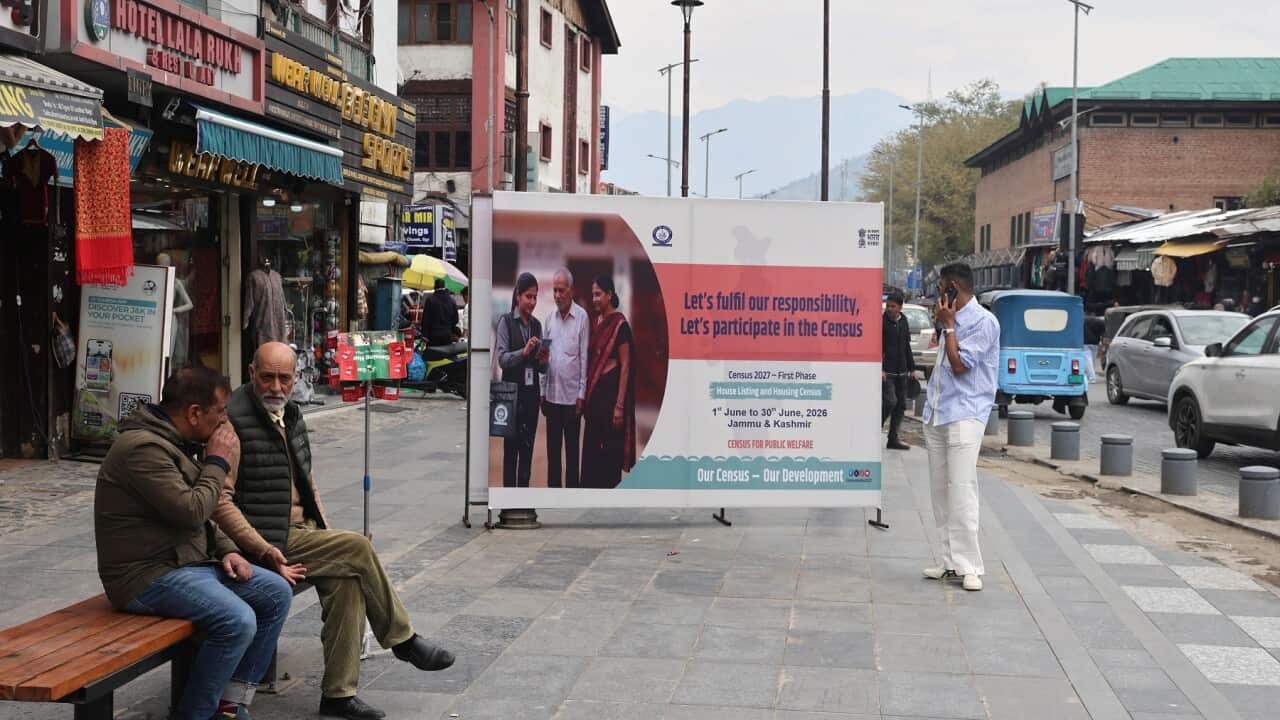

India is about to conduct the world’s largest census of its predicted 1.4 billion population after a five year COVID-initiated delay, budgeted for almost two billion Australian dollars.More than 3 million paid surveyors, including school teachers and government officials, will head out and knock on each door in India’s hundreds of thousands villages and cities, as the task unfolds with questions around process, data security and the government claim that caste will be included for the first time since the 1930s.
Listen to Australian and world news and follow trending topics with SBS News Podcasts.
TRANSCRIPT
2026 will mark the first time India’s census has taken place in 15 years.
While only one census form per household is filled in Australia, India’s census will see two phases, each with its own set of questions.
The first phase is straightforward.
Called the House Listing and Housing Census, questions are less personal and based more on living conditions including amenities, assets and household information.
For example, whether the house has a television and internet, the type of lighting and sanitation systems present, or the material the roof is made of.
Economist Mitali Nikore says information like this, will help inform government efforts in addressing disparities between rural and urban areas, especially considering the time since the last census.
“It becomes very important to have the (census) data to properly plan especially infrastructure investments ... and in many cases, because of the census not getting done on time, we might be planning for a smaller population ... we might be oversupplying to rural areas but undersupplying to the urban poor.”
For the first time, a mobile app has been rolled out as an option to help speed up the process, before surveyors come knocking from the 16th of April.
The digitisation of the process has brought up many questions around security, but India’s Ministry of Home Affairs says security systems will be regularly audited throughout the process, and information encrypted in protected data centres.
Questions have been mainly surrounding phase two of the census however. Political scientist Sudha Pai says a caste enumeration will be included.
“Every individual will have to tell the person who comes to their household what is his or her caste. And the attempt is to find out the caste structure and the changes that have taken place in the post-independance period.”
While the exact questions are still unknown to the public, this Population Enumeration phase is where personal questions are asked, including around fertility, education, and economic circumstances.
Census data on caste has not been published since the 1931 census (under British colonisation of India), it will be the first time it will be asked of the entire population.
Conversations on the inclusion of caste in the national census increased during India’s 2024 elections, with India’s opposition leader Rahul Gandhi saying its inclusion must also include information on wealth and economic distribution, to influence change for those sitting outside the caste system and unable to achieve beyond its social limitations.
Caste discrimination is condemned in India's constitution, and a percentage of government seats and jobs are reserved for disadvantaged groups.
While it is not yet clear what exactly the government will be asking with regards to Caste in that second phase of the census, India’s Census Commissioner says the data will help the government better inform decisions and policies, including percentage allocations.
As the biggest census campaign in the world begins, data collection offered in 16 different languages, will continue until next year.