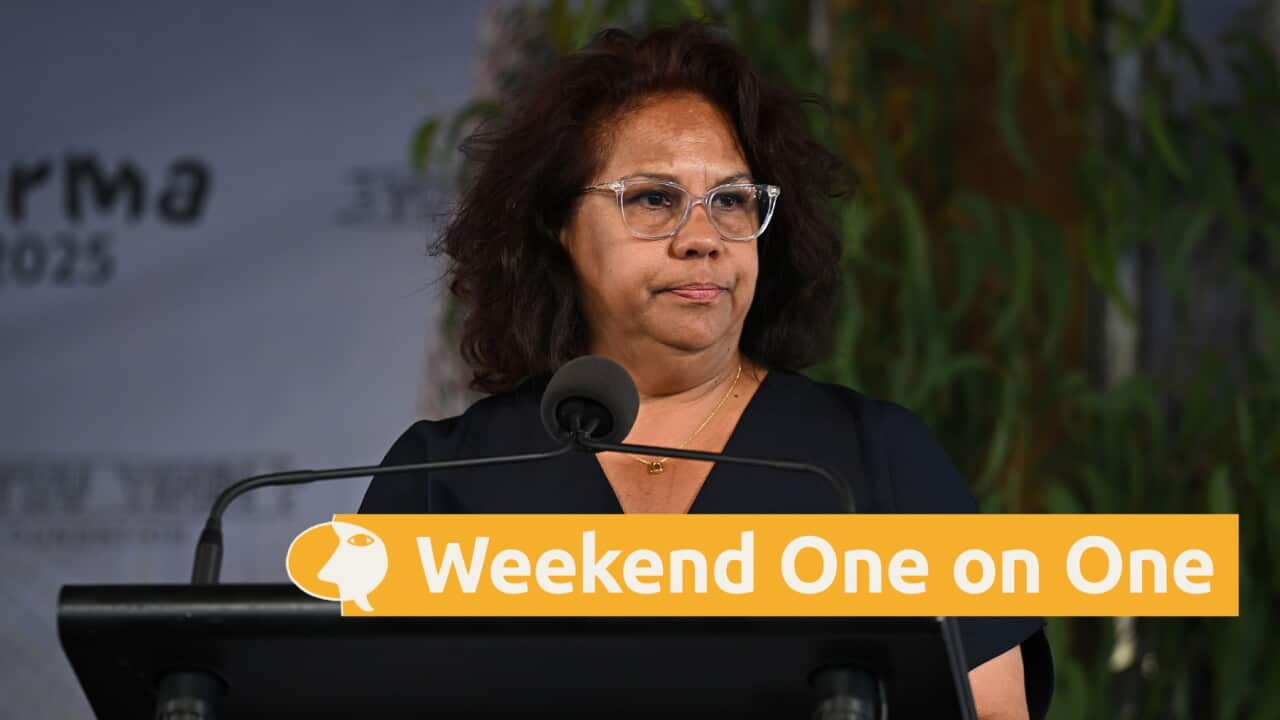


A First Nations advocate and activist for incarcerated women says the social contract between the Australian government and the community is broken. Tahlia Isaac, who founded 'Project:herSelf', says authorities are more interested in punishment than providing the conditions to keep people safe. She says the system needs to change and the government needs to start listening to women who have real insight into the cycle of incarceration.
Listen to Australian and world news, and follow trending topics with SBS News Podcasts.
TRANSCRIPT:
Tahlia Isaac says she had two options when she walked out of prison seven years ago.
"Turn left and head back to the Gold Coast in the destructive life I had known, or turn right into the arms of my waiting mother who had received a call from my lawyer and been there to support me. Turning right wasn't an easy choice to make. I was 29 at this point in my life. All I had ever known was the life I had before prison. I had to rebuild everything from nothing, starting with my own sense of self."
Ms Isaac had survived more than a decade of addiction, three years cycling in and out of custody, and significant experiences of violence.
The now 35-year-old criminologist, social justice advocate, and founder of the charity Project Herself says she is now working to change the justice system by supporting vulnerable women.
She has told the National Press Club on International Women's Day that the way Australia handles incarceration and release is broken.
"From the first time I went into a police watch house, I became more dangerous to our community. Being released after being charged with drug driving, drug possession and drug supply without any orders to engage in drug rehab services is a failure of the social contract that's supposed to exist between me and the government."
Ms Isaac says when it comes to thinking about women's rights, incarcerated women are often forgotten or ignored, and it's time these silenced voices are heard.
"I do not represent every woman who has been incarcerated. Our personal experiences are complex and our pathways into prison are different, but what we are connected by is what prison does to a person, how it reshapes our sense of identity and belonging, our dreams, and our potential. There are many faces of incarceration, different histories, different risk factors, but what we all share is what it feels like when society breaks its contract with us."
She says without adequate support, women are given limited chance to break the cycle of incarceration.
"Almost half of women who exit prison will exit into homelessness, released in the same way I was, but without prior warning, but often unlike me because they have no safe place to return to. Women will exit back into the violence they entered prison from or straight onto the streets. Having nowhere safe to live is a key factor contributing to the rising re-offending or recidivism rate."
Australia currently operates 114 custodial correctional facilities across the country.
The latest data from the Productivity Commission reveals the yearly price tag of Australia's prisons has gone up by more than 49 per cent over the last ten years, now costing the country more than $7 billion dollars annually.
At the same time, the Commission found prison population to be at an eight year high, with more than 45,000 adults on average locked up each day in the 2024-2025 financial year- around 2,500 more than the previous financial year.
Ms Isaac says there has been a trend towards tougher crime policies in recent years, which has been seen across states and territories, like Victoria – where Premier Jacinta Allan says the Parliament has recently approved adult time for adult crime laws.
"Children will be treated as an adult in the court system, where we know jail is more likely, and sentences will be longer. And this has come from victims who have said clearly not enough consequences, which is why the work is being done to bring adult time to violent crime to the Victorian parliament."
For Ms Isaac, such approaches are clearly not working.
"If we continue down the tough on crime path, expanding facilities, strengthening laws while ignoring the conditions that drive people there, we will continue widening the gap and entrench the very harm that we claim to prevent."
Indigenous women make up 37 percent of the total female prisoner population in Australia.
They're 21 times more likely to be incarcerated than non-Indigenous women.
And according to the Bureau of Statistics, First Nations women are the fastest-growing prison demographic, with rates rising over 10 percent in the last year.
Ms Isaac says these statistics should be cause for deep national shame.
"I have been in prisons where entire units are made up of black women from the same remote community who don't speak English as a first language. These women live by law, not L-A-W, but L-O-R-E. They live on country, they live in community and they live by old ways. Until they are sent to prison and with generations of the same family, they sit in cells side by side."
She says the focus needs to urgently shift away from a system which prioritises incarceration and punishment over rehabilitation and support.
"What if every woman had someone waiting in the gate? What if housing, therapy, employment pathways, community were normal and expected and legislated? Not lucky breaks, but part of our social contract. How many fewer would return to prison? When women are given the chance to come home, they do not just rebuild their own lives. They rebuild families and they rebuild communities."