
Israel’s move to authorise 19 West Bank settlements has reignited debate over security, annexation and the future of a Palestinian state. Supporters say it formalises existing outposts, while critics say it deepens occupation and fuels violence. The decision has also sharpened political divisions here in Australia over recognition and the two-state solution.
Listen to Australian and world news, and follow trending topics with SBS News Podcasts.
TRANSCRIPT:
Israel has authorised 19 settlements in the West Bank.
The approvals extend into areas the international community considers occupied, where nearly three million Palestinians and more than 450,000 Israeli settlers live under separate legal systems.
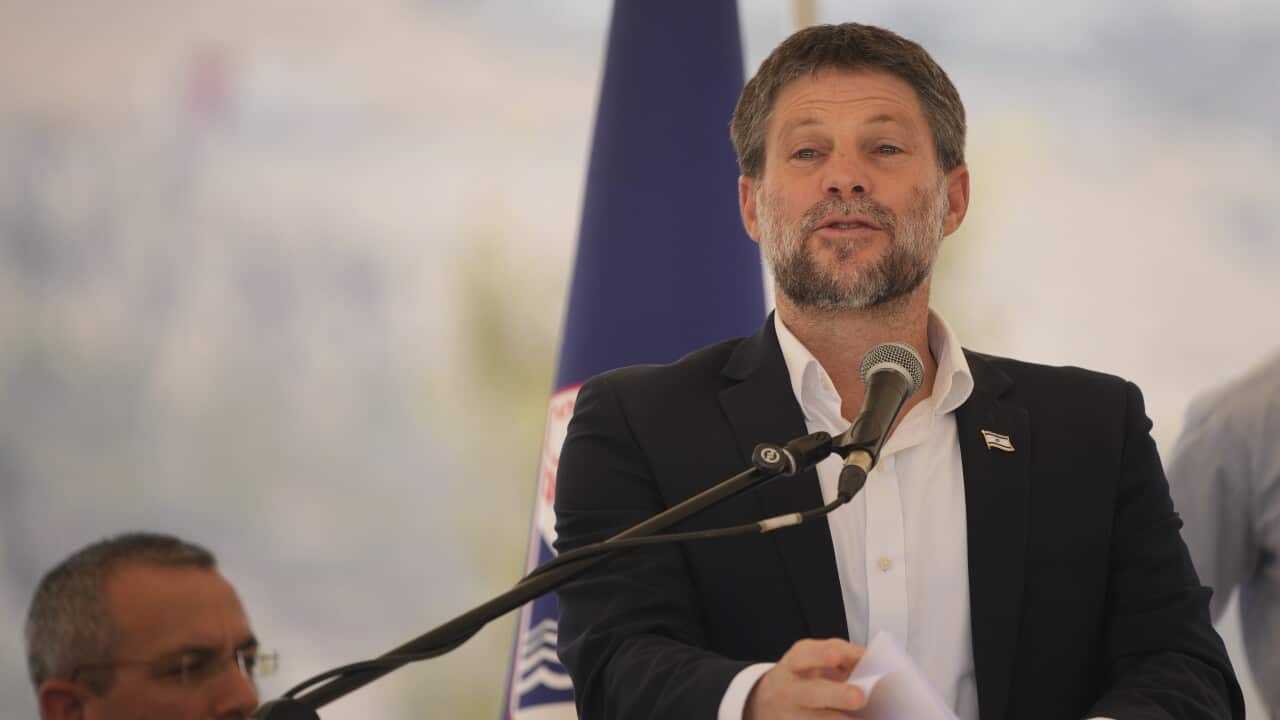
Finance Minister Bezalel Smotrich, a pro-settler politician and a settler himself, argues it bolsters Israel’s security and blocks a future Palestinian state.
But at the United Nations last week, Palestinian envoy Riyad Mansour argued the expansion and rising settler violence are displacing communities and fracturing Palestinian land.
“The unprecedented escalation of settler violence terrorising Palestinian communities must be understood in the context of Israel's continuing policy of displacement and replacement of our people. ... Settler militias acting hand in hand with the occupying army, systematically targeting our people. The objective is clear and unchanging - annexation. ... It aims at destroying the territorial integrity of the Palestinian state and with it any chance for a just peace.”
Israel’s envoy at the United Nations, Danny Danon, rejects the claims of annexation, insisting armed groups must be neutralised first, part of its 2026 overall goals for the region.
“Our New Year’s resolutions for the Security Council in 2026 are clear. Hamas disarmed in Gaza. Iranian backed terrorist proxies dismantled. A Palestinian Authority that stops rewarding terror. A Syria that protects its people. And the Middle East, defined by cooperation and peace.”
Peace Now is an Israeli civil society organisation founded in 1978 that opposes settlement expansion and advocates a negotiated two-state solution between Israelis and Palestinians.
It monitors settlement construction, publishes research on land use in the West Bank, and campaigns for policies it argues will protect Israel’s democratic character while enabling Palestinian statehood.
In a statement released last week Peace Now said the authorisation undermines Palestinian territorial continuity.
“The government is doing everything it can to entrench Israel’s presence in the territories and to foreclose the possibility of a future of peace and two states for two peoples. Establishing settlements in areas where Israel has not previously had a presence is intended to sever Palestinian territorial continuity and to destroy what little economic development remains possible for Palestinians. The government’s policy is not only immoral, but also a security and economic folly that will further worsen Israel’s situation.”
Dr Ran Porat is a researcher at the Australian Centre for Jewish Civilisation at Monash University, and also works with the Australia Israel and Jewish Affairs Committee (AIJAC).
He has told SBS News he disputes Power Now's statement, arguing many sites are long-standing outposts being formalised.
"The government did not approve 19 new settlements. ... they were on the ground already. The question of settlements is a disputed one in international law. Some claim it's illegal. Some say it is legal. ... If you think about the reality of a two state solution there are two levels. One is geographical, and the more Israeli settlements there are in the West Bank, geographically, it is harder for the Palestinians to create a state which is with geographical continuity."
Peace Now disagrees:
"Some of the settlements are slated for areas where Israel has not previously had a presence, while others would be built in densely populated Palestinian areas. Several of the planned settlements are expected to be built in the northern West Bank, on the sites of settlements that were evacuated under the 2005 disengagement plan. In several cases, the new settlements are expected to be established on sites from which Palestinian communities were expelled."
But Dr Porat argues that Palestinian political fragmentation is a greater barrier, above and beyond geography.
"We have a very complex situation on the ground. ... The Palestinian policy is helping extremists on both sides. Hamas, Lion's Den, terror groups that are funded by Iran in the West Bank and Gaza. ... When they promote that kind of policy, they give the extremists on the Israeli side, their extreme right, the motivation to push forward with their plans, which is to prevent the Palestinian state. What Israelis saw on October 7, what many Israelis have understood is that Israel is vulnerable."
Under the Albanese Labor government, Australia has taken a firmer line on settlements, one matter, he says, will harm Israel-Australia relations.
Dr Porat says the issue of settlements is among several now shaping political discourse in Australia.
"As for Australia, I don't know how the relationship between the Albanese government and the Israeli government can go any more south. Albanese's government has failed dramatically in understanding the meaning of October 7, and even worse, failed to protect Australians and specifically the Jewish community, as we've seen in the Bondi massacre just a week ago."
Australia has reiterated its support for a negotiated two-state solution and has taken a firmer diplomatic line on West Bank settlements under Foreign Minister Penny Wong, who restored the use of the term “Occupied Palestinian Territories” in 2023 and joined 20 other countries in calling Israel’s settlement plans “unacceptable” and a violation of international law.
Dr Porat says the Labor government's stance is an issue.
"It's this government that is the problem, this government that fails to understand that you have to align yourself with the western values of democracy and freedom and not recognise a state that doesn't exist that has no borders, that has no leadership or stable leadership, that has no democracy, that is dysfunctional, that has no territory, that is half of it is, you know, of people made of people that support terror, and actually parts of it engage in terror. So the only way forward is constructive dialogue between the sides in an atmosphere that understands that you cannot predetermine the outcome."