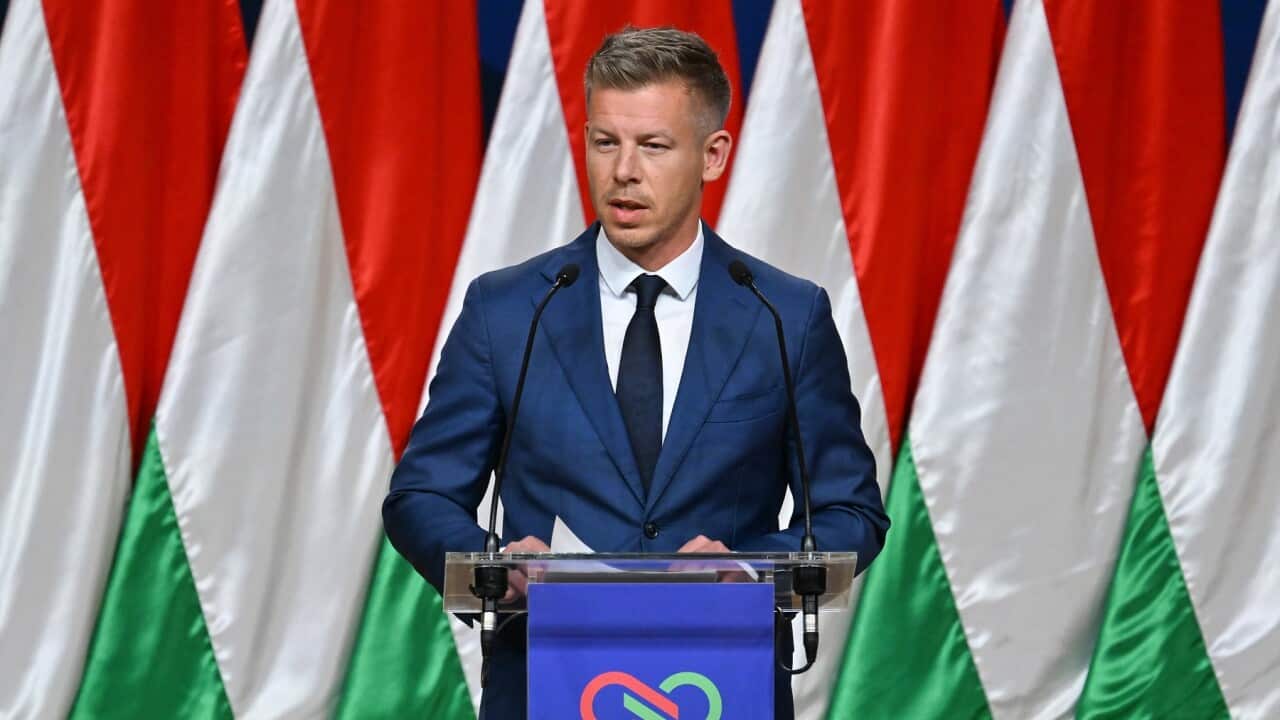

Hungarian voters continue to celebrate after ousting Prime Minister Viktor Orbán after 16 years in power. The election result was a rejection of his authoritarian, far-right agenda in favour of pro-European challenger Peter Magyar. But for the new leader, the coming months won't be easy.
Listen to Australian and world news and follow trending topics with SBS News Podcasts.
TRANSCRIPT
In Hungary, the supporters of new leader Peter Magyar are still on a high.
“I was smiling on a tram, I was smiling to everyone. And we did it, yes, we did. We did it, so it was totally different. It's never happened before. It never happened before. The people were smiling again on the street. It was amazing.”
These are the words of shop owner Viktor Halas in the Hungarian capital Budapest, after the country's new prime minister-elect pledged to usher in a new era.
On Sunday the 45-year-old defeated long-time nationalist leader Viktor Orban in a decisive victory.
While Mr Orban's supporters say their long-term leader defended Hungary's sovereignty and traditional values, his critics say he drove economic stagnation, international isolation, and enabled oligarchs to amass wealth.
Within hours, Mr Magyar vowed to implement measures to fight corruption and restore democratic standards to Hungary.
In his first press conference since the election, the leader of the centre-right Tisza party says he will limit the prime minister's mandate to two terms, which is eight years, half the time Mr Orban spent at the helm.
He will also review the country's budget, relaunch Hungary's accession to the International Criminal Court, and create a new office to oversee the government sector and root out corruption.
"We are ready to eradicate this industrial-scale corruption, as this is largely why Hungary and the Hungarian people are not receiving the eight thousand billion forints of EU funds. And well, this is why the money disappears, this is why we have become Europe's poorest and most corrupt country, so we will have a huge responsibility to get this office up and running as soon as possible.”
But Mr Magyar's job of stamping out corruption won't be easy.
Analyst Bulcsú Hunyadi at Budapest-based think tank Political Capita says while the Tisza party enjoys a constitutional majority, there are what he calls 'obstacles' in the system.
“The institutions are led by people who are cemented in their position for many years, depending on the institutions and depending on when they were appointed. But many leaders of institutions, they cannot really remove from their positions.”
Mr Magyar has already accused outgoing Foreign Minister Peter Szijjarto of shredding important documents relating to sanctions at government offices.
And he says the outgoing government is not being fully co-operative in the handover of power.
"This situation contrasts sharply with what happens during a normal handover in a normally functioning country after a political campaign. If there's an opposition party that has, for a year and a half, certainly surpassed the governing party in popularity, and it's widely known that they will take over the responsibility of governing, then the outgoing prime minister would share information crucial for national security, and perhaps even involve them in decision-making during the final period. That's not what's happening here. Instead, we have no information at all.”
He has urged President Tamas Sulyok, an Orban ally, to convene parliament as soon as possible.
The president has 30 days, until May 12, to call a session.
Mr Magyar's defeat of Mr Orbán has significant reverberations outside Hungary.
Mr Orban is an icon among the global right for his anti-immigrant stance and was long embraced by US President Donald Trump and many U-S conservatives.
But political analyst Dalibor Rohac at American Enterprise Institute said Mr Magyar's victory has framed radical right-wing, nativist politics as a universal failure.
“Donald Trump looks more and more kind of isolated than any sort of singular figure on the global stage rather than somebody who is leading a movement that spans across countries and continents. So I think that's a limiting factor.”
In the European Union, many leaders have welcomed Mr Magyar's win following years of tension with Mr Orban over democratic standards and the rule of law.
China — which Viktor Orban courted — has also congratulated the new leader, while the Kremlin says it hopes for good relations with Hungary's new government.
Russia has enjoyed close ties with Mr Orban, who repeatedly blocked EU moves to help Ukraine fight Russia's invasion, and continued to purchase Russian oil, frustrating EU efforts to sanction Russia and support Ukraine.
Mr Magyar is pro-EU and more wary of Russia, and has promised a change of policy regarding the conflict between Russia and Ukraine.
Though he says he opposes sending EU military aid to Ukraine or offering Ukraine a fast-track route to join the 27-nation bloc.
A spokesperson for the Russian president Vladimir Putin, Dmitry Peskov, says Russia is watching to see what direction Mr Magyar will take.
"The Hungarians have made their choice, and we respect that choice. We expect to continue our highly pragmatic contacts with Hungary’s new leadership. We have heard statements about a readiness to engage in dialogue. Naturally, this would be beneficial both for Moscow and for Budapest. As for what actions the new Hungarian leadership will take, we will likely need to be patient and see how events unfold.”
At the press conference, Mr Magyar also spoke of Hungary's special bond with Israel, hinting at where the country's alliances lay in the Middle East.
However he says his government would examine EU decisions on Israel as they arise.
"Regarding the relationship between Israel and Hungary, I can state that there is clearly a special bond. Many of our Hungarian compatriots live in Israel, and numerous Israeli citizens visit Hungary. A very strong Jewish community, one of Europe's largest, resides in Hungary, fortunately in peace and security. Hungary has so far maintained, and will continue to uphold, a zero-tolerance policy against all forms of antisemitism.”
With the future uncertain, Mr Magyar's supporters are for now, simply enjoying the moment.
Like Adrien Rixer, a Hungarian living in the UK, who came home to Budapest to cast her vote.
“I’m over the moon, I just can’t believe it. And I hope we are going to get 2/3 and then, oh my God, finally I can say that I’m a proud Hungarian, finally after 16 years.”