
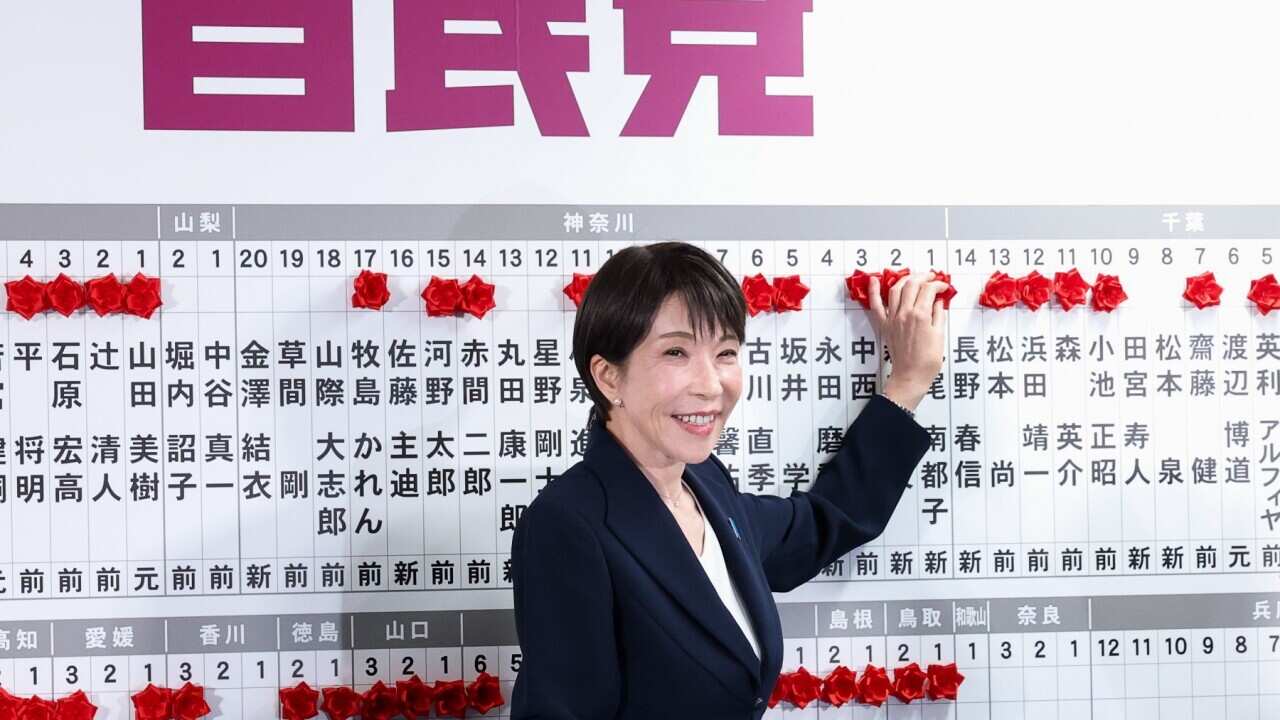

Japan's Prime Minister Sanae Takaichi has won the country's election In a landslide victory, with her party expected to secure a more than two-thirds majority in the powerful lower house. Takaichi's government will push for greater defence spending, tougher immigration policies, and a stronger economy.
Listen to Australian and world news, and follow trending topics with SBS News Podcasts.
TRANSCRIPT:
In what many considered a gamble, the snap election called by Japan's Prime Minister Sanae Takaichi last month has paid off handsomely.
Projected to have won a two-thirds majority in the powerful lower house, Japan's first female prime minister has one of the strongest mandates in living history to implement her conservative agenda.
In a televised interview with public television network N-H-K following her sweeping victory, Ms Takaichi has said she is ready to pursue policies to make Japan strong and prosperous.
"I think my cabinet members are a good team. Just over three months have passed, but everyone is working hard and achieving results, so I'm not thinking of changing the cabinet. However, as an exception, if asked, I would think about a cabinet position for the Japan Innovation party."
The incumbent Liberal Democratic Party, or L-D-P, alongside junior coalition partner, the Japan Innovation Party, or J-I-P, are expected to have secured at least the 310 seats needed for a two-thirds majority in the lower house.
With such a significant majority, the coalition has the power to override upper house opposition on legislation, even with a minority in the upper chamber.
But while making policy change far easier for the government, the majority doesn't grant the coalition unchecked power.
For major changes, such as constitutional amendments, the government would still need a two-thirds majority in the upper house.
Leader of the right-wing coalition partner J-I-P, Hirofumi Yoshimura has told N-H-K that despite only securing 36 seats, his party won't let their voters down.
"It was a very tough and difficult election. Amid strong support for Prime Minister Takaichi, some people still voted for us. We'd like to implement policies in the coalition government so that we don't betray the confidence of those voters."
The results are a bitter disappointment for the main opposition party, the Centrist Reform Alliance, currently projected to lose around half of its seats.
Co-leader Yoshihiko Noda has called the results humbling.
"I thought we could make it, seeing the number of members who felt a sense of urgency started to increase in the midst of the campaigning period. However, we got swept up in the mood. If that was one of the ruling parties' tactics, we fell for it."
The ultraconservative Takaichi has reinvigorated the L-D-P, which, despite governing Japan almost non-stop for decades, has in recent elections lost support.
Described as Japan's "Iron Lady", Ms Takaichi was a heavy metal drummer in her youth and sat on the ultraconservative fringe of the party when she took leadership.
With far-right populism gaining ground in Japan, the prime minister wants to crack down on immigration, increase defence spending, and shift away from post-war Japan's pacifist principles.
Office worker Akihito Iwatake says the conservative shift won many voters over.
"Over the past several years, I think the LDP has been quite liberal. With Takaichi, things shifted more toward the conservative side, I think that led to this result."
Despite her huge popularity, not everyone is so pleased with the results.
Young office worker Waka Kimura says the results don't seem to reflect what young Japanese people want.
"I find it somewhat a bit disappointing. It seems the opinions of younger people are not being reflected very much, or rather, that there is a visible lack of effort among young people themselves to try to have their views reflected. I find that a bit unfortunate."
On the global stage, the election is being watched closely by regional allies as to how Prime Minister Takaichi now deals with China.
Before being elected, Takaichi was seen as a China hawk.
Within two weeks of taking power, she suggested that Japan could intervene militarily if China sought to take Taiwan by force.
This came just days after United States President Donald Trump received a warm welcome to Japan, prompting an unimpressed China to summon Tokyo's ambassador and warn its citizens against visiting.
Publicly endorsed by Donald Trump, U-S Treasury Secretary Scott Bessent has told Fox News the election result was also a win for the United States.
"Yeah, well, Japan, the prime minister called a snap election the quickest snap election in Japanese history. And boy, she had a big victory today. She's going to have two thirds majority in the upper house. President Trump endorsed her last week. She is a great, great ally, great relationship with the president. And when Japan is strong, the US is strong in Asia."









