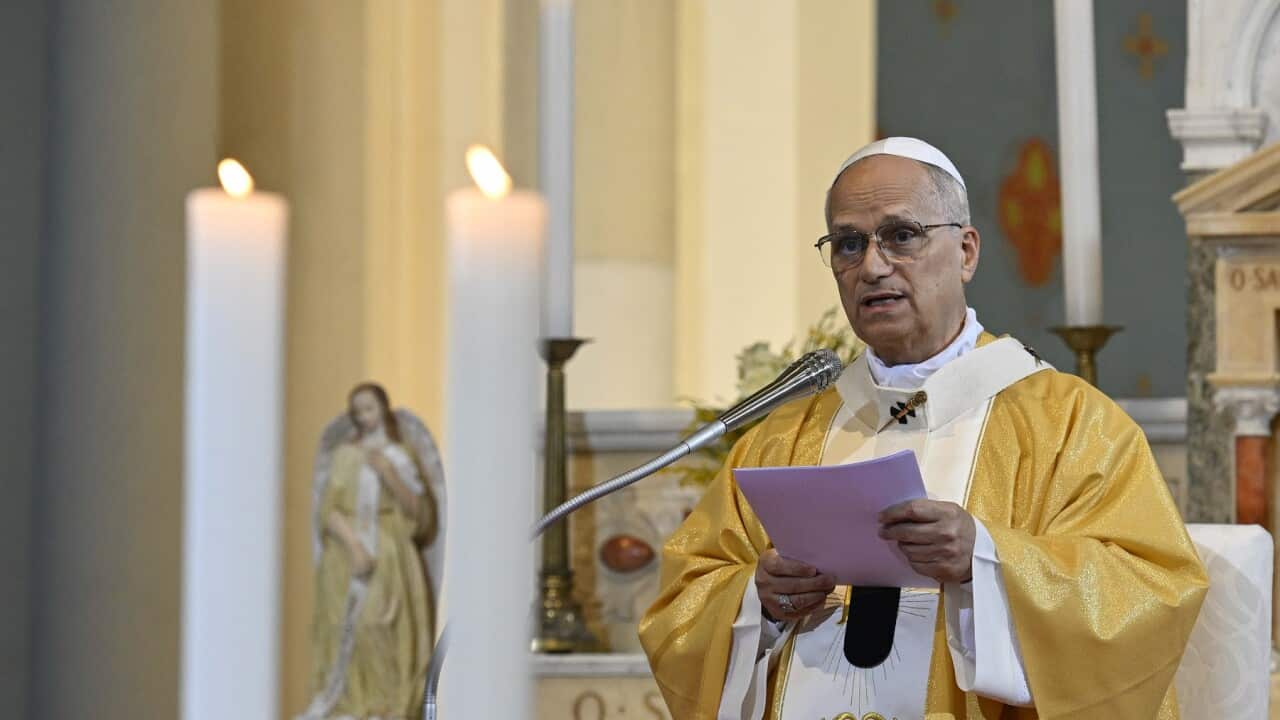

Pope Leo the Fourteenth is on a historic tour of Africa, a journey spanning four countries, thousands of kilometres, and a continent that is now central to the future of the Catholic Church. From Algeria to Cameroon, Angola and Equatorial Guinea, the visit is being described as both pastoral and political.
Listen to Australian and world news and follow trending topics with SBS News Podcasts.
TRANSCRIPT
Pope Leo’s first trip to Africa is underway.
The first American pontiff left Italy on Monday for a 10-day visit to Algeria, Cameroon, Angola and Equatorial Guinea, a tour shaped by faith, history and geopolitics.
Popes have travelled to Africa before, but this is Leo’s first visit to the continent, and an early test of how he intends to lead on the global stage.
In Algiers, Leo framed the visit as a call for dialogue and justice in a world he says is sliding deeper into conflict, pushing his visit beyond religion and into the way power still works across the world.
“If you are able to engage in dialogue regarding the concerns of all and show solidarity with the sufferings of so many countries near and far, then you will be able to contribute to both envisioning and bringing about greater justice among peoples. By respecting the dignity of everyone and allowing yourselves to be moved by the pain of others, instead of multiplying misunderstandings and conflicts, you can surely become protagonists of a new chapter in history. Today, this is more urgent than ever in the face of continuous violations of international law and neocolonial tendencies.”
The Pope also visited the Great Mosque of Algiers, in a gesture aimed at Christian-Muslim coexistence, before speaking later about unity in a divided world.
Addressing worshippers, he said lives lived in peace and humility can send a powerful message far beyond the Church.
“In a world where divisions and wars sow pain and death between nations, in communities, and even within families, your united and peaceful life is a powerful sign. United, you spread fraternity, inspiring in those around you desires and feelings of communion and reconciliation, with a message all the more powerful and clear for being borne witness to in simplicity and humility.”
That warning about war and division would soon draw a political response far beyond the continent, from U-S President Donald Trump.
On Tuesday, in Annaba, the ancient city of Hippo, a Roman-era settlement in present-day Algeria, Leo walked in the footsteps of Saint Augustine, a towering figure in Christian history whose teachings have shaped generations of Church leaders, including popes.
At the Basilica of St Augustine, he spoke of endurance, faith and generosity.
“Your history is one of generous hospitality and resilience in times of trial. Here the martyrs prayed; here Saint Augustine loved his flock, fervently seeking the truth and serving Christ with ardent faith. Be heirs to this tradition, bearing witness through fraternal charity to the freedom of those born from above as a hope of salvation for the world.”
The Pope's Africa visit is now moving to Cameroon.
The country is grappling with conflict, insecurity and youth unemployment, and many there are hoping the Pope’s visit will do more than draw crowds.
Cameroon resident Pierre Ze Mekong says he hopes the visit brings relief
“May the Lord protect Cameroon. With the Pope's visit, I hope things improve for young people, that they can really find work, that crime rates decrease. Because for some time now we have noticed too many kidnappings, assaults, murders, children being raped, children dying every day in the city, in Cameroon in general. There is also the war in the northwest with the Ambazonians. So I think the Pope's visit will try to ease our suffering and allow Cameroon to be at peace.”
Peace and conflict specialist Immanuel Wanah Bumakah says the Pope’s presence could open space for dialogue that others have struggled to create.
“We can say that somebody of his magnitude coming to Cameroon and given that he's going to speak to religious leaders and civil society leaders, it's an opportunity for dialogue maybe with the government because he's someone that many people look up to. If the government is inviting him here or if he's coming here, it means that the government is ready to listen to what he is about to tell them so he can play that role of advice.”
Separatists in the English-speaking regions have announced a temporary pause in fighting to allow safe movement during the visit.
So far, the trip has moved from coexistence in Algeria, to spiritual inheritance and peace-making in Cameroon.
And then came the reaction from Donald Trump to the Pope’s remarks in Algeria about war, division and the human cost of conflict.
The US President, the first ever to criticise a Pontiff, says Leo was simply wrong, and accused him of being weak on crime and security.
“I don't think he's doing a very good job. He likes crime, I guess. ... We don't like a pope that's going to say that it's okay to have a nuclear weapon. We don't want a pope that says crime is okay in our cities. I don't like it. I'm not a big fan of Pope Leo. He's a very liberal person, and he's a man that doesn't believe in stopping crime.”
President Trump's criticism of the Pope has drawn a response in Europe, with Italy's prime minister Giorgia Meloni stating the comments about the Pope are unacceptable.
Leo responded on the papal plane, insisting his message is rooted in the Gospel, not politics.
"The message of the church, my message, the message of the gospel IS Blessed are the peacemakers. I do not look at my role as being political, a politician. I don't want to get into a debate with him. I don't think that the message of the gospel is meant to be abused in the way that some people are doing. And I will continue to speak out loud against war, looking to promote peace, promoting dialogue and multilateral relationships among the states to look for just solutions to problems. Too many people are suffering in the world today. Too many innocent people are killed. And I think someone has to stand up and say, there's a better way."
He also said he has no fear of the Trump administration.
The dispute might have ended there.
But it did not.
Soon afterwards, President Trump was asked about an image of himself he posted on social media.
The image appeared to depict him as Jesus Christ.
He says the image of him wearing a robe with with him bathed in light seemingly emanating behind him from the heavens above, was misunderstood.
“Well, it wasn't a picture. It was me. I did post it and I thought it was me as a doctor and had to do with Red Cross, as a Red Cross worker there, which we support. And only the fake news could come up with that one. So I had just heard about it. And I said how did they come up that? It's supposed to be me as doctor making people better. And I do make people better, I make people a lot better.”
The image has since been deleted from his social media account.
Earlier this month, President Trump's longtime spiritual adviser and evangelical pastor, Paula White, drew a parallel between his political struggle and the story of Jesus' persecution and crucifixion before rising from the dead.
“Mr President, no one has paid the price like you have paid the price, it almost cost you your life. You were betrayed and arrested and falsely accused. It’s a familiar pattern that our Lord and Saviour showed us… and sir, because of his resurrection, you rose up. Because he was victorious, you were victorious.”
It is not a comparison that the Vatican is making.
From Cameroon, Pope Leo will continue on to Angola and Equatorial Guinea.
And as the tour moves forward, so does the question at its centre ... whether a message built on peace can still cut through in a world shaped by war, political anger and spectacle.