
For Australian politics in 2025, it was a year of predictable policies - and shock results. That included the May election that saw Labor win back government in a landslide, and two separate party leaders - Peter Dutton and Adam Bandt - lose their seats. We back at the year in Canberra.
Listen to Australian and world news and follow trending topics with SBS News Podcasts.
TRANSCRIPT:
For followers of Australian federal politics, national security is how the year began.
First, it was a revival of accusations that Australia's intelligence agencies had bugged the cabinet room of Timor-Leste's government, allegedly seeking information as the Timor Sea Treaty was being negotiated.
Then, in August, the government announced ASIO had determined Iran was behind at least two antisemitic attacks against Australia's Jewish community - prompting the Prime Minister Anthony Albanese to announce a tough response.
"A short time ago we informed the Iranian Ambassador to Australia that he would be expelled. We have suspended operations at our embassy in Tehran, and all our diplomats are now safe in a third country. I can also announce the Government will legislate to list Iran's Islamic Revolutionary Guard Corps, the IRGC, as a terrorist organisation."
The PM said the Iranian-directed attacks were aimed at undermining social cohesion in Australia, which he felt was a matter of national security.
And a report on Islamophobia released this year underscored just how much of a risk authorities felt that could pose, with the document by special envoy to combat Islamophobia Aftab Malik recording a 30 per cent increase in anti-Muslim incidents since the October 7 Hamas attack.
"We have seen Muslim people and children targeted, not for what they have done but for who they are and what they wear."
For the Islamophobia register's co-executive director, Sharara Attai, the federal government's response left much to be desired - but Anthony Albanese begged to differ.
"We have legislated against hate speech across the board. We have strengthened Commonwealth hate crimes to criminalise threats of violence… that target individuals or groups based upon race, religion or nationality. That applies across the board... We have been consistent."
Meanwhile, as much as the government hoped that Australians would get along much better with each other, it also hoped that voters would continue to get along with it.
Accordingly, a federal election was called for May.
"My fellow Australians, this morning I visited the Governor General and Her Excellency has accepted my advice that an election be held on Saturday, May 3, 2025."
That election saw Labor not just stay in government, but gain a record number of seats, which put the PM in a good mood as he toured Marrickville in his electorate the next morning.
By contrast, opposition leader Peter Dutton lost his seat in Queensland, and quietly vanished.
Greens leader Adam Bandt also went down in Melbourne.
"To win in Melbourne, we needed to overcome Liberal, Labor and One Nation combined. And it's an Everest we've climbed a few times now, but this time we fell just short."
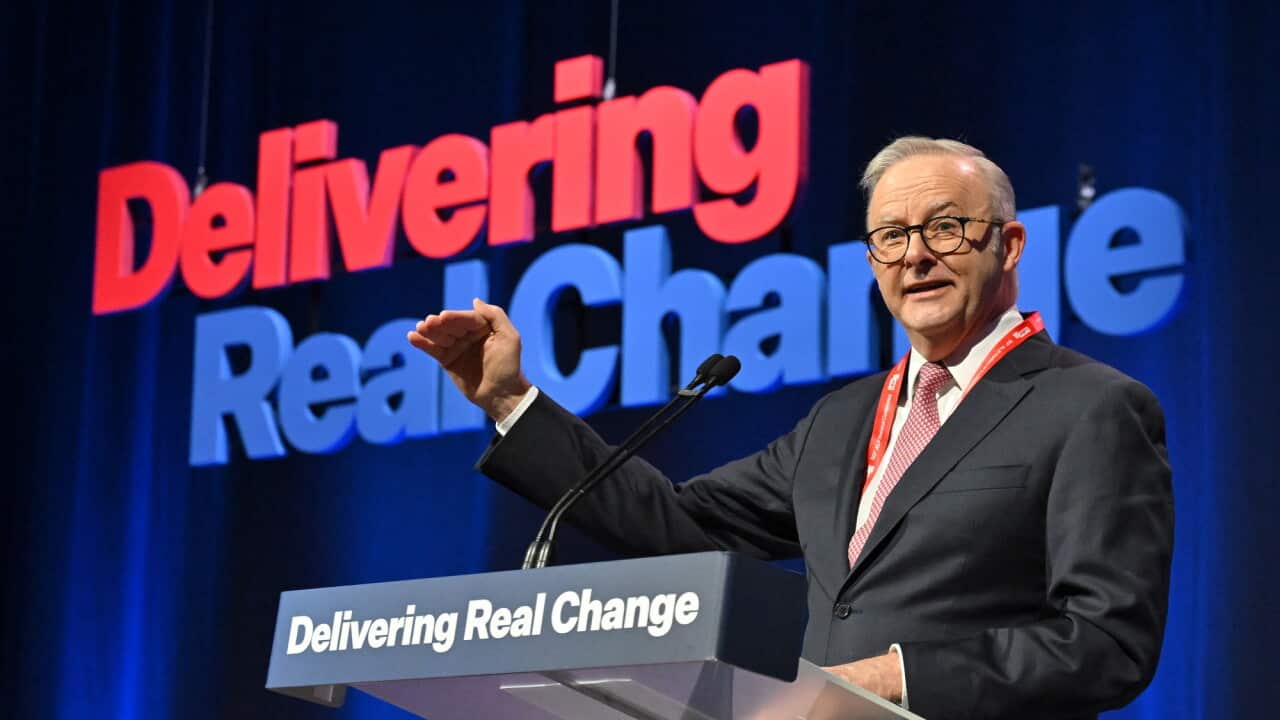
Anthony Albanese wasted no time in laying out his second term agenda.
"The positive program that we took to this election was shaped by the Australian people's priorities and our government will dedicate the next three years to making a positive difference to your lives and to your future."
That task has been a complicated one.
Education Minister Jason Clare kept the PM's promise to introduce a 20 percent cut on HECS debts as the new Parliament's first order of business.
"The average HECs debt today is about 27 grand. This will cut that debt by about 5.5 thousand dollars."
Still, the government is yet to address the concerns that kept coming up this year about how the indexation process piles on more debt before repayments through the tax system are applied - and that the HECS system puts women at a disadvantage because they graduate with bigger debts, and ultimately earn less than men.
Little wonder these students told SBS they were happy with the change - but remained wary.
"I guess that is a positive but it also sort of raises the question, what else is being done."
"I think it's condescending for a generation of politicians who largely received their education for free."
There was movement too on items long called for by advocates concerned about gender-based violence, with more than 14,000 sexual assaults on university campuses each year.
Legislation passed the House of Representatives in August to establish a national higher education code, as government MP Carol Berry told Parliament.
"This legislation will provide a pathway to justice for survivors, while pursuing the end of gender-based violence. And institutional leaders will be expected to actively lead change. Vice-chancellors and CEOs will be expected to confront these issues head-on."
The government has also spent the year focused on aged care.
There's been a lot of talk this year about long waiting lists for support at home.
Consequently, changes to the rules so that potential home care patients and residents of aged care facilities have to pay more of their own money have been the focus of intense debate - which Aged Care Minister Sam Rae said was about giving dignity to older Australians - and making the system sustainable.
"The updated program that allows older people to stay in their homes and in their communities for as long as possible with the right level of support and care in place."
Some have been unconvinced by the minister's sales pitch.
The Inspector-General of Aged Care Natalie Siegel-Brown suggested there was an increased risk some older Australians would be forced to miss out on care, because under the changes, the cost of things like nursing and physiotherapy will be covered by the government, but residents will have to pick up some of the bill for so-called 'independence supports' like bathing and transport.
"My concern is that those with the least means in our community may have to forsake the most under the model of co-payments. And indeed that might push people earlier into residential care, which costs the taxpayer more. I do feel that that needs to be revisited."
The pressure to keep up with the cost of living has been felt across the board, especially with housing affordability.
So federal politics this year has been at ground zero of the argument of what to do about it, as report after report outlines just how bad it's become.
Housing minister Clare O'Neil said the government had been trying to address that through encouraging more supply, and establishing a five percent deposit scheme for first home buyers.
"This policy is going to have a hugely meaningful impact for the people who choose to use it."
But the move went down like a lead balloon for some voters - and the opposition's finance spokesperson, Senator Jane Hume.
"That is going to push up prices. Of course, that's going to have absolutely no effect on supply."
Meanwhile, as Australians worry about a place to call home, the government has been active well beyond its own backyard, keen throughout 2025 to establish its credentials as a middle power on the world stage.
“Mr Albanese has flown out of Perth for the summit in Johannesburg, which will see him become the first Australian Prime Minister in more than a decade to visit South Africa.”
With the changing of the guard in Washington, part of the task for the government was to tread carefully when Donald Trump made his many announcements of tariffs that included Australian goods, as advised by Green Senator David Shoebridge.
"Because it's a dangerous radical regime in Washington, and we need to respond to it with maturity and independence."
It also meant some persistent and diplomatic negotiations as the Trump administration considered if it would still honour the AUKUS treaty, struck between the UK, US and Australia under Joe Biden - not the President's favourite person.
Australia finally got word that all was well on that score.
REPORTER: "How can you guarantee Australia will get the boats?"
TRUMP: "Oh it's getting them. No, they're getting them."
Like the leaders of many other countries, Anthony Albanese took to the podium at the United Nations General Assembly in September to affirm that Australia was recognising Palestinian statehood.
"The Commonwealth of Australia recognises the state of Palestine. We have had in Australia a long term position on a bipartisan basis of two states. One of those states is of course Israel and the other is Palestine."
Still, Foreign Minister Penny Wong said in her speech to the Australian Institute of International Affairs in November that their diplomatic efforts were focused closer to home.
"Australia will always make our contribution as part of multilateral efforts to protect civilians and uphold international law because we know that peace shouldn't be contingent on where you born. Having said that, our overriding responsibility as a middle power of the Indo Pacific is to support peace, stability and prosperity in this region. The Indo Pacific is where the world's future is most being shaped. It is where we have most on the line. It is where we can have most effect."
For that reason, it's been climate change where Australia has perhaps sought to stand out the most.
Nowhere was that more evident than in Australia's bid for COP-31 hosting rights, which they competed for alongside Turkiye.
Australia had looked a likely winner - but Turkiye effectively pledged to veto Australia's bid, and Climate Change Minister Chris Bowen agreed to let them have their way.
The result has been described as a diplomatic disaster for the government - but the Prime Minister has argued it shouldn't be seen like that.
"We consulted our Pacific neighbours. I spoke with Prime Minister Marape, I spoke with Prime Minister Rabuka of Fiji. And what we did - we've come up with an outstanding result."
Climate change has also been at the heart of political debates at home.
Chris Bowen confirmed the net zero target for Australia would be to cut greenhouse gas emissions to somewhere between 62 and 70 per cent of 2005 levels to meet its obligations under the Paris Agreement.
"It's ambitious by international standards compared to like-minded, similar economies. It is ambitious terms of halving emissions from today, but it's achievable. A target's got to be two things - ambitious and achievable. "
Meanwhile, it's net zero that's been at the heart of troubles for both the Nationals and Liberals since the election, as Nationals leader David Littleproud made clear.
"We will not be re-entering a Coalition agreement with the Liberal Party after this election... The National party will sit alone on a principle basis."
Happily, as quickly as the divorce was announced, Liberal Leader Sussan Ley was able to call it off.
"Today, David and I have reached agreement, formally, to re-form the Coalition and we can announce our new Coalition Shadow Ministry."
The Nationals ultimately voted to scrap net zero from their policy platform - and the Liberals followed suit not long after.
The leaders then unveiled the Coalition's energy policy platform, which included a plan to boost fossil fuel production in the short term.
Nobody but the Coalition thought that was a good idea - including Minister Bowen, who hinted at political needs crowding out climate change priorities.
"Clearly the National Party is calling the shots and Barnaby Joyce is calling the shots within the National Party and that is sad for Australia because it means we don't have an opposition fully engaged in the great challenges and opportunities of our time. They just don't get it when it comes to the need for action on climate change. They continue to dispute the science and they continue to dispute the economics that renewables are the cheapest form of energy."
As the year came to a close, the social media ban for under 16s came into force.
There's been plenty of arguments around whether or not it's a good idea - but Minister Anika Wells says the vast majority of students she's spoken to are happy and grateful for them - even if the government is fighting a challenge in court.
"And when we went to the UN several weeks ago it was significant how many countries wanted to engage with us about the how and the why of what we are doing. These laws will not mean perfection but they will mean a significant and meaningful difference and they will spread cultural change across 13 to 16 year olds in this country."
Yet, just as the year began with a focus on national security, that's how it has also ended.
At least 15 people were gunned down in a terror attack at Sydney's Bondi Beach in December, as they attended a Hanukkah celebration.
The perpetrators were identified as a father and son.
The older held a gun licence and owned six registered firearms, while ASIO chief Mike Burgess confirmed the younger man had come to the notice of the spy agency in 2019 for his association with extremists.
"Like the NSW Police, one of these individuals was known to us. But not in an immediate threat perspective. So obviously we need to look into what happened here."
Opposition Leader Sussan Ley has been among a range of leaders and other prominent figures to accuse the government of not doing enough to address antisemitism.
"We've seen a clear failure to keep Jewish Australians safe. We've seen a clear lack of leadership in keeping Jewish Australians safe. We have a government that sees antisemitism as a problem to be managed, not evil that needs to be eradicated."
Envoy Jillian Segal released a 20-point plan to combat hostility towards Jewish Australians in July, but the recommendations have remained under consideration.
She wants her plan implemented - and quickly.
"I mean, my plan that I delivered over six months ago lays out a number of measures that need to be taken as I consulted around the community and as I best conveyed to remove antisemitism, to educate people about it and to take it out of the fabric of our society, and some of those measures can be and should be accelerated."
The PM meanwhile has rejected these accusations.
He says the government has been doing everything it can and that work is already underway to toughen up even further Australia's gun law framework.
"Quite clearly the Howard government's gun laws have made an enormous difference in Australia and are a proud moment of reform, quite rightly, achieved across the Parliament with bipartisan support. If we need to toughen these up, if there's anything we can do - I'm certainly up for it."