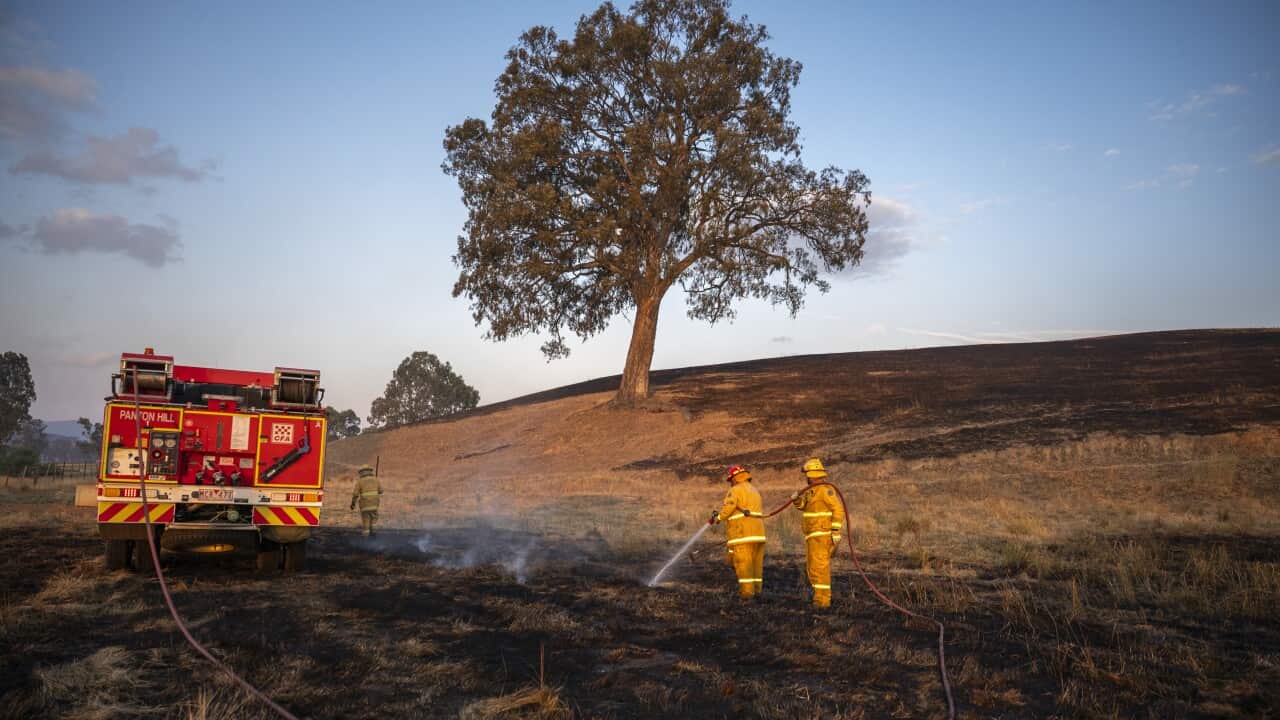

Cooler conditions are helping fire crews in Victoria contain the raging bushfires which have devastated regional communities around the state for the past six days. But with many blazes still out of control, those communities now face an overwhelming recovery and uncertain future.
Listen to Australian and world news and follow trending topics with SBS News Podcasts.
TRANSCRIPT:
Warwick O'Donnell thought he was prepared for the approaching inferno, but was still caught by surprise.
"I went in my room to pack a bag, packed my bag, and again, looked out the window to see how much time I had, and the fire was there. It was here. It was at the house was at the front on the road, and I pretty much had to jump out the window to get to the car before the fire hit the car."
As he fled, his car was engulfed on the road by a massive fireball which lasted for several hundred metres.
"It just turned into a, like a cocoon. It was just orange, yellow, red and blinding, completely blinding. Couldn't see a thing. I was almost about to pull over because I didn't want to drive into someone else. I didn't know what was going to be in front of me. And luckily, it just started to clear, it started to clear."
His home at Longwood East withstood the fire but he lost his shed, workshop and all his tools.
Shaken by his near-death experience, he says he should have left his property earlier.
It's advice that Premier Jacinta Allan continues to give residents, even as the fire threat begins to slowly ease.
"Fires continue today in many parts of the state, it's another difficult day for our emergency services, it's another difficult day for those communities that are continuing to be under fire threat. It's a reminder that we do need to continue to follow the advice of our emergency services if you are told to leave do so. "
Cooler temperatures and lighter winds are helping firefighters contain the blazes on the sixth day of Victoria's bushfire emergency.
But crews are still fighting 12 major bushfires with dozens more active, including two under emergency warnings, in the border region near Walwa, and the Otways region in the southwest.
Advice for the most damaging of the bushfires, at Longwood in central Victoria, has now been downgraded to watch and act, while blazes at Natimuk and Mt Mercer have been contained.
As authorities applaud the incredible work of Victoria's Country Fire Authority and volunteers, Emergency Management Commissioner Tim Wiebush says its resources are being boosted from interstate.
"That's been bolstered by 380 interstate resources, and they've come from almost all parts of Australia. Now, we've got Queensland, New South Wales, ACT, South Australia that are here, helping our Victorian emergency services as well."
But the damage so far has been extensive - and fatal.
A person was found dead about 100 metres from a vehicle near the town of Gobur within the Longwood fire footprint on Sunday.
More than 350 structures have been destroyed across the state - including at least 80 homes and three businesses - and there is damage to infrastructure, rail lines, vineyards and cropland, while thousands of residences remain without power.
More than 400,000 hectares of land has been razed, and an estimated 15,000 head of livestock has been lost,
Like hundreds of farmers, Terip Terip resident Vicki Gilbert was forced to abandon her animals when she evacuated her property near Longwood.
"To leave was very, very hard because I didn't want to leave my horses and my beautiful cattle. My cattle are my world, and have been for the last 20 years. So that was pretty heartbreaking decision to make, but I did leave and yeah, it's been like a roller coaster of emotions and all that type of thing, just wondering if they're okay. "
Meanwhile there are fears the impact on native wildlife could be serious.
Shelley Stafford from the Narbeview Wildlife Shelter, south of Longwood, says she has been treating animals for burns and smoke inhalation.
"Today, we got a falcon in, a ring-tailed possum. I've gone for a drive through their areas and been taking a lot of birds, deceased a wombat, deceased, burnt wildlife, a lot of wildlife deceased, The animals will come out in the next couple of weeks, then it'll get worse. It'll get worse."
The federal and Victorian governments announced yesterday a 19.5 million dollar assistance package including one-off relief payments, accommodation support and animal fodder for farmers
In addition, the state government is funding expanded mental health support, and payments of up to $52,000 dollars will be available from Friday to help people who have lost their homes.
Victorian Minister for Emergency Services, Vicki Ward:
"So if you haven't got the money that you need to start to re-establish yourself, if you don't have building or contents insurance, if you cannot return home because of the damage that is there or the destruction, if you cannot get to your home for more than seven days, you may well be eligible for this payment ."
Regional communities say impact of a disaster of this scale can last for many years, and recovery involves not just rebuilding - but preparation for future natural disasters, reviving the local economy, and providing emotional and mental health support for the entire community.
Natalie Egleton is the CEO of the not-for profit Foundation for Rural Regional Renewal.
"What we often hear after big disasters like this is that there's a recovery from the recovery. So just getting through this early phase, which will probably take, you know, in terms of those that have lost huge amounts of property, livestock, infrastructure, homes. You know that that part actually takes a really long time in itself. But recovering from that, then is another phase, just really being able to regroup, think about what next, get to grips with what happened, it can really often mean a re imagining of community and place when something this disruptive happens."
For now, authorities remain focused on confronting fire threats because, Country Fire Authority Chief Officer Jason Heffernan says - more hot weather on the way.
"It's likely to be another heating event towards the end of January, to the extent that's yet to be determined. But I guess the indication there is, you know, there's been a lot of fire in the landscape. Much work will be done between now and then to contain these fires."