
It’s been more than four years since the Taliban took control of Afghanistan - and according to human rights organisations, the situation for women and girls is only getting progressively worse - with a near-total exclusion from most public employment and education. The United Nations has warned the country is expected to remain one of the world’s largest humanitarian crises for the year ahead.
This story produced in collaboration with SBS Pashto.
Listen to Australian and world news and follow trending topics with SBS News Podcasts.
TRANSCRIPT
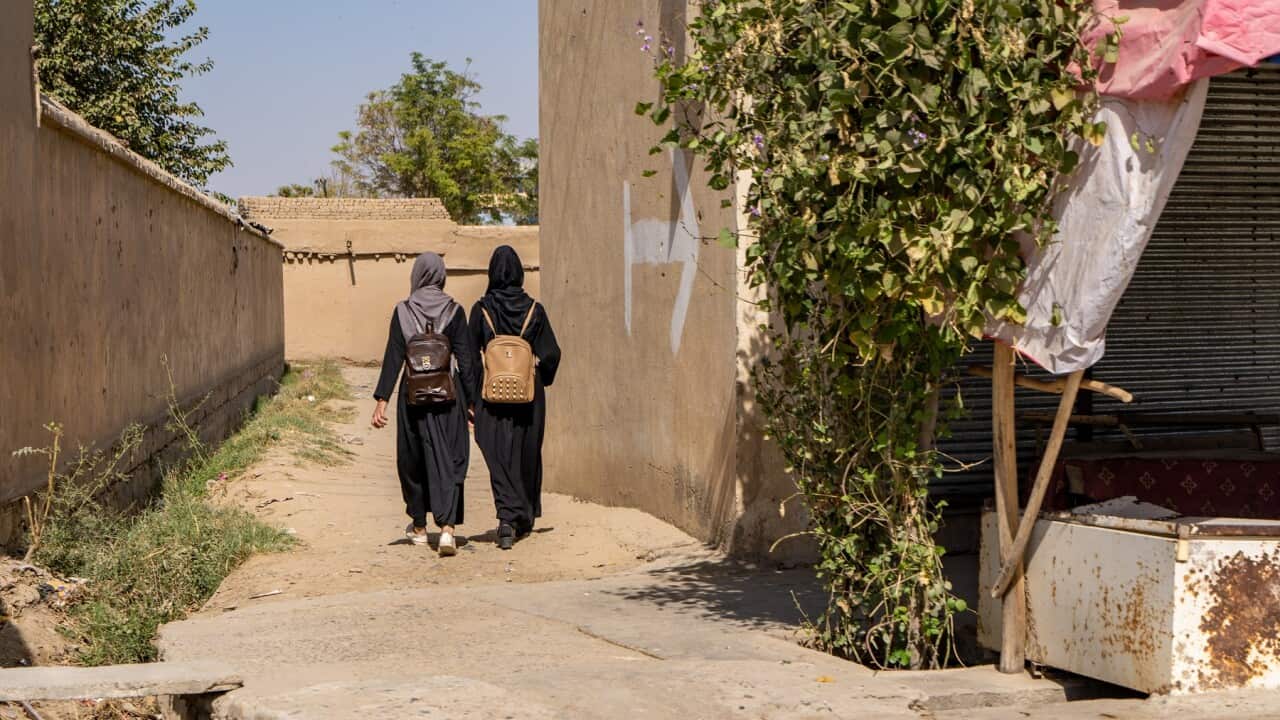
In the Taliban’s Afghanistan - there are few opportunities for women.
To financially support their families - many beg on the streets.
Roya was able to finish her university studies before the Taliban restrictions.
Now, she can’t work.
“The Taliban's restrictions didn't just take away my job. I think they took away my identity and a part of my future because I was an independent girl, standing on my own feet and making my own decisions. But unfortunately, I think I was left out of all these situations.”
Roya’s name has been changed for her safety.
She has told us, her future looks bleak.
“This situation has not only destroyed my life, but I think it has also silently destroyed the future of a generation of Afghan women.”
Afghan women experienced harsh suppression under the first Taliban rule in the 1990s.
But the Post-Taliban era from 2001 saw significant gains for women.
This is Zaki Haidari from Amnesty International Australia.
“Women could have some rights. They could go to university, we had a parliament where we had women MP, in all sort of government offices and public spaces.”
Despite social change, in 2011, Afghanistan was named the most dangerous place in the world to be a woman, contributors including high levels of violence, poor health care and poverty.
In August 2021, after 20 years of war, the US withdrew its troops and the Taliban reclaimed power.
Since then, rights for women and girls were rapidly rolled back.
This is Haidari again.
“International communities were hoping that this was a Taliban version two, that they would give women some movement and some rights, that was all false. In the past four years, women have been completely erased from public space.”
Among the restrictions - women and girls have been banned from accessing secondary education and university.
They can’t work in most sectors, and are excluded from political participation.
Women cannot travel more than 75 kilometres without a male escort and they are forbidden from speaking in public.
SBS contacted the Taliban to put specific questions to them - but received no response.
In an interview from August 2025, with SBS Pashto, Zabiullah Mujahid, a Taliban spokesperson called the ban on women and girls from accessing education a quote: "temporary decision."
“It was initially stated that this is a temporary decision and that the needs would be assessed. We want to find a way that respects our Sharia principles and also achieves consensus in society.”
Afghanistan's Ambassador to Australia in exile, Wahidulla Waissi, calling on the community to unite for:
“Greater advocacy for the girls and women of Afghanistan who are under the biggest repressive regime, we call it gender apartheid.”
According to the United Nations, an estimated 45 per cent of the population are in need of humanitarian assistance.
Of those, more than three-quarters are women and children.
Dr Nilofar Ibrahimi fled Afghanistan in 2021, after the Taliban takeover.
Having worked as a gynaecologist and then a politician – Afghanistan’s women and girls are never far from her mind.
“Women in Afghanistan are living in the darkest period of history, and the world should not remain silent in the face of this darkness. They do not have the right to leave their homes, they do not have the right to study, they do not have the right to work and they do not even have the right to speak loudly in public.”
From Canberra, Dr Ibrahimi runs the ZamZam foundation, which aims to support and empower women and girls.
The main focus – running secret schools in Afghanistan, where girls risk everything to attend classes and learn.
“Our students are approximately 60 girls, and most of them have no fathers, and a number of them were poor girls who sold bread on the streets to help their families financially.”
Mariam was in Year Five when the Taliban banned girls from secondary school.
Her name has been changed for her safety.
“I want to go to university in the future, study law and political science because I want to be able to serve Afghan girls and the Afghan people in the future.”
The Australian government has provided more than 260 million dollars in aid to Afghanistan since the Taliban takeover, which it says has been delivered with a strong focus on women and girls.
A further $50 million is allocated for this financial year.
A departmental spokesperson told SBS: 'The Australian Government is committed to supporting the people of Afghanistan who are enduring one of the world’s most protracted humanitarian crises.'
SBS understands the aid is provided in line with autonomous and UN security council sanctions, ensuring it does not directly benefit the Taliban.
With no presence in Afghanistan, Australia's funding is provided to UN agencies.
SBS understands this has included the United Nations Office for the Coordination of Humanitarian Affairs and the World Food Programme.
This is Arafat Jamal -the representative of the UNHCR in Afghanistan.
“The overall picture for women is very bleak, whether it's in education or jobs. At the same time, and I think this is really the strength of the United Nations and why the funding that Australia and others provide is so essential, is that with that funding, we do have leverage. And that leverage helps those who want to help women”.
With severe restrictions, women can still work in areas such as primary school teaching, health care and some forms of handicrafts.
Jamal again.
“For example, there's a town called Harat in the West, a beautiful town, where we have built a three-story mall for women by women. And I was quite astounded at how we were able to do this. And I spent some time with the women there and I asked them, "Well, do you not have visits from the morality to police? Do you not get harassed?" And they said, no. One, the community sees this as a tangible asset. They value it.”
According to a forecast from the United Nations, about 1.7 billion dollars is required to reach those in urgent need in Afghanistan this year -
That is a 29 per cent reduction in resources in comparison to 2025.