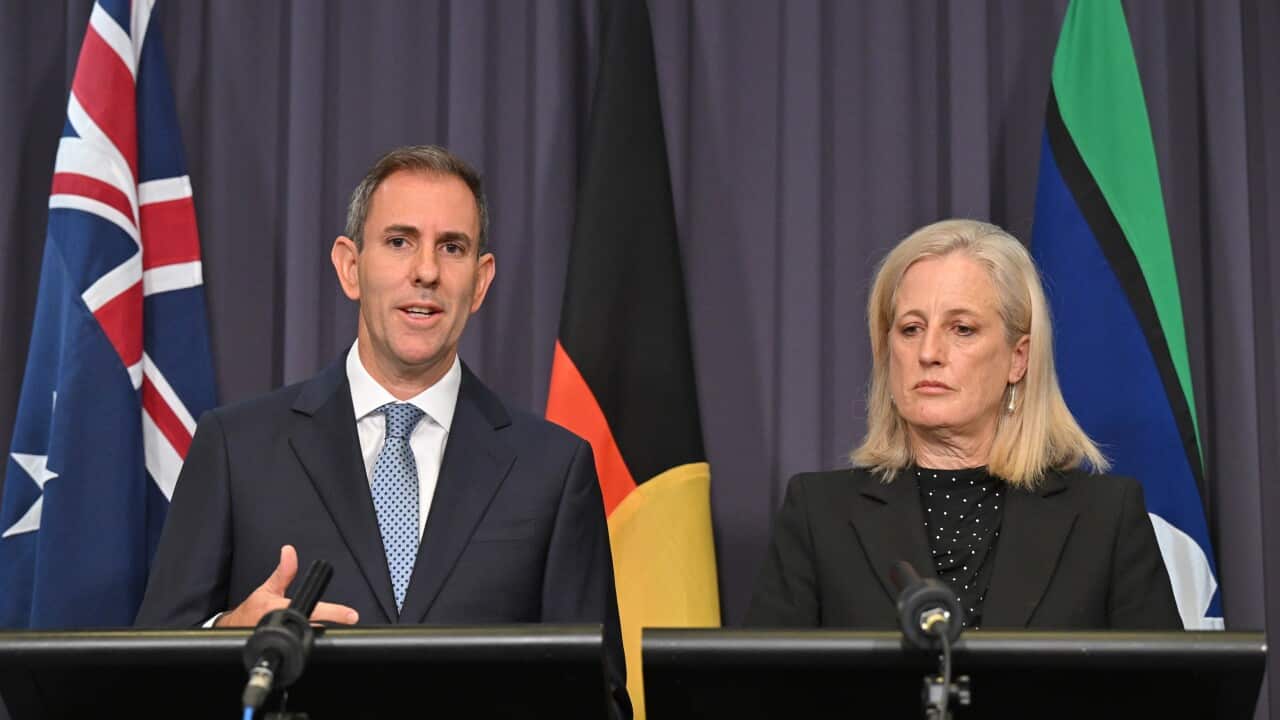

Federal Treasurer Jim Chalmers has promised to deliver his most responsible budget yet with savings expected across every portfolio. Defending possible changes to negative gearing and capital gains taxes, the government says this budget is about adapting to the uncertain circumstances facing Australia's economy.
Listen to Australian and world news, and follow trending topics with SBS News Podcasts.
TRANSCRIPT
In the midst of severe economic uncertainty, the federal government is preparing to release what Treasurer Jim Chalmers says is his most responsible budget yet.
"This will be a really responsible budget focused on resilience and reform. There'll be a productivity package, there'll be a tax reform package, and there'll also be a very substantial savings package as well."
The budget is poised to deliver higher usual gross savings, with Dr Chalmers promising more spending restraint.
Amid expectations of a small revenue boost from high inflation and commodity prices, driven by the war in the Middle East, the treasurer says all extra revenue will be saved.
"We will save more than we spend, and we will bank the upward revisions to revenue as well. We did this in December, in the mid-year update, and we will do it again in May. I understand and I appreciate that there is a lot of interest in tax reform in this budget. That's welcome, from my point of view, what you will see in the budget is, in gross terms, there will be more dollars in savings than dollars in revenue upgrades. There will also be more dollars in savings than dollars in tax reform."
Jim Chalmers played down speculation of further tax cuts, pointing to the already legislated income tax cuts of $5 a week from July 1 and a further $5 the following year.
Speaking at an Australian Chamber of Commerce and Industry event in Melbourne, Shadow Treasurer Tim Wilson says the government's tax cuts are far from solving the economic pressures faced by Australians.
"Those tax cuts didn't even come close to returning bracket creep by the time of the December budget update last year, just seven months after the last federal election, the tax cuts Labor took to the last election had already been wiped out by the treasurer's active inflation agenda. That's why, over their time in government, the Albanese government is the highest taxing government in Australian history, and why personal income taxes in particular, are at the highest level as a share of the economy ever."
Despite election promises ruling out changes to negative gearing, Dr Chalmers says the budget will focus on intergenerational pressures.
Commentary ahead of the budget has seen speculation about possible changes to capital gains tax and negative gearing.
Asked if a backflip on such changes could breach voter trust, the treasurer says the government is expected to make decisions based on its circumstances.
"Our responsibility is to calibrate the budget to the conditions, to understand and respond to the very real pressures that people are under now and in intergenerational terms as well. And you build trust by taking the right decisions for the right reasons and explaining if you've come to a different view over time, being upfront and explaining why that has been the case."
With intergenerational pressures on the agenda, speculation has also surrounded possible increases to the tax paid on distributions from family trusts.
Speaking to Seven's Sunrise, One Nation MP Barnaby Joyce argues the measures would unfairly target those who have invested over time.
"People who are prudent, who after they have paid tax on their income, invest in capital assets so their children can have a better life by handing across an asset to them because they went without, they didn't buy the new boat, they didn't go on the trip, they didn't buy the new car. They put their money away for other people who come after them. And what's happening now is Uncle Jim has run out of money. He's desperately looking for it, so he's going to the prudent people and ripping it off them."
Tim Wilson says after breaking promises regarding the stage three tax cuts, the government is losing control of the Australian economy.
"Jim Chalmers is now actively telling us he needs to break trust, to build trust so that he can target trusts. The economic follow through is real. Last financial year, eight businesses collapsed every business hour. It is clear the treasurer has lost control of the economy policy is heading in the in one direction, the Reserve Bank in the other, and Australians are being caught in between."
As well as cuts to the National Disability Insurance Scheme and private health insurance rebates, Finance Minister Katy Gallagher says every portfolio has identified savings.
"The budget will also include $2.7 billion in savings in 29-30 from reduced spending on external labour and non-wage spending like travel and property hospitality across the APS, and it'll also have significant savings from unallocated funding across a number of departments. It will also include reprioritisation within defence, which the DPM (Deputy Prime Minister) has taken you through and also an effort around reducing fraud and non-compliance across MBS (Medicare Benefits Schedule) and PBS (Pharmaceutical Benefits Scheme) and so just I guess the message I'm saying there is, and I've been asked this in the last few days, is there will be savings across every portfolio. We've looked everywhere for savings."
On cost-of-living measures, the treasurer says the budget won't include a decision to extend the fuel excise cut beyond June.
Emphasising the temporary nature of those cuts, Dr Chalmers says there is a range of contingencies in place for future cost-of-living measures.
Separate from the central budget, he says the government will provide commentary on a possible downside scenario.
"Obviously, we've got a whole range of contingencies, and we need to be prepared for any scenario, including a downside scenario, I think, in response to Leah's question before we made it clear that we will sketch out for Australians what that downside scenario could look like. And clearly, if the economy deteriorates quicker and worse than what we're anticipating in the budget, of course, we will consider our options at that point."