
Women and girls fleeing Sudan’s war are describing rape, torture and abuse, with aid workers warning the suffering runs far deeper than the cases reaching medical care. A new report from Médecins Sans Frontières says sexual violence in Darfur is widespread, and many survivors remain out of reach.
Listen to Australian and world news, and follow trending topics with SBS News Podcasts.
TRANSCRIPT
A warning, the following story contains elements that may distress some people.
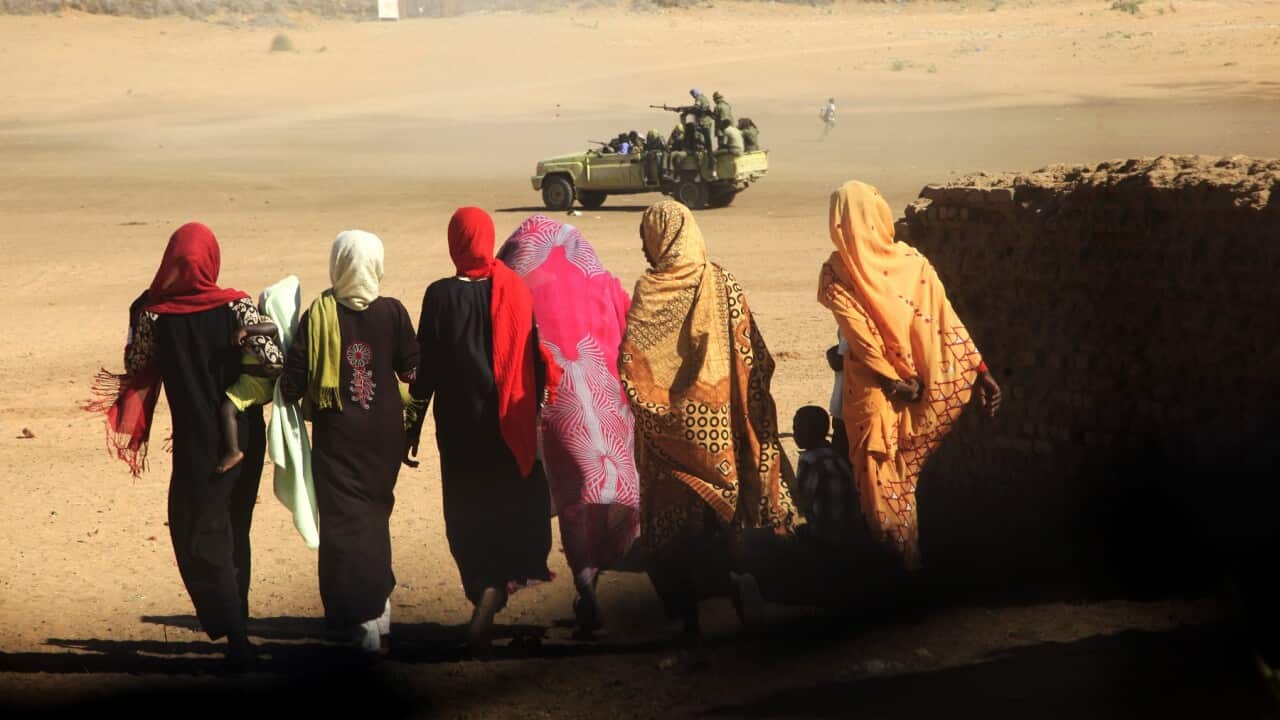
In Sudan, rape is being used as a weapon of war, where women and girls fleeing the conflict are describing rape, torture and abuse as they try to reach safety.
Medecins Sans Frontieres says sexual violence against women and girls is widespread in Darfur, and warns the cases reaching its clinics are only a fraction of what is happening on the ground.
MSF says 3,396 victims and survivors of sexual violence were treated in its supported facilities in North and South Darfur between January 2024 and November 2025.
MSF emergency coordinator Myriam Laroussi says this violence is not incidental.
She says women’s bodies are being used as part of the war.
"We are now calling (on) all the warring parties to just stop. Stop using women's bodies to fight this war. To hold the fighters accountable every time there is SGBV (sexual and gender based violence) cases. This is possible, this is a matter of will."
MSF says survivors in Darfur have described gang rape, rape at gunpoint and severe physical violence, often while trying to flee attacks or reach safety.
The organisation says women and girls made up 97 per cent of those treated in the cases it documented.
And the warning from MSF is being echoed internationally by the UN's Human Rights Chief, Volker Turk.
"I met nine women and girls, all of them survivors of sexual violence, and they told me horrific stories I've never seen so traumatised individuals. What they told me was about a gang rape in Al-Fasher. When they tried to flee, they told me about the men being taken out and killed in front of them. Then some of them were taken - older women, women, younger women, taken away, sometimes held for ransom, and gang raped for day, in some instances. The trauma that they have gone through is unspeakable. This is a weapon of warfare. Sexual violence is used as a weapon of warfare. It's a war crime, and it's a crime against humanity."
The violence is not confined to sexual assaults.
The UN human rights office says drone warfare has intensified sharply this year, and that more than 500 civilians were killed in drone strikes between the first of January and the fifteenth of March.
It says schools, markets and health facilities have all been affected.
Ms Laroussi says those attacks are now close to daily, and civilians are being hit in places that should be safe.
"We are talking about drone attacks. This is close to a daily occurrence right now and drone attacks not only on military target we are talking about school, we are talking about health structure, we are talking about markets. Civilians are being killed every day by drone attacks. We are talking about a massive displacement where 14 million people have been displaced by this war, 14 million Sudanese. Nine million inside of the country, 4/4.5 (million) outside of it. So, this situation of sexual violence is happening in this ground."
The wider humanitarian toll is also immense.
Millions of people have been displaced since the war began in April 2023, many forced to flee their homes more than once.
And for many women, reaching help can take days.
MSF says survivors have often had to travel for days to reach care in Tawila, in North Darfur, with many arriving after fleeing El Fasher and other conflict zones.
Midwife Gloria Endreo says many women only begin speaking once they are somewhere safe enough to do so.
"I happened to encounter so many cases of survivors coming to confide in me for what has happened to them during the time they flee from El Fasher to Uganda. It was a heavy moment and a difficult moment, both to me and also to the survivors who came to seek for care."
She says many women told her they had seen killings and brutality on the road to safety.
"A lot of them testified their colleagues being killed on their way while they were coming to Tawila. A lot of them witnessed brutality, physical torture, psychological torture, gang rapes and raped under gunpoint. This takes a strong energy for one to stand up and say 'ABCD has happened to me', considering the community that they live in, it is a very conservative community, where talking about sexuality is considered as a taboo."
That is also why timing matters.
MSF says many survivors arrive after the first 72 hours, which health workers consider the critical window for emergency care after rape, including treatment for injuries, prevention of infection and urgent medical support.
Ms Endreo says that delay can affect what care is possible.
"We were seeing an average of 10 to 15 women per day, who turn up. A greater percentage of it arrive after 72 hours. As healthcare practitioners, we consider the 72 hours as a golden period because we provide a lot of care within that period."
Sudan’s conflict began on 15 April 2023, when a power struggle between the Sudanese Armed Forces and the paramilitary Rapid Support Forces erupted into open fighting.
Since then, the war has spread far beyond Khartoum, devastating Darfur and other regions, and exposing civilians to ethnic violence, hunger, displacement and repeated attacks on homes, hospitals and markets.
MSF says the cases it has documented are only the visible portion of a much larger crisis.
And Ms Laroussi says one of the biggest barriers now is access to survivors, to communities and to basic care.
"The data that we have are very focused on North Darfur and South Darfur. Now, the reality we know, is far bigger than that. These data are the peak of the iceberg and still these data are huge, huge. So it really gives you the feeling of what is right now happening on the ground and all the women, the victims, we do not have access to. And that is the main issue when it comes to Sudan generally, the lack of access to the patients, to the victims of sexual violence that we are having is a real issue. We need now to have full access within Sudan, within Darfur and have the freedom to implement the programs that we want to implement in order to support the population."
International investigators are also examining what is happening in Darfur.
The ICC told the Security Council in January that it is undeniable sexual violence is being committed there, and that its Darfur investigation remains active.
Aid groups say the cases documented so far are only part of a much wider crisis, with many survivors still beyond reach.
If you or someone you know is impacted by sexual assault, call 1800RESPECT on 1800 737 732, text 0458 737 732, or visit 1800RESPECT.org.au. In an emergency, call 000.