
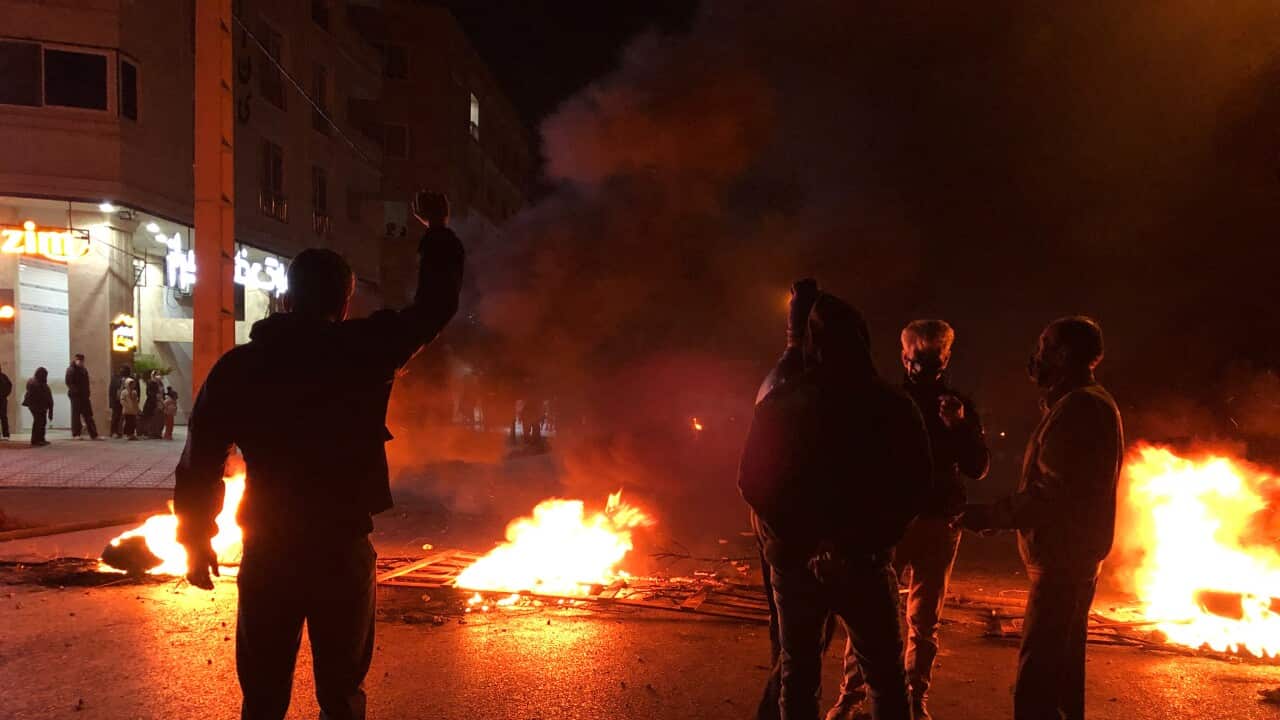

The United States has sent what President Donald Trump has described as an armada of naval and military assets into the Middle East, placing American forces on heightened alert as tensions with Iran escalate. The move comes as protests spread across Iran, internet access is cut for millions, and a sharp exchange of threats and warnings unfolds between Washington and Tehran on social media and through diplomatic channels.
Listen to Australian and world news and follow trending topics with SBS News Podcasts.
TRANSCRIPT
United States Secretary of State Marco Rubio has defended a major US military build-up in the Middle East, after Washington sent what President Donald Trump has described as an armada of naval assets into the region in readiness for possible strikes by or against Iran.
The deployment includes a U-S Navy carrier strike group and additional forces aimed at protecting American troops and allies and deterring any Iranian response.
At a Senate hearing, Republican Senator John Cornyn of Texas questioned what would follow if Iran’s Supreme Leader were removed, either as a result of a revolution or a result of US actions, as the president weighs a range of military and diplomatic options.
“The president is very concerned about what's happening to the demonstrators in Iran. And, of course, there are some estimates that as many as 30,000 Iranian demonstrators have been executed by by the regime. But I know the president's being presented with a range of options. We notice a lot of movement into the region by our navy and other authorities. But what happens if the Supreme leader is removed?"
Mr Rubio says the structure of power in Iran makes any prediction deeply uncertain.
“No one knows who would take over. Their system is divided between the supreme leader and the IRGC that responds directly to him ... I don’t think anyone can give you a simple answer as to what happens next in Iran if the supreme leader and the regime were to fall, because you’re talking about a regime that’s been in place for a very long time, and that’s going to require a lot of careful thinking.”
Mr Rubio framed the fleet of U-S forces in the region as a deterrent, not a signal of imminent attack.
"We have to have enough force and power in the region just on a baseline to defend against that possibility that at some point, as a result of something, the Iranian regime decides to strike at our troop presence in the region. ... We also have security agreements, the Defence of Israel plan, and others that require us to have a force posture in the region to defend against that. And so I think it's wise and prudent to have a force posture within the region that could respond and potentially not necessarily what's going to happen, but if necessary, preemptively prevent the attack against thousands of American servicemen and other facilities in the region and our allies."
Iran has previously warned that any attack on its territory by the United States and or Israel would result in US assets in the Gulf region being targeted.
Secretary Rubio has been using measured language, in contrast to the tone used by President Donald Trump online.
In a post on social media, the U-S president called on Iran to negotiate over its nuclear program, warning of severe consequences if it does not.
He wrote.
“Hopefully Iran will quickly ‘Come to the Table’ and negotiate a fair and equitable deal – NO NUCLEAR WEAPONS – one that is good for all parties. Time is running out, it is truly of the essence! The U.S. Navy strike group led by the carrier USS Abraham Lincoln is ready, willing, and able to rapidly fulfill its mission, with speed and violence, if necessary.”
The message raises tensions between Washington and Tehran even further, as protests and political pressure continue to mount inside Iran.
Iran’s response to Mr Trump's social media post came through its mission to the United Nations.
In a post on X, it wrote:
“Last time the US blundered into wars in Afghanistan and Iraq, it squandered over $7 trillion and lost more than 7,000 American lives. Iran stands ready for dialogue based on mutual respect and interests—BUT IF PUSHED, IT WILL DEFEND ITSELF AND RESPOND LIKE NEVER BEFORE!”
Behind the public warnings lies a deeper question - whether the United States would seek to influence or accelerate a change in Iran’s leadership if the confrontation deepens.
While leaders trade warnings and threats, daily life inside Iran is becoming increasingly isolated.
Authorities have imposed widespread internet blackouts following weeks of anti-government protests, cutting millions off from the outside world and crippling online work and communication.
Online trainer Boshra Khademlou says the shutdown has severed her from her family and her livelihood.
"Since exactly 9:30 pm on Thursday, the 18th (of the Iranian calendar month Dey), I think it's been 17 days since we've had no internet. We have no information from outside, we don't know anything about what happened in our city, in our country. We've been cut off from all the people we knew and even from people who live outside of Iran."
She compared the loss of internet access to losing a basic necessity of life.
"They took something from us that was like a vital element. People, I mean, I think a major part of people's communication is done with the internet. When you cut off the internet, it's like you took away my water, like I can't eat at all. But naturally, we have to ask those who cut off the internet to restore it."
Twenty-six-year-old language teacher Nazafarin Mosavari believes she knows why Iran has switched off the Internet.
"In my opinion there may be several reasons. One of the reasons was because the government wanted the photos and videos that people were taking during the protests not to be broadcast, and that fire of protests and the fire of people's anger and rage would calm down sooner."
Ms Mosavari says the impact has been financial as well as emotional.
“My classes were cancelled, my income stopped. I am a book translator, and when translators work they have to use dictionaries and online tools, which were not accessible, and everything was closed.”
Rights groups say the protests and subsequent crackdown have been among the deadliest since Iran’s 1979 Islamic Revolution, though casualty figures remain disputed and difficult to independently verify.