
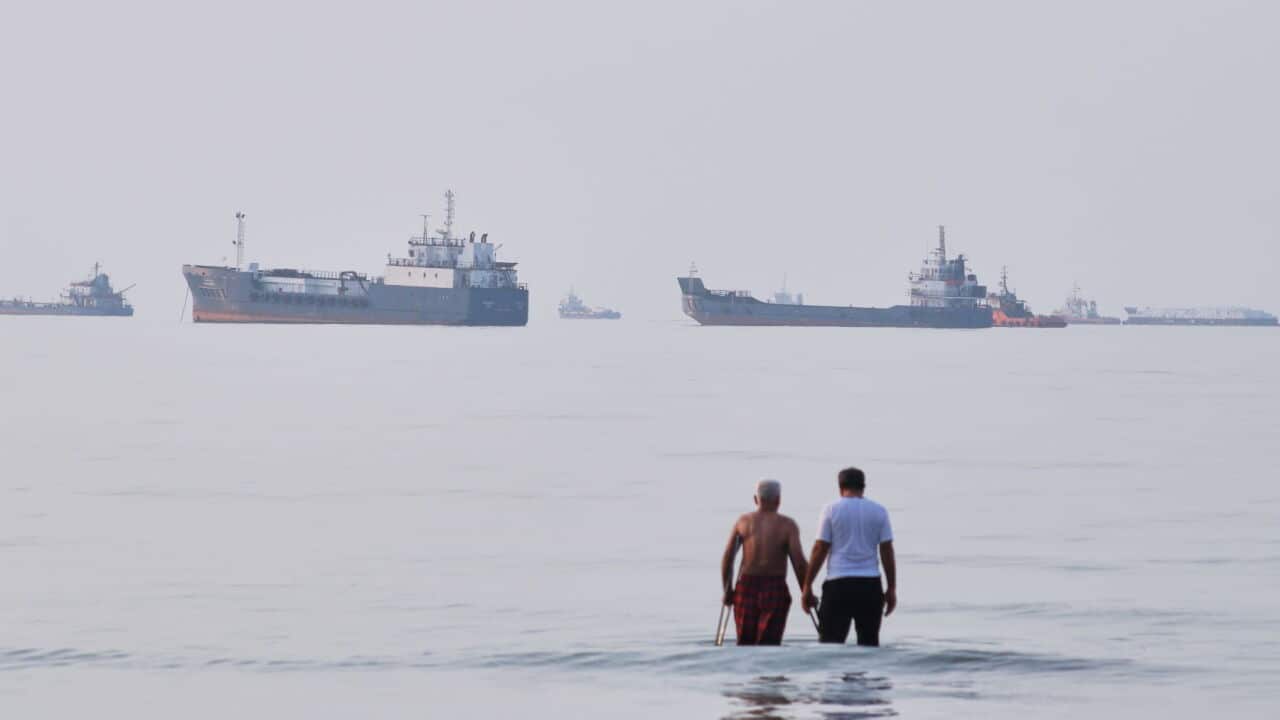

The United States has launched fresh strikes on Iran, as the battle over one of the world's busiest shipping lanes intensifies. Donald Trump has reinstated a blockade on Iranian shipping, after two oil tankers were hit in the Strait of Hormuz. Iran is warning it will not allow the United States to take control of the strategic waterway.
Listen to Australian and world news, and follow trending topics with SBS News Podcasts.
TRANSCRIPT:
The United States has launched a third straight night of strikes on Iran, targeting military sites linked to the Strait of Hormuz.
The latest escalation comes after two Emirati oil tankers were struck while transiting the strategic waterway, killing one crew member and injuring eight others.
President Donald Trump says the United States is consequently reinstating its blockade on Iranian shipping.
"We're controlling the Strait. We're putting the blockade back. And it's a blockade. Not for anybody but Iran. In other words, anybody doing business with Iran can't go through. Everyone else will be able to go through it. So it's a blockade. A very strong blockade. And the blockade was probably more effective even than hitting them. But I think the combination is a thing that really does it.”
Trump has also declared the US would collect a 20 percent toll on all cargo shipped through the strategic strait, calling it a matter of fairness.
But Iranian Foreign Minister Abbas Araqchi has pushed back, writing on X that Tehran was the guardian of the strait and would remain so forever.
The latest hostilities followed Iran's announcement at the weekend that it was closing the vital waterway.
The Strait of Hormuz links the Persian Gulf to the Arabian Sea and carries around a fifth of the world's oil and gas supplies, and before the conflict began in February, more than 15 million barrels of oil and gas passed through the Strait every day.
A spokesperson for Iran’s top joint military command, Ebrahim Zolfaqari, says US intervention is threatening shipping and increasing the risk of a wider regional war.
“The repeated adventurism and hostile actions by the United States to interfere in the management of the Strait of Hormuz have seriously endangered regional security, international trade, and the passage of oil tankers and commercial vessels, and unfortunately the cooperation of some countries in the region has also increased the risk of the war spreading throughout the region.”
The renewed fighting has cast fresh doubt over the memorandum of understanding signed last month, which was intended to halt the conflict and reopen the Strait while the two sides negotiated a broader peace agreement.
Washington and Tehran have each accused the other of breaching the deal.
Middle East analyst Thomas Juneau says the ceasefire was always likely to unravel.
"Initially, the memorandum of understanding between the U.S. and Iran had two objectives: to stop the fighting and to lead to the reopening of the Strait of Hormuz. The challenge, however, is that because of the vagueness of the terms of the MOU, it was largely inevitable that there would be disagreements between the two sides, that there would be disagreements on the interpretation of the vague terms, and that what was meant to be a ceasefire would, in fact, not lead to a cessation of the violence. That was predictable, and that is pretty much exactly what we've seen since then."
At the United Nations, U.S. Deputy Ambassador Tammy Bruce has said that any further attacks on commercial shipping would draw a military response.
"If Iran shoots at ships, we will immediately respond with force. U.S. military operations are a response to these threats, in self-defense and defense of others The United States will continue to stand with our partners in the region. Make no mistake, this is not a talking point. It is a commitment that we will back, and are backing - with action."
The United Nations itself is urging restraint.
The United Nations' shipping agency has rejected Trump's proposal to charge a toll, saying it opposes any fees for straits used in international navigation and that there is no legal basis for introducing mandatory tolls on strait transits.
Spokesperson Stephane Dujarric says the UN wants to see a return to diplomacy.
"Mr Guterres calls on the parties to exercise maximum restraint, avoid further escalatory action and take immediate steps to, in fact, de-escalate. The secretary-general reiterates that a return to full-scale hostilities would have catastrophic consequences for the people of the region, for international peace and security, and for the global economy."