
Fifteen years after a devastating earthquake in New Zealand left 185 people dead, scientists are on guard, ready to spot an impending disaster. In the control rooms at Earth Sciences New Zealand headquarters, seismologists are continuously analysing data from a network of 700 detectors looking for warning signs of an imminent quake.
Listen to Australian and world news and follow trending topics with SBS News Podcasts.
TRANSCRIPT
Perhaps in the eyes of some, Matt Gerstenberger has a stressful job.
He is the man leading a team of seismologists as they create computer models of previous Richter Scale 7 and 8 earthquake events in New Zealand and add near real-time analysis to determine seismic patterns and better forecast future large earthquakes.
He's in no doubt that it’s a case of not if, but when the next catastrophe will strike.
“It’s likely that we’ll see something like that again in the future; that we will see over the next hundred years maybe multiple magnitude sevens that occur kind of within New Zealand land mass. It’s possible that we’ll see something bigger offshore. The likelihood of that is much lower.”
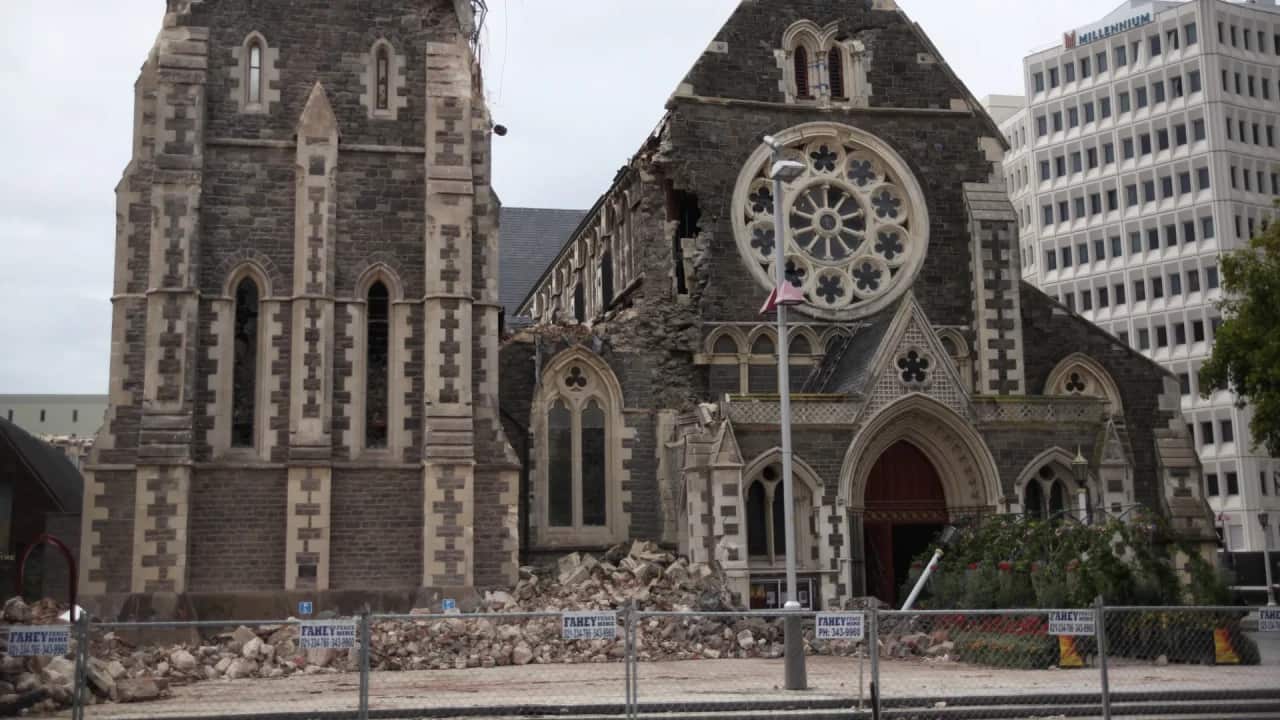
Christchurch was the scene of New Zealand’s last major earthquake in February 2011, that left 185 people dead.
A number of buildings, including the city’s Anglican cathedral consecrated in 1881, suffered serious damage in the 6.3 magnitude quake, and its towering spires and famous rose window collapsed.
Those killed are commemorated on a memorial - each victim’s name faithfully etched in stone for visitors to see and loved ones to remember.
Peter Beck was Dean of the cathedral at the time, inside the complex as masonry crashed around him, burying one woman alive and injuring others.
“It has to be one of sadness and pain. It was a painful day and it changed my life and our lives here in the city forever. Did I ever get over it? No I don’t think so.”
After overcoming a government funding hiatus, a phased rebuilding plan has now been agreed for the landmark cathedral, with 2030 set as the target date for its doors to reopen to 700 worshippers.
Quake City spokesman Stephen Pennruscoe says they are considering how to honour those lost - and preparing for the future.
“One of the key stories here that we give people is how to be more prepared for earthquakes and I feel that that is creating a much more resilient city.”
The country itself is also preparing for the worst.
Fifteen years on, New Zealand has developed a comprehensive monitoring system.
Every minute of every day a network of 700 detectors stands guard, monitoring variations in New Zealand’s seismic activity.
The listening stations are sited on bush-covered hilltops and along the shores of volcanic lakes, sensitive equipment that is precisely calibrated by technicians to warn of imminent danger.
The signals are monitored in the Earth Sciences New Zealand emergency control centre outside the capital Wellington.
Mike Ross is the Geohazard Analyst Shift Leader at Earth Sciences New Zealand, and says while there have been more than 158,000 thousand quakes in New Zealand or off its coast since 2018, up to 150 a year are large enough to be felt by humans.
“If it’s a big event, that’s threatening and we have to assess that threat, determine how big it is, where it is, possible consequences - if there’s a tsunami threat etcetera.”
Professor Tom Wilson has studied the quake’s impact on the population and says a mature national conversation is needed on an acceptable level of future risk.
“The blunt reality is there’s going to be trade offs that we make. We can’t be totally safe on everything. We do need a degree of risk in our lives and managing that risk and tolerating it and accepting it is part of what makes us human.”
Back in Christchurch, Brenden Winder is still raising the alarm.
He helped manage council relief efforts in the destroyed heart of Christchurch for more than 800 days.
And he feels current policy focuses too much on recovery and not enough on preparedness and resilience.
“That model needs to be flipped. We get far more return on investment by spending money, by reducing the impacts of these events, by preparing the community for them. The money saved afterwards is a factor between six and 10 to one.”