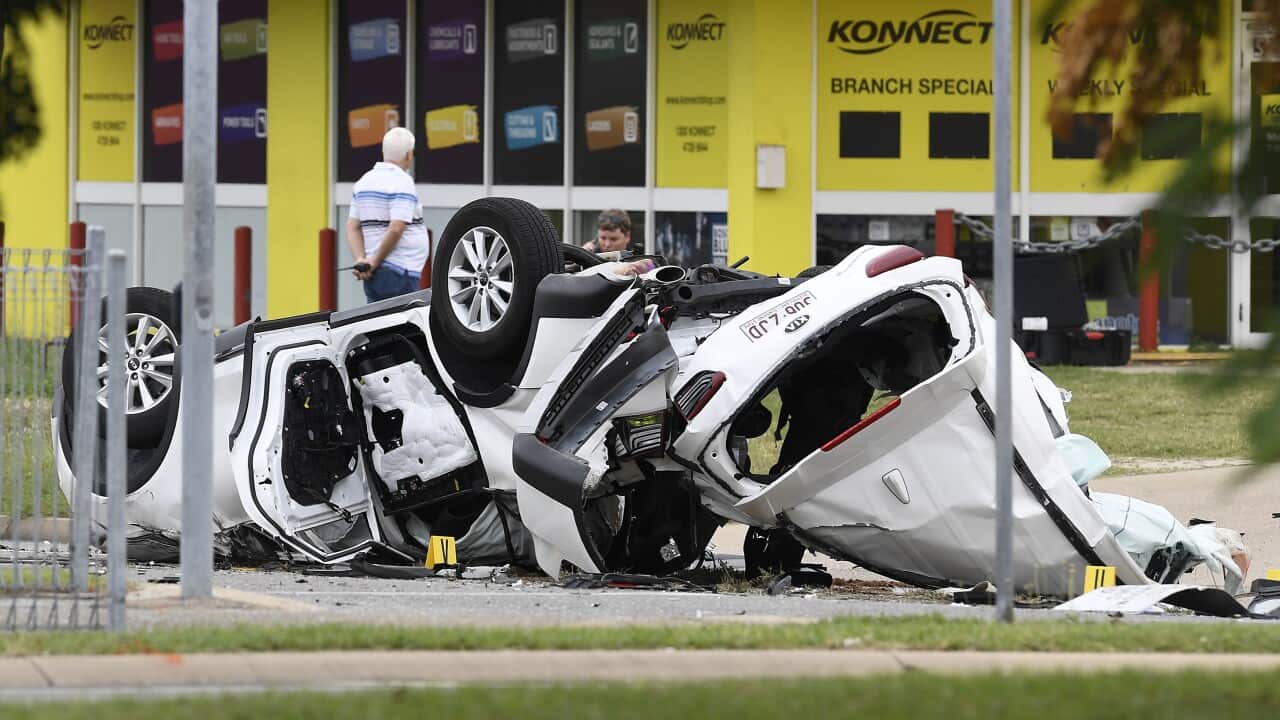

Australia’s road toll is rising, and new warnings suggest the country is drifting away from its goal of halving deaths by 2030. More than thirteen hundred people were killed on Australian roads last year, with early 2026 figures showing little sign of improvement. Industry leaders and victim advocates are calling for urgent action, from safer street design to changes in driver behaviour, as families continue to live with the consequences of road trauma every day.
Listen to Australian and world news and follow trending topics with SBS News Podcasts.
TRANSCRIPT
“My beautiful daughter, all her life had been taken away, because of the action of someone who was acting irresponsibly, because they were a distracted truck driver. The grief becomes profound, it stays with you for the rest of your life. For many people, they felt hard to get up in the, in the morning, let alone to actually go back to their their normal routine routines and the like.”
Behind every road death is a family like Mr Peter Frazer’s.
Fourteen years ago, on the 15th of February 2012, his 23-year-old daughter, Sarah, was killed on the Hume Highway when a truck ploughed into her broken-down car.
He has since founded the Safer Australian Roads and Highways Group also known as the SARAH Group in memory of his daughter which aims to increase road safety in Australia.
But despite advances in vehicle technology and enforcement, Australia’s road toll is climbing again.
Official figures show annual fatalities have risen steadily since 2020, with an increase of more than 13 per cent in pedestrian deaths, and cyclist fatalities have also gone up.
Ehssan Veiszadeh is chief executive of Roads Australia.
“So in 2025 we had 1314 people die on our roads. Tragically, that was up from 1292 in 2024 and the rate has been steadily going up for the last five years. And these are not, of course, numbers and statistics. These are people, right? Friends, family members, children who never made it home from an ordinary trip to the shops, at school or work.”
A new report from Roads Australia finds a growing proportion of deaths now occur on high-capacity urban roads and local streets - places where communities expect lower speeds and safer conditions than on highways.
Mr Veiszadeh says as cities become denser and vehicles larger, street design is playing an increasingly critical role, and that simple cost-effective measures save lives.
“The humble wombat crossing. You know, this raised crossing that effectively, you know, brings a standard zebra crossing on a raised platform, which is normally a similar height to an existing footpath or a curve. You know, that raises the visibility of people walking, uh, whether it's children or elderly people or others, um, and they've proven to work. You know, they've reduced the fatal and serious crashes by, you know, 67% and reduced total crashes by 61% where they've been implemented. “
Behaviour behind the wheel remains a critical factor.
National road safety data consistently shows speeding, distraction and impairment among the leading contributors to fatal crashes.
Research also highlights how small reductions in speed dramatically improve survival outcomes for pedestrians.
Mr Veiszzadeh explains.
“If a pedestrian is struck at 50 kilometres an hour, there's a 90% chance of death. At 40 kilometres an hour, there's a 40% chance of death, and at 30 kilometres an hour, that's reduced to just 10% chance of death, and that's why you see in those urban environments where we think there should be a focus more on the place and more on the people and the pedestrians than the movement of cars, that reducing those speed limits where it makes sense is absolutely a must.”
For Peter Frazer, road safety is not a policy debate but a lived reality - a nightmare for any parent to live through.
“What's happening is that selfishness that we're seeing in the way that people drive, speeding, drink driving, not giving a care about the person on the road ahead, putting their lives in danger because of those actions, we've seen a big increase in that and indeed, of course, the last five years, the statistics themselves even show that, you know, each year, it's increasing the number of people are being killed.”
Mr Frazer's daughter, Sarah, did not die alone that fateful day 14 years ago.
Geoffrey Clark, a 40-year-old tow-truck driver who had stopped to help Ms Frazer was also killed when the driver who was distracted crashed into them.
The breakdown lane they were in was just one and a half metres wide.
Peter Khoury is the NRMA's spokesman.
“This highly tragic event which occurred on the Hume Highway, where Sarah lost her life, where one of our contractors also lost their life, they just reinforced the risk associated with road safety, and particularly breakdown safety. There was, there was absolutely no reason for those lives that have been lost on that day, and indeed, there's no reason why anyone should lose their lives when they're on the side of the road or and that is one of the many challenges that we face across the road network today, and trying to reduce the road toll.”
Mr Khoury believes Australia’s rising road toll cannot be solved with a single measure, and calls for deeper investigations into crashes, saying understanding every contributing factor could help governments invest in the right solutions.
He says lowering speed limits and installing more cameras on their own won’t solve the problem.
“If the solution was, let's just cut speed limits everywhere and put up cameras, then that's what we should do. But we've seen jurisdictions try that. It hasn't worked, and so that is a frustrating thing for policymakers and for any organisation that is interested in road safety, like the NRMA. So what? Where does that leave us? What that means is we need to do more of everything and particularly focus on the things that we know work.”
And among those fatalities are e-bike riders.
“They're being used illegally. They're being used unsafely. They're being used by children who have limited understanding of road rules and road safety measures. And so it's no surprise that we're seeing an increase in deaths and injuries across the country. We need to do more.”
With fatalities rising rather than falling, advocates warn progress will depend not only on government policy, but on everyday choices we all make behind the wheel.
For Mr Frazer, that message is deeply personal.
“Everyone has a right to get home safe to their loved ones every day without exception and that relies on us all actively looking after those on the road ahead.”