
Collective grief is a common experience, following a mass tragedy like the one Australia bore witness to at Bondi Beach. Fifteen people were killed in the terror attack, and ever since there's been an outpouring of grief across Australia and around the world, especially among Jewish communities who were targeted in the attack. Rituals play an important role in the Jewish community, and experts say they are an essential part of the grieving process.
Listen to Australian and world news, and follow trending topics with SBS News Podcasts.
TRANSCRIPT
Flowers, tears and silence at Bondi Beach.
A shared sense of loss felt across Australia and around the world, especially among Jewish communities.
CARA: "For Jewish people, every single person who has been murdered here is like our brother, like our sister, like our mother, like our father."
RABBI YOSSI: "And it's been uplifting seeing so many people come down here, different faiths, backgrounds, and that's the message: that we're one united humanity. It's not about our faith, it's not about the colour of our skin or our backgrounds."
MEG: "We just wanted to come down to pay our respects. It's a place where we always really felt like we were safe. And there's a real sense of community down here, and we just wanted to be with everyone to do that."
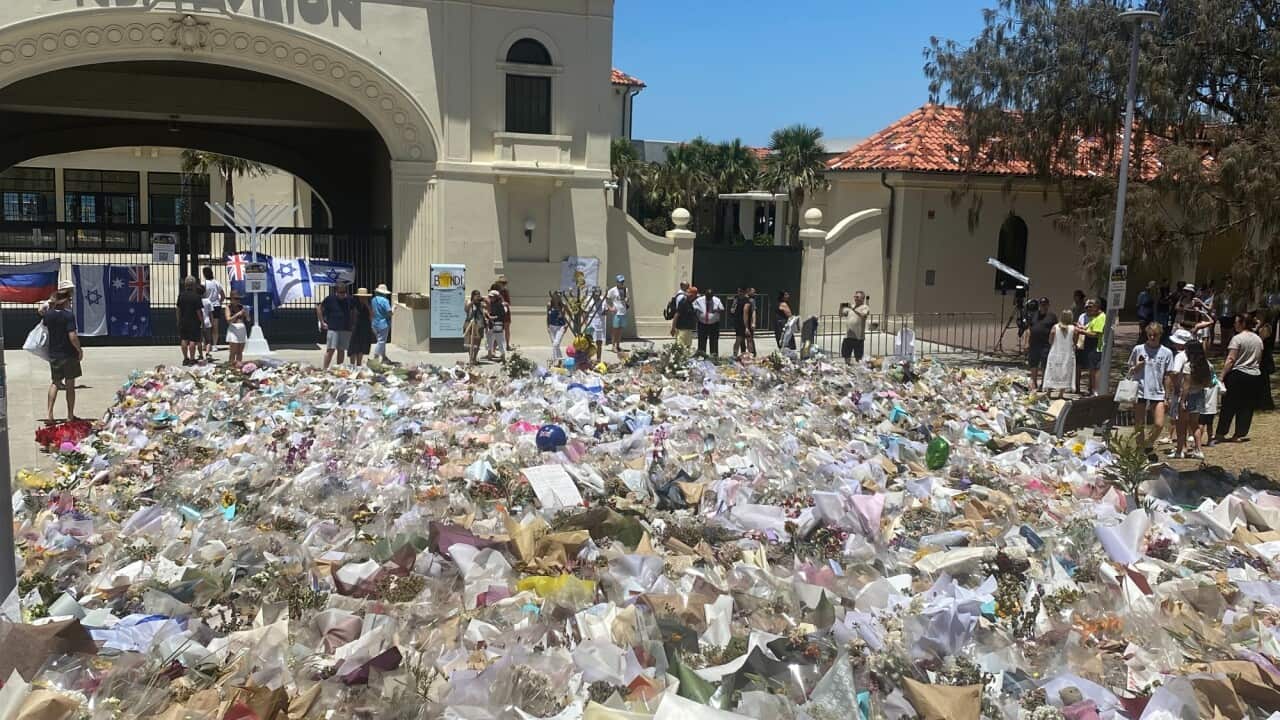
These are some of the hundreds of people who continue to flock to a flower memorial outside Bondi Pavilion.
The tribute follows a terror attack where 15 people were killed while celebrating a Hanukkah festival.
It's just one example of collective grief following the incident.
But what is collective grief and how do people move through it?
Grief Australia's chief executive, Christopher Hall, explains.
"Collective grief is that experience which is shared where people join with others to both have their own experience of grief recognised and I guess validated, as well as a desire to come together. And sometimes it is a desire to restore a sense of safety, of connection. Sometimes that coming together can also be an act of defiance, particularly in the context of an event such as terrorism."
Loss and grief have been most acutely felt by the Jewish community targeted in this antisemitic attack.
The Prime Minister says arrangements are being made for a day of national mourning for the Jewish community in the new year - while one week on from the attack, there is a National Day of Reflection for all Australians to honour the victims.
Rabbi George Mordecai is from the Emanuel Synagogue in Woollahra.
He says the Jewish community are not monolithic and while they are grieving collectively, people are expressing their grief in a variety of ways.
"Of course, there's a lot of anger, there's a lot of sadness, fear. But also, I will say this, and I've experienced it myself, there's been such an outpouring of warmth and support from the greater Australian community. And it's really warmed my heart. I'd be walking on the street and people see my kippah on my head and they'd come up to me and say, 'We're with you'. And a lot of my congregants have also had similar experiences as well with my colleagues. So it's a mixture, it's a plethora of different sorts of emotions in our community right now."
In an attempt to rebuild a sense of safety and hope, Rabbi Mordecai is hosting a listening circle this weekend, where Jewish people and others can gather to share their grief.
"The way that we sort of organise ourselves in these listening circle spaces is that the person speaking will hold a ritual object. And while they're holding that object, it's their time, it's their space. And we, everybody else in the circle have to engage or we engage in active listening. We're not allowed to interrupt that person while that person is speaking and expressing their grief. And we are bearing witness to their grief and listening even across difference, even when it's difficult for us to hear maybe."
Christopher Hall says rituals are an important aspect of grief because they offer a sense of purpose and agency.
"I often describe grief as love with nowhere to go. It's this energy that seeks expression. And we might do that in conversations with others. We might do that through activism. We may do that through charitable work. We saw people lining up to donate blood. So this kind of legacy making is really important. It's a way of keeping also the deceased present in the world."
But it's not just the Jewish community in Bondi reeling after this tragic event - Jewish communities across Australia and around the world are feeling this loss profoundly.
A Hanukkah celebration in London on Tuesday evening turned into a vigil for victims of the Bondi attack, while a celebration in Jerusalem united Jewish organisations to honour the victims.
Professor Nicole Sadler is the CEO of Phoenix Australia - a centre for post-traumatic mental health.
She says traumatic events can create layers of grief across multiple communities.
"I think that there is a general sense of collectively understanding that there has been a loss here. But also it's a grief around I think that sense of safety and security. There's a grief around the loss of what Bondi has meant to them, that that's a place that they've associated with a place of going to have a great time or leisure. And people have also spoken about the impact of this happening, the beginning of a religious celebration where people have come together as a community to celebrate. All of that can contribute to a sense of grief or loss, and we might think about those in collective ways."
Professor Sadler adds that mass traumatic events disrupt communities' sense of safety.
"So it starts to look at how a community might function. And those structures, which we know are so important for recovery from difficult experiences such as this, they're disrupted. So the things that should be bringing us together and helping us to get a sense of safety and security back and a sense of normalcy. Those things are harder to establish or reestablish because they're the things, which have also been disrupted or undermined by such a large-scale event."
In an effort to regain that sense of normalcy, others gathered for a commemorative swim on Wednesday morning to honour the victims and express solidarity with the Jewish community.
Courtney Moran - from Bondi Penguins swim club - was one of the organisers of the event.
She says the swim groups were initially unsure whether to run the session out of respect for the Jewish community, but decided it was a respectful way to acknowledge what happened and to recognise the Jewish community's loss.
"We really want to reclaim the beach and start to move forward and recreate those memories of Bondi Beach being a safe and happy place. And I think ritual gives grief a bit of structure, especially when the words fall short. So after a traumatic event, people often don't know what to do with their feelings. So I think the swim can be a simple embodied ritual, entering the water together, pausing, acknowledging what happened and returning. And I think the ocean, it holds a lot of people without judgment. It allows emotions to be felt physically through breath, movement, cold and stillness rather than kind of being explained."
In Judaism, the initial seven-day period of bereavement is known as shiva and involves a host of rituals while mourners remain at home to grieve the deceased - including reciting of the Kaddish, as well as a meal prepared for mourners upon their return from the cemetery.
Rabbi Yossi Friedman says the typical custom in Judaism is to lay a stone in honour of the deceased - but says the Bondi flower memorial sends an important message of solidarity and support from non-Jewish Australians.
"What we typically lay is a stone - a stone that represents permanence - it doesn't wilter or rot, which symbolises the legacy of our loved one - that they have made a permanent impact upon us and upon the world. But beautiful that we have here, we have stones, we have flowers. It's all gorgeous, where there are beautiful signs, each one personalised by people who have really been touched by this tragedy."
Rabbi Mordecai says it's important that grief isn't politicised.
"And I think that we are very much in the middle of it right now. And I do want to say that it's really troubling for me when I see our grief being politicised right now in the general community for us right now. The seven days following a funeral of a loved one in Jewish tradition is a very holy time. We call it shiva where we just tend to the mourners and really the whole community is in that shiva in that mourning space right now. And we need to be present to the community in all of its grief without politicising anything right now. I think it's really important. It's important message. Let us be in our grief."
No matter the ritual, he hopes all Australians can engage in dialogue, listen and grieve together.
"Let Australia grieve too, not just the Jewish community together. We can then, after that, engage in deeper relational building. And I am positive that if we do that, good things will come out of it. Healing will come and it'll be productive and positive for Australian society. We live in a great country and we have to remember that even though this has been a dark moment in our country's history, I have no doubt that we will get beyond this as Jews - and also the greater community as well."