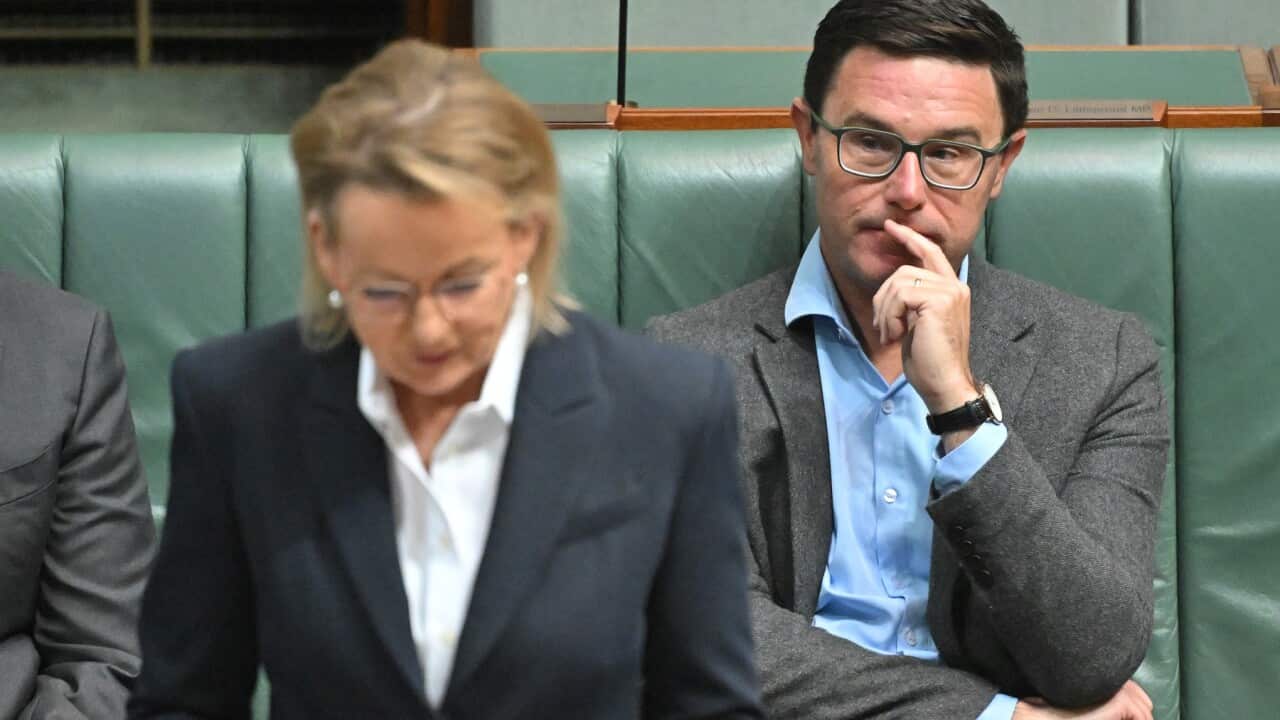

The Coalition’s unity has reached a new low following what's being described as a 'terminal' breakdown between key frontbenchers, marking their third significant split since the 2025 election. While leadership maintains that the door remains open for future cooperation, analysts suggest the in-fighting is further alienating a public that is increasingly turning toward minor parties and independent alternatives.
Listen to Australian and world news and follow trending topics with SBS News Podcasts.
TRANSCRIPT
“The door between a Coalition, between our two parties, from my point of view, is still open. But I'm not looking at that door. I'm looking at the Australian people, because they're counting on us to deliver for them. They're counting on us to work hard for them, and that's what I will do every single day.”
That was Opposition Leader Sussan Ley insisting the Coalition remains viable, despite the Nationals officially splitting from the Liberal Party this week.
With whispers of potential challenges from Andrew Hastie and Angus Taylor, she is dismissing concerns of a leadership spill.
"I am absolutely confident in the leadership that I have delivered, the leadership I will deliver and the strength of effort that my party and I are making every single day on behalf of the people. The millions of Australians who sent us to Canberra. But what is really going on here is the business of opposition. And it matters. And the government has made mistakes and will continue to make mistakes.”
Now, the National Party Leader David Littleproud is countering Ms Ley's friendly rhetoric, saying the alliance has collapsed after she cancelled joint party meetings and ignored his party's concerns over the new legislation.
He put the blame solely on Ms Ley's leadership, claiming that his party acted with transparency and integrity while defending their right to vote according to their values.
“When she accepted those resignations, and effectively accepted, therefore accepting the resignations of our entire ministry, that disbanded the coalition, and we could not come back and serve until those three were reinstated, that's that's where we were. The leadership of the Liberal Party is a matter for them, not for me.”
Dr Jill Sheppard is senior lecturer in the School of Politics and International Relations at the Australian National University.
She says following previous splits and re-unifications of the Coalition, there are two things are different about this split.
One is it's the second serious split, but the third notional split that's come since the election, which was only in May last year.
Secondly, she notes that while Ms Ley’s popularity has failed to rebound since the last two splits, One Nation’s support is surging.
“It's almost impossible for the Liberals to form government by themselves. It's happened a couple of times in history and under really unusual circumstances. On the other hand, I think it's really impossible for the Nats to run alone. They don't have the funding sources of the Liberal Party. They have a viable brand in the bush, but they don't really have a viable brand in the city.”
As far as Liberal party cohesion goes, deputy leader Ted O'Brien is backing Ms Ley's leadership, but others like Senator Jacinta Price are using the opportunity to re-hash old wounds.
Ms Price told Sky News that there has been a terminal breakdown in her relationship with Ms Ley, following the formal collapse of the Coalition.
This rift dates back to 2025, when Ms. Price was removed from the frontbench after making controversial remarks about Indian migrants.
Senator Price argues the Liberals made a tactical error by backing the government's rushed legislation - leaving the question of leadership in the hands of a fractured party room.
“I think I made it very clear that obviously the leader had lost trust in me, lost faith in me, and I suppose I felt the same at that time. I don't feel like things have improved to that effect....and this is a decision for the party room ultimately.”
So with all this chaos in the Coalition, what does the future hold for major party politics in a Westminster democracy?
Dr Sheppard compares the current instability in the Coalition with the insurgent rise of the UK’s Reform and Green parties, noting a growing worldwide disillusionment with major party politics.
“I think two things are happening at once. One is that voters, on the whole are becoming a little bit more progressive, and so we're seeing a lot of governments become more more progressive try to capture that voter base. On the other hand, there are lots of voters who feel like they're getting left behind by things like globalization, free trade, and the liberalization of, you know, domestic industries. And it's really hard for governments to find a line that can speak to both of those groups of voters. And I think that's why we're seeing rises in support of parties like reform one nation.”
She says voters appreciate smaller parties that are a bit more nimble, who are able to speak to very contemporary concerns in a relatable way.
“Major parties, by definition, are very big, and they're very hard to change trajectory. If they can see voters going off in another direction, they find it really difficult to chase them. So what we end up with are major parties that sometimes feel like they are out of date, like they are relics from a past era.”
Dr Sheppard suggests this fragmentation reflects a broader shift in how voters worldwide are engaging with power.
She argues that as voters abandon traditional party memberships, they are instead pouring their energy into grassroots activism and union movements, things that are political in nature, but not necessarily party political.
They want to find the representation the major parties have failed to provide.
“I think that has been a warning bell that the political parties here have ignored, because we have compulsory voting. Even if we're not joining those parties, we're still turning up to vote. And for our major parties, that's been good enough, and I think we're now seeing the consequence of that.”
As for the prospect of a new alliance between One Nation and the Nationals, Dr Sheppard says that while the political landscape is shifting, One Nation currently lacks the formal party infrastructure required to sustain a governing coalition.
“One Nation still struggles to win seats in the House of Representatives, even with preferential voting. It's a little bit easier here than it is, to say in the UK or the US, but it's still an almighty challenge. Where they do benefit in Australia is by being able to win seats in the Senate, and that means that you have a visible presence. Now, Reform in the UK is a little bit different, because even though they have huge support among voters at the moment, they only have four seats in the House of Commons there.”