
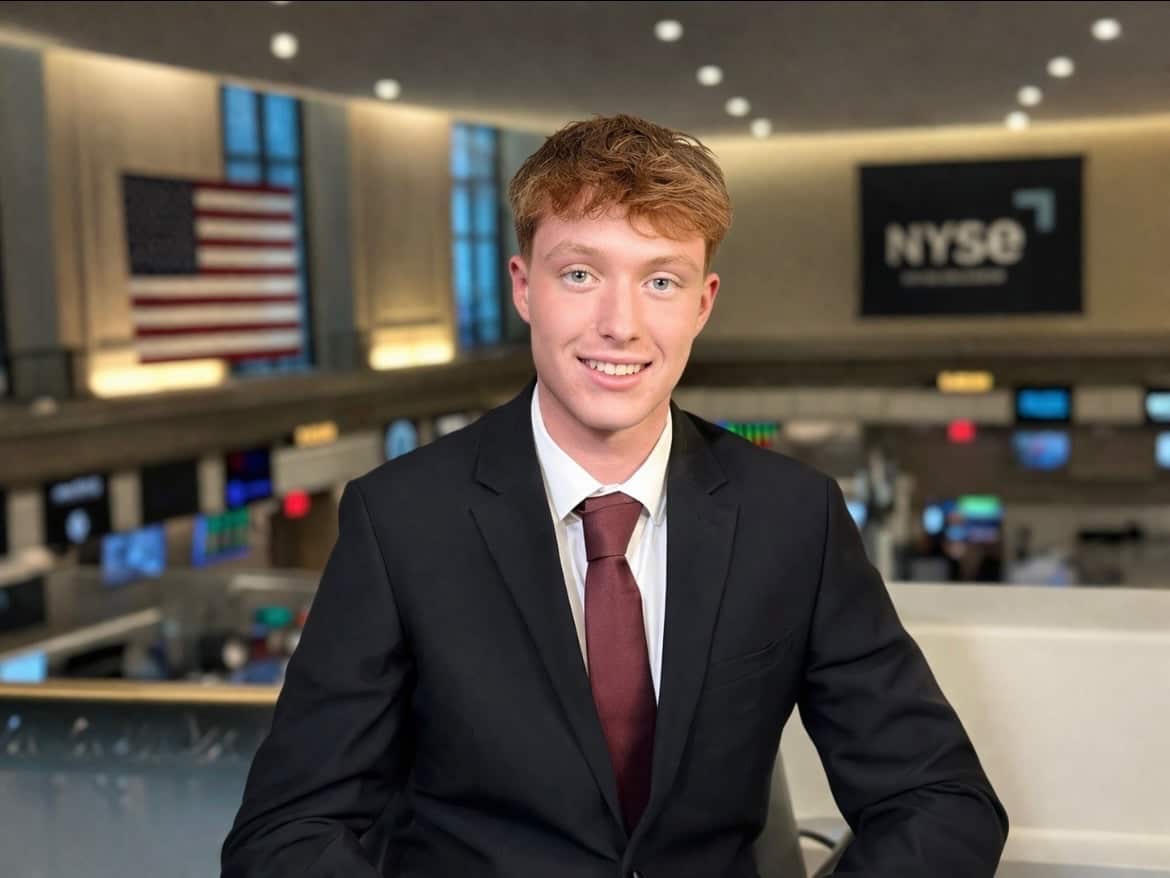
Eighteen-year-old Jackson Semenas spends most evenings betting in markets Australians are officially barred from accessing.
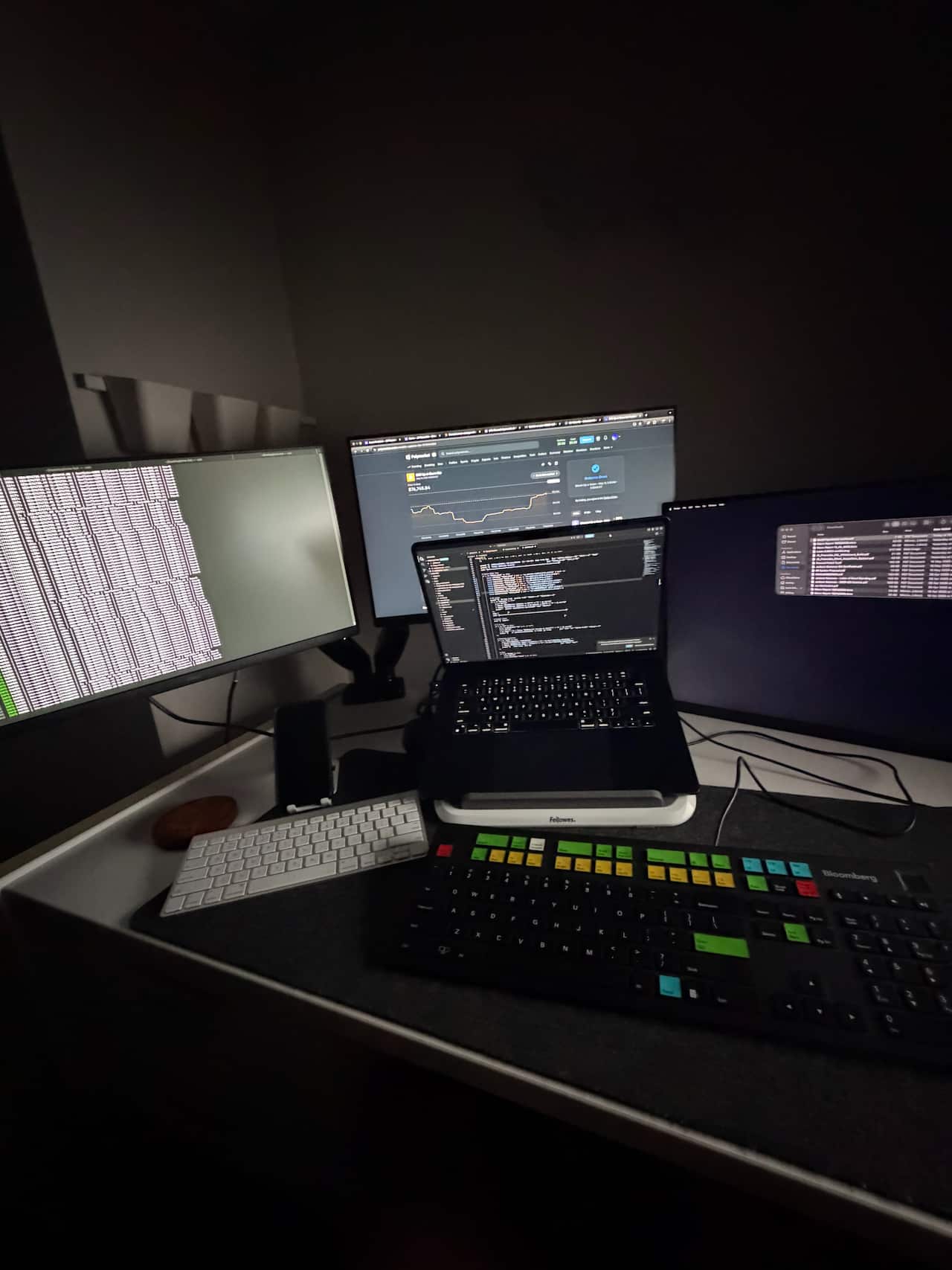
From a small desk in the corner of his Canberra bedroom, illuminated by streams of flickering code, the recent high school graduate runs an automated trading system across offshore prediction markets — a rapidly expanding online industry where users can wager on almost any future event.
Available contracts include anything from tomorrow's weather to high-stakes elections — or, in Semenas' case, the movement of financial markets.
He began building economic models — those used to analyse market trends — at 14 after becoming absorbed in maths and macroeconomics at school.
That interest has now evolved into a complex, three-tier portfolio of trading systems. Together, they generate the equivalent of a full-time income, which he describes as "above average".
News that makes sense
Your trusted source for staying up-to-date with the world around you. Get free daily news updates and analysis, straight to your inbox.
"The percentage gains that are possible are nothing that I've ever seen before," the self-taught trader tells The Feed.
He claims to have "made over 100 per cent returns in a day".
The models rely on methodologies more commonly associated with hedge funds, which Semenas applies to fast-closing cryptocurrency prediction markets.
"No human is going to be able to click faster through something than a code," he says.
Prediction market platforms — of which the biggest players are US operators Polymarket and Kalshi — remain restricted in Australia under gambling regulations, but Semenas says the barriers to entry are remarkably low.
"With a good hour of learning basic VPNs [virtual private networks] and VPSs [virtual private servers] ... anyone can really do it," he says, estimating the services cost about $10 to $15 a month.
That accessibility is fuelling interest among young Australians, even as regulators and ethicists warn prediction markets come with many of the behavioural and financial risks associated with traditional gambling.
For Semenas, though, the appeal lies in the pursuit of a competitive edge at a new financial frontier where knowledge can be directly monetised.
What are prediction markets?
Prediction markets, which exploded into a multi-billion dollar industry in 2024, allow users to buy and sell "shares" in contracts tied to any future event with a measurable outcome.
Platforms bypass strict US state gambling laws and taxes by registering federally with the Commodity Futures Trading Commission, which classifies their contracts as financial derivatives rather than traditional bets.
All operate on a binary basis: yes or no.
While sports event contracts account for more than 80 per cent of global prediction market activity and volume, the events traded on can extend far beyond that.
Will Taylor Swift announce a new album before December?
Will a hurricane make landfall in Florida this season?
Will a humanoid robot complete a half marathon faster than a human competitor?
Each contract is priced as a probability. If traders collectively believe an event has a 70 per cent chance of occurring, the contract will trade at roughly 70 cents.
If the outcome occurs, the contract settles at its full value, typically $1. If it does not, the contract becomes worthless.
For example, if you buy 1,000 shares at 70 cents, you pay $700 upfront. If the event happens, you get $1,000 (a $300 profit); if not, you get $0.
An information compass
Supporters view prediction markets as a powerful information compass, arguing they can tap into the 'wisdom of the crowd' by pooling dispersed knowledge.
The theory is that collective intelligence — particularly when money is on the line — can sometimes produce more accurate forecasting than punditry or expert analysis. This is because people with stronger conviction or superior information are incentivised to place larger bets when they believe the market is wrong.
Adam Piovarchy, a research fellow specialising in ethics and moral psychology at the University of Notre Dame, says prediction markets try to solve one of the core problems of the modern information landscape: determining who or what to trust.
"If you've got a lot of people participating in it, then there's a lot of incentive for people to aggregate our available evidence and to process it reliably to arrive at informed judgment," he tells The Feed.
Piovarchy says a market's accuracy often depends on its liquidity, or cash volume.
Large, heavily traded markets are generally considered more reliable, or "well calibrated", because they draw on broader pools of information, while niche markets are more vulnerable to volatility, poor information and manipulation.
Unlike traditional bookmakers, many prediction markets allow users to trade directly against one another within those markets, rather than betting against the house.
However, this peer-to-peer model has drawn scrutiny from Australia's online content and gambling regulator.
Following an investigation in 2025, the Australian Communications and Media Authority (ACMA) determined Polymarket was providing a prohibited interactive gambling service "specifically in the form of in-play betting", as well as an "unlicensed regulated interactive gambling service". Polymarket has offered no formal response regarding the ACMA's probe or subsequent finding.
An ACMA spokesperson told The Feed the finding prompted the regulator to request internet service providers block access to the site; while noting it is not illegal for Australians to circumvent geo-blocking, including through VPNs.
Yet for users like Semenas, regulatory warnings have done little to curb participation.
During the recent Farrer by-election, Polymarket saw nearly US$500,000 ($700,000) in trading on the outcome, while Kalshi recorded almost US$100,000 ($140,000) on the same contest. It remains unclear whether the trading occurred in Australia or originated offshore.
Other popular Australian wagers include unemployment figures, Reserve Bank cash rate decisions and even the specific words Prime Minister Anthony Albanese might say during parliamentary question time.
The insider advantage
Despite the promises of aggregating collective knowledge, prediction markets are attracting mounting scrutiny over who profits from them — and whether ordinary users are being enticed to enter a game they have little chance of winning.
A recent Wall Street Journal analysis found 0.1 per cent of accounts on Polymarket were responsible for around 67 per cent of profits on the platform. Kalshi, too, was found to have a similarly inequitable profit distribution.
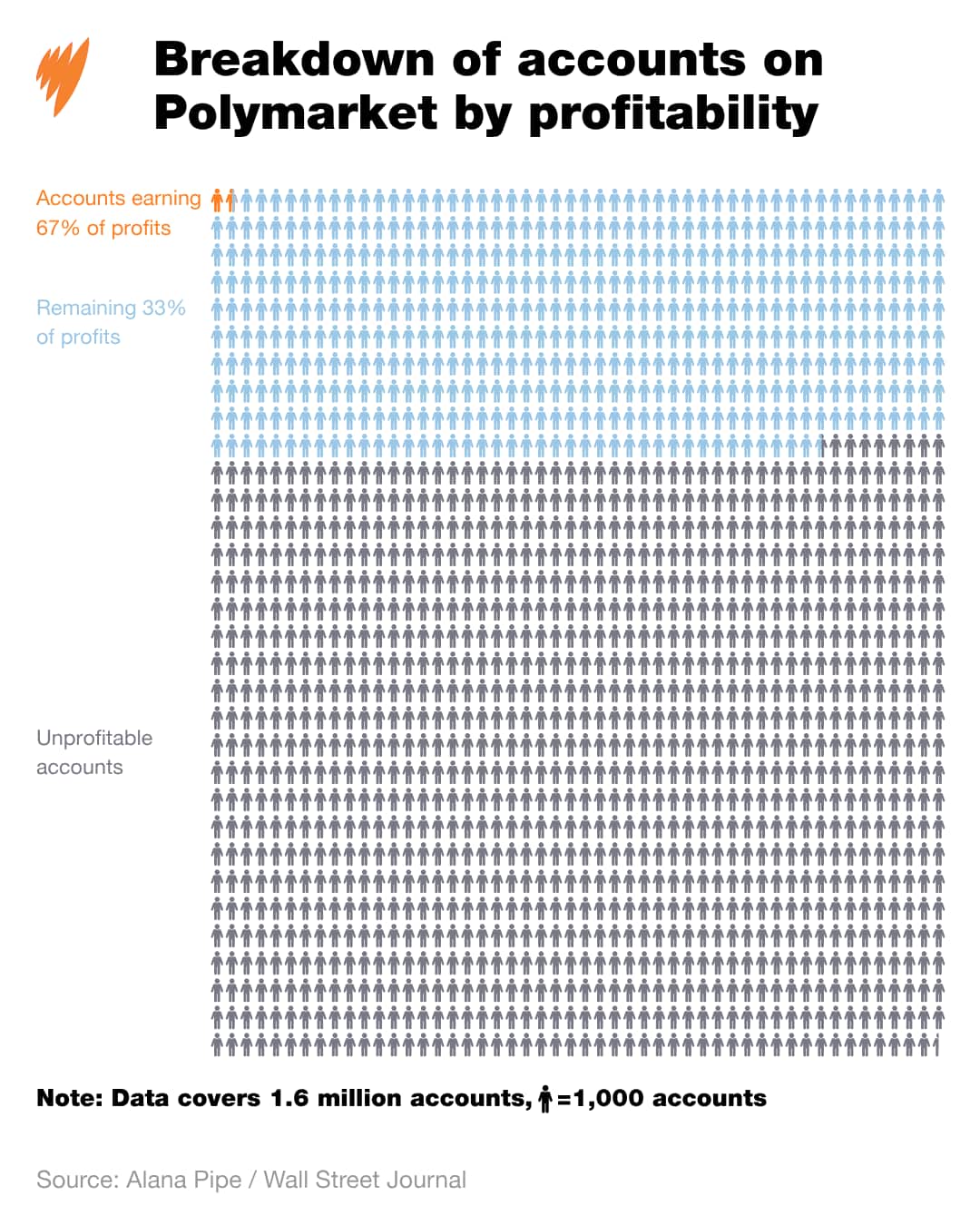
Those figures, and the associated catastrophic losses well documented in online communities like Reddit, appear to undermine claims the platforms are democratising finance by allowing those beyond the world of finance to profit from their unique knowledge. Instead, they seem to be rewarding a small class of elite traders equipped with sophisticated models, bots and an informational edge.
It is unclear who those accounts belong to, or who may be steering high-volume bets, because users appear only as anonymous crypto wallet addresses or autogenerated usernames. Trades can only be traced by platform operators, blockchain operators or federal regulators.
Piovarchy suspects it is "basically impossible for any one group of people" to account for all profits across such a broad and fragmented market. He says the biggest winners are more likely "sharks" taking advantage of an influx of "average punters".
"The way you make money is by spotting places where the current estimate is wrong," he says.
"It requires you to have more information than everybody else or to have somehow processed that information better than everybody else."
That dynamic, however, has spurred one of the industry's biggest ethical concerns: insider trading.
Supporters argue such information is not necessarily a flaw in prediction markets, but part of what makes them accurate. If somebody knows more than the public, their trades push the market closer to the true probability of an event.
But critics warn the same incentives can be deeply unfair or perverse, particularly when markets involve politics, conflict or public safety.
During recent Middle East tensions, users traded heavily on whether the United States would strike Iran, if the Strait of Hormuz would be closed, if senior Iranian leaders would survive the conflict, and if a broader regional war would erupt — raising concerns that some were exploiting their privileged access to classified government or military information to rake in massive profits.
In April, active-duty US special forces soldier Gannon Ken Van Dyke was charged after allegedly using classified details about a covert operation targeting Venezuelan leader Nicolás Maduro to place bets on Polymarket before the information became public.
US prosecutors allege Van Dyke made more than US$400,000 ($560,000) trading on markets linked to Maduro’s removal after wagering more than US$33,000 ($46,000) while in possession of classified operational details.
Piovarchy warns the issue becomes particularly dangerous when the people placing trades may also possess influence over the outcome itself.
"It provides an incentive to change the outcome in a way that … matches what you've bet on," he says.
Some platforms have already tried to limit extreme topics that incentivise harm. Kalshi, for example, has banned "violent markets" including those tied to war, death, nuclear war, assassinations, kidnappings, rocket explosions or missile strikes.
But some argue platform regulation remains too weak, leaving many seemingly less controversial markets vulnerable to manipulation.
Brian Price, executive director of the FEX Global futures exchange, says markets built around subjective or easily influenced outcomes are among the clearest examples of prediction platforms operating badly.
"If you're trying to run the market on something that can't be readily settled, can't be readily identified, you can't surveil for market abuse ... that's an example of the bad contracts," he says.
"The problem is the contracts listed, not the venue necessarily they're listed on."
Beyond the bet
Valuable information rarely comes without cost.
Price argues that, if properly regulated, prediction markets could provide ordinary people with unprecedented tools to manage real-world uncertainty.
He points to the examples of homeowners concerned about interest rate decisions, travellers exposed to currency fluctuations and small businesses vulnerable to sudden economic shocks or insurance losses.
"It allows people to really intricately match their risk with what really might happen," he says.
Piovarchy sees that value extending beyond individual finances to questions of broader public importance.
"Will there be a pandemic in the next five years? That's a very important question that we need to have an answer to," he says.
"If this policy passes, will it reduce crime? If the Liberals get in, will they successfully restrict immigration?"
At a time when trust in institutions, experts and traditional sources of authority has become increasingly fragmented, Piovarchy argues prediction markets could eventually provide a useful, additional source of information for the public alongside more conventional forms of analysis.
For Price, the appeal is also generational.
He believes prediction markets offer younger people a rare opportunity to "express their power" in being able to participate directly in conversations that would otherwise unfold above their heads.
That idea resonates with Semenas, who says one of the platform's biggest attractions is the ability to directly influence the odds other users see.
"Every time you or anyone places a trade, you are directly changing the odds that are offered for that specific market," he says.
"In that sense, you do have quite a bit of gratification in that."
Semenas says Australia will eventually need to decide whether prediction markets should be treated differently to other forms of wagering.
He argues that there is little logic in allowing sports gambling while banning prediction markets outright and believes that, with appropriate safeguards and risk management, the platforms can safely provide more equitable access to public participation in financial markets.
But his optimistic outlook also comes with a warning for his peers.
"It is quite easy to get drawn into these get rich quick schemes," he says.
"Be wary of where you spend your money and what you put your money into … It would require a lot of effort to get to the level myself or others are at."
For the latest from SBS News, download our app and subscribe to our newsletter.

Through award winning storytelling, The Feed continues to break new ground with its compelling mix of current affairs, comedy, profiles and investigations. See Different. Know Better. Laugh Harder. Read more about The Feed

Have a story or comment? Contact Us







