55 years ago today, the Aboriginal Flag was unfurled for the very first time.
It was National Aborigines Day - Friday 9 July 1971 - and a land rights march snaked through Adelaide City, finally reaching Tarntanyangga (Victoria Square).
A flag, designed and created by Luritja and Wombai artist Harold Thomas, was raised for the first time, above Kaurna Country.
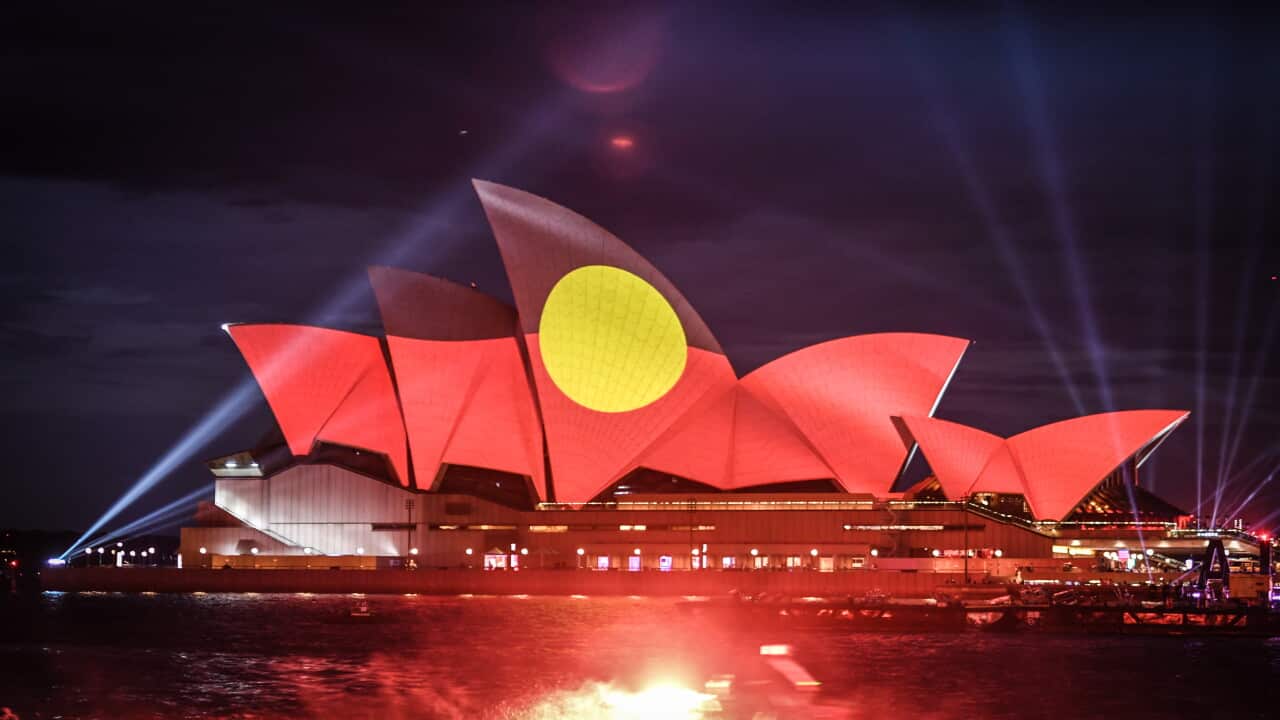
The colours of the flag: black, representing the Aboriginal people of Australia; a yellow circle, representing the Sun, the giver of life and protector; and red, which represented the red earth and Aboriginal peoples’ spiritual connection with the land.
Sadly, that first Aboriginal flag is lost.
From July 1972, Thomas’ flag would join two others at the newly established ‘Aboriginal Embassy’ (later referred to as the Aboriginal Tent Embassy) at Parliament House in Canberra.
It was originally referred to as the ‘Land Rights’ flag, used as a rallying call for the implementation of national land rights legislation.
By the late 1970s and early 80s, the flag began to appear wherever there was protest.
It was increasingly being used by Aboriginal organisations and individuals in posters and murals, and by the early 1980s on T-shirts.
At the 1980 blockade at Noonkanbah Station in WA's north-west, it would gain more prominence across the country.
That only increased with the passing years – especially in the build up to the passing of the NSW Aboriginal Land Rights Act 1983.
In 1982, the Council for Aboriginal Unity encouraged all 177 councils across NSW to fly the Aboriginal Flag for a single day: National Aborigines Day in July 1982.
58 Shire Councils across NSW decided to fly the Aboriginal Flag outside their buildings.
The flag also made an appearance at protests at the Brisbane Commonwealth Games in 1982.
Its design and colours were replicated to celebrate the 1985 Handback of Uluru to its Traditional Owners in the iconic poster by Australian artist Chips Mackinolty.
Increasingly, Aboriginal organisations used the flag in their logos, branding and identity.
But it was during Australia’s Bicentennial in 1988 that the flag was thrust loudly onto the national and international stage.
On 26 January 1988, while official celebrations marked 200 years since British colonisation, more than 40,000 people marched through Sydney in one of the largest Indigenous-led protests in Australian history.
Aboriginal flags transformed the march into a powerful visual statement of survival and sovereignty.
In 1994, Cathy Freeman captured global attention during the 1994 Commonwealth Games by waving both the Aboriginal flag and the Australian flag as she triumphantly completed her victory lap after winning gold in both the 200m and 400m events.
Arthur Tunstall, who was Australia's Chef de Mission at the Games, criticised her for the act.
On the 14 July 1995, His Excellency the Hon. Bill Hayden AC, under instructions from the Keating Labor government, proclaimed the Aboriginal and Torres Strait Islander Flags official flags of Australia under Section 5 of the Flags Act 1953.
Officially recognising the flags was one of 113 recommendations delivered to the Keating Government for institutional, structural, collaborative, and cooperative reforms by the Aboriginal and Torres Strait Islander Commission (ATSIC) in its ground-breaking 1995 report Recognition, Rights and Reform.
Flag recognition was also recommended by the Council for Aboriginal Reconciliation in its report to achieve Social Justice post Mabo.
However, that 1995 Aboriginal Flag proclamation had occurred despite Mr Thomas’ objection to it.
ATSIC had made the decision to support the formal recognition of the Aboriginal and Torres Strait Islander flags by proclamation at a Board meeting on 28 March 1995.
Following the proclamation of the Aboriginal flag as a Flag of Australia, the Commonwealth government proceeded to arrange the production of flags and a book bearing the flag.
In 1996, Mr Thomas commenced legal proceedings against the Commonwealth government in the Copyright Tribunal and the Federal Court of Australia.
In 1997, the Newcastle City Council began regularly flying the flag, making Newcastle as the first city to grant the flag any sort of official recognition.
In April that year, Mr Thomas was confirmed as the designer and copyright holder of the Aboriginal flag after the Federal Court of Australia officially recognised him as the author of the flag.
This decision meant the flag was protected under the Copyright Act 1968 and could only be reproduced in accordance with this legislation or with the permission of Mr Thomas.
As copyright holder, Mr Thomas exercised his right to grant several exclusive licences for the reproduction of the Aboriginal flag.
In 1998, Mr Thomas entered into a world-wide exclusive agreement with Flags 2000 Pty Ltd, known today as Carroll & Richardson Flagworld, to reproduce or authorise the reproduction of the design on flags, pennants, banners and bunting.
At the Sydney Olympics in 2000, Cathy Freeman carried the Australian and Aboriginal flags after winning gold in the 400-metre race watched by a global TV audience of over eight million people in Australia, and an estimated cumulative billion viewers worldwide.
In 2001, ATSIC entered into a licence agreement for the non-commercial use of the Aboriginal flag which granted them and their Regional Councils, as well as any other bodies of elected Indigenous representatives that might succeed them, a non‑exclusive, irrevocable and worldwide licence to reproduce the work for any non‑commercial purpose.
In January 2008, the Aboriginal Flag was proclaimed as a Flag of Australia under the Flag Acts 1953 for the second time due to an administrative oversight.
In 2018, Thomas signed an exclusive licence and agency agreement for the flag on clothing with the non-Indigenous company, WAM Clothing – who enforced its rights as a licensee against a multitude of Indigenous organisations and companies, Not For Profits, as well as major sporting codes.
WAM Clothing's approach to enforcing its rights as an exclusive licensee for the Aboriginal flag was the catalyst for a campaign—led by Spark Health—to garner community support to 'Free the Flag'.
Freeing the flag
On 3 September 2020, the Senate established the Select Committee on the Aboriginal Flag.
The committee considered the current and former copyright and licensing arrangements for the Aboriginal flag and set about investigating options available to the Government to enable the Aboriginal Flag design to be freely used by the Australian community.
In January 2022, the Commonwealth of Australia acquired the copyright of the Aboriginal Flag which now allowed the design of the Aboriginal Flag to be freely reproduced by the public on apparel, merchandise on all other mediums.
The then-Morrison government paid more than $20 million to obtain the copyright to the flag, plus terminate commercial licenses owned by companies which had limited the reproduction of the symbol.
However, as author of the artistic work, Mr Thomas retained moral rights in respect of it under the Copyright Act.
Under the deal secured by the federal government, Carroll & Richardson-Flagworld Pty Ltd remained as the exclusive licenced manufacturer and provider of the Aboriginal Flag on flags and pennants, banners and buntings.
They agreed that future royalties from its sale of the flag would go towards the work of NAIDOC (National Aborigines and Islanders Day Observance Committee).
As part of the deal, the Federal Government also agreed to the establishment of an annual $100,000 scholarship in Thomas’ name for Indigenous students to further the development of Indigenous governance and leadership.
When asked to confirm whether these scholarships had been established, the National Indigenous Australians Agency (NIAA) was unable to provide a definitive answer.
“The Australian Government remains committed to delivering opportunities for First Nations people to acquire a formal education in leadership and governance scholarships under its agreement with Harold Thomas,” they said in a statement.
NIAA were also unable to confirm how much royalties have been collected since 2022 and how those royalties - collected from Flagworld - have been invested in NAIDOC.
“Since the copyright was transferred to the Commonwealth, royalties have been collected from Flagworld’s sale of the flag - these funds will continue to support the ongoing work of NAIDOC,” they responded.
Overall, ‘freeing the ‘flag’ in 2022 removed a major barrier for many First Nations’ businesses and gave them greater freedom to use one of the country's most important Indigenous symbols in their work and enterprises.
It allowed Indigenous fashion labels and artists have greater freedom to celebrate identity and culture through their products. It allowed community organisations and events can use the flag more easily in campaigns, merchandise and fundraising activities.
The Aboriginal flag is one of the most powerful and recognisable symbols in Australia.
Thomas describes his flag as representing the timeless history of our land and our people’s time on it.
“It is an introspection and appreciation of who we are. It draws from the history of our ancestors, our land, and our identity and will honour these well into the future,’ he said.
For many Aboriginal people, the flag is more than a design or emblem.
It tells a story of Country, survival, resistance and pride — a visual reminder that Aboriginal people have always been here and always will be.