A new First Nations exhibition displaying significant works of Indigenous artists from every state and territory has opened at the National Gallery of Victoria's Ian Potter Centre.
‘Future Country’ is the culmination of mentorships between emerging and established artists supported in a partnership between NGV and Country Road.
Dr Jessica Clark, a Palawa woman and Senior Curator First Nations Art at NGV told NITV the exhibition is ‘crucial’ for the gallery.
“It’s our flagship First Nations commission project, so it’s our dedicated show celebrating and highlighting what’s happening in First Nations contemporary art across the country right now,” she said.
“I think it’s a really exciting indication of what artists are working on at the moment, providing a real snapshot of what’s happening in contemporary practice.”
Clark says the show explores ancestral memory, truth telling, and future making, with artists creating works that celebrate land, legacy, community and cultural continuity.
“Art is an incredible vehicle for storytelling and engaging with hard truths, confronting and challenging histories but also exploring, reimagining and restoring the future for First Nations peoples’ culture and community,” she said.
One mentor partnership is between Quandamooka artist Megan Cope and mentee Nywaigi, Meriam and Manbarra woman, Boneta-Marie Mabo.
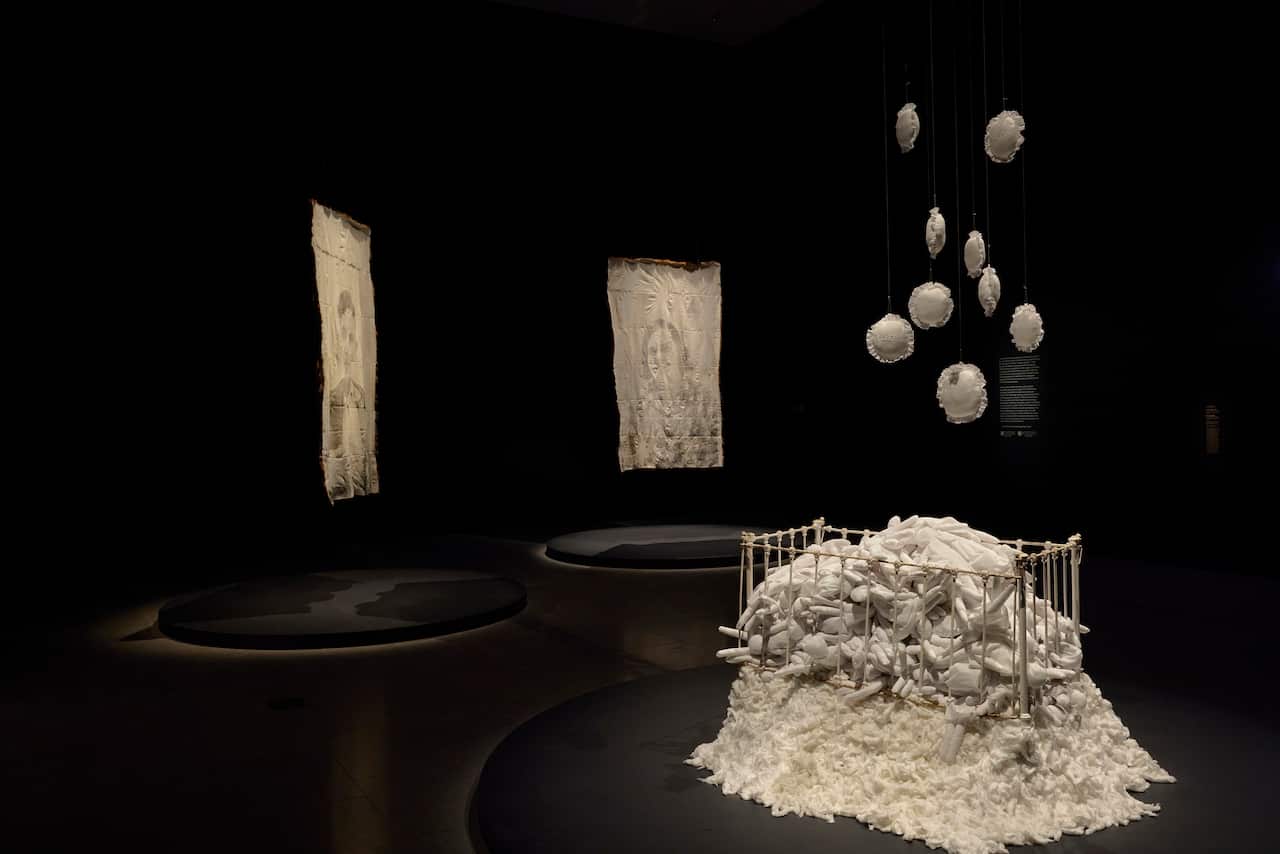
Mabo’s piece titled ‘Colonial Threads’ is an installation that honours Aboriginal girls who were forcibly confined in missions and dormitories under the 1864 Industrial and Reformatory Schools Act in so-called Queensland.
The work features 238 handmade textile rag dolls, symbolising each year since invasion, and are crafted from wool which references colonial agriculture and Aboriginal labour.
Mabo said her inspiration for the work was drawn from her connection to Palm Island - Manbarra Country through her grandmothers and its history as a mission and open-air prison.
"That history isn’t abstract for me, it’s lived, inherited," she said.
"I’m also drawing from my time working with criminalised girls as an abolitionist.
"You can see the direct line between those dormitories and the systems girls are still pushed into now."
Cope said the piece creates a dialogue between the past, present and future.
“I think what’s really powerful about her work is that she raises that mirror up to us and is making that statement that ultimately kids belong with family and on Country and that’s what’s necessary for this theme, Future Country, land back is really critical for the health and well-being for our peoples and our children because they are the future,” she said.
Cope highlighted Mabo’s capacity for research and her roots as an activist for 16 years as strengths in her art practice.
“I was really excited to work with her in that space because her politics are so sound and her capacity for research and dialogue within a political and activist space, being a Mabo, was already crystal clear so it was very exciting to see how she could have this conversation as an artist and within in the medium of art,” she said.
Mabo said she doesn't want people to 'like' her work but understand that histories aren't finished.
"If people walk away unsettled, that’s good," she said.
"If they start questioning systems they’ve taken for granted, even better.
"For mob, I want it to feel recognisable. Not re-traumatising, but honest. It’s an honouring for Blak women and girls, and to all the families that have been affected by these systems in so-called Australia."
Clark said works in the show feature diverse approaches, from photography, possum skin cloak making and weaving installations to a bronze cast coolamon installation from Paul Girrawah House accompanied by a soundscape with House singing in language.
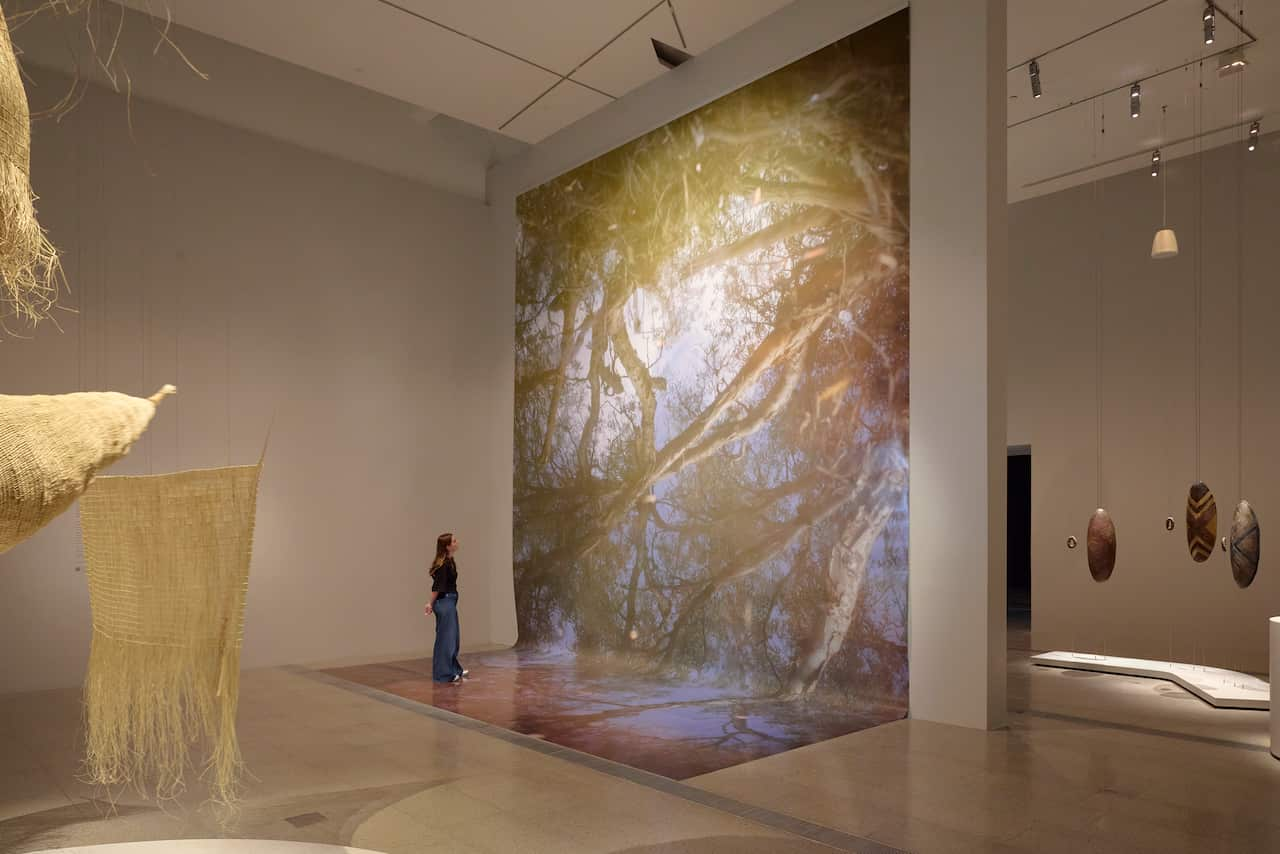
Burarra woman Stephanie Ali's installation suspends dilly bags, fish traps and fish fences, representing the inter-generational exchange of knowledge - supported by her mentor Doreen Jinggarrabarra.
Kaurna, Narungga and Ngarrindjeri artist Carly Tarkari Dodd utilises hand-stitched possum-cloaks to show 'mission mugshots' with Yhonnie Scarce as mentor.
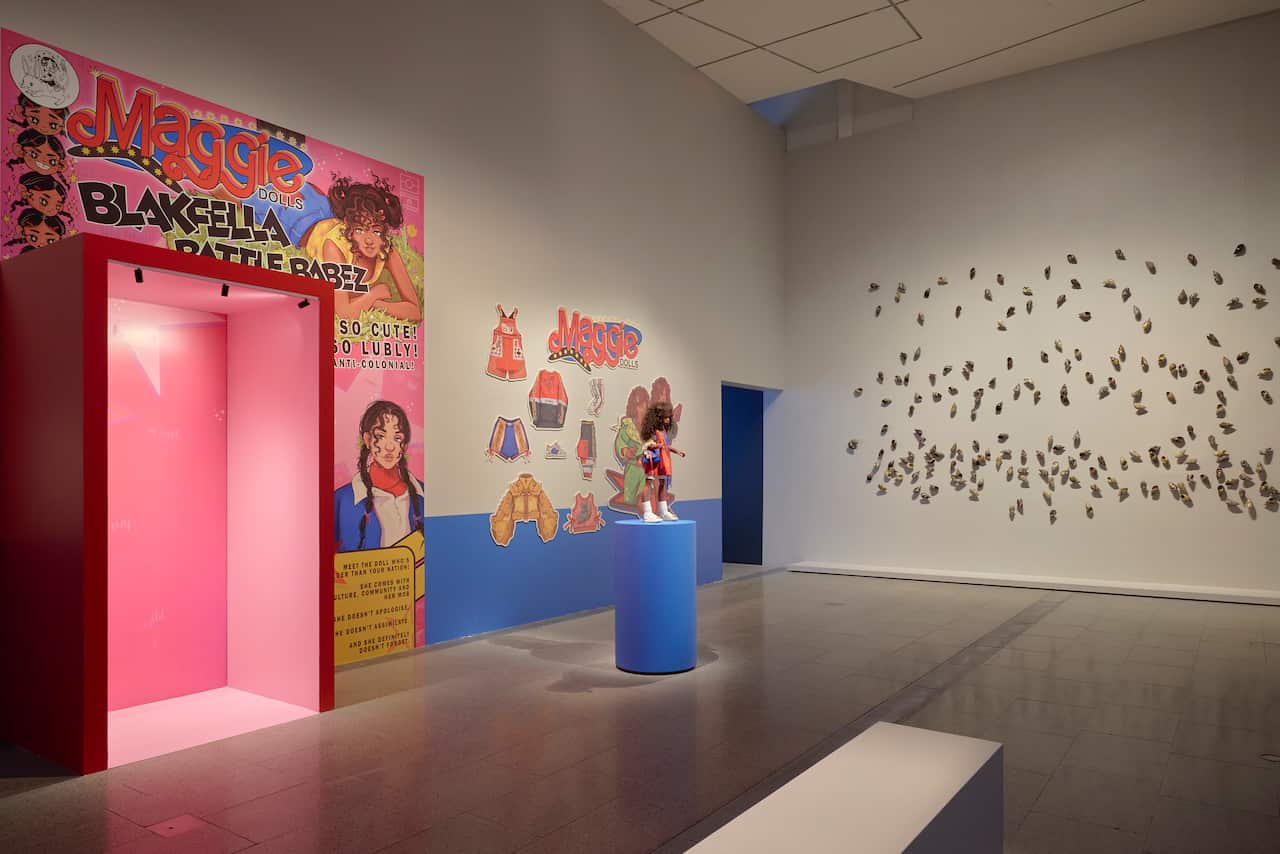
Using slipcast techniques, Palawa and Warlpiri artist Nunami Scunthorpe-Green Lola Greeno recreates 200 supersized marina shells to display the NGV.
Yindjibarndi artist Katie West uses moving image to present and share the history of the Stolen Generations and their family, with mentor Clothilde Bullen.
A series of coolamons are presented and reimagined by Paul Girrawah House, a Senior Ngambri-Ngunnawal custodian with Wiradjuri, Walgalu and Ngunnawal ancestry. He is supported by Brenda L Croft.
In textile work, Nywaigi, Meriam and Manbarra woman Boneta-Marie Mabo worked with mentor Megan Cope to create 238 white cotton ragdolls in a rusted iron cot - representing 238 years of colonisation.
Wiradjuri and Ngiyampaa woman Charlotte Allingham presents a 'Maggie Doll' with Karla Dickens - a 'so cute, so lubly, so decolonial' piece with an accompanying lifesize doll box.
Pitta Pitta artist Jahkarli Felicitas Romanis' is mentored by Brook Andrew and uses large-scale landscape photographry to immerse viewers and prompt reflection on the treatment of Country.
FUTURE COUNTRY runs 20 Mar – 13 Sep '26 at the Ian Potter Centre, Federation Square, Melbourne.