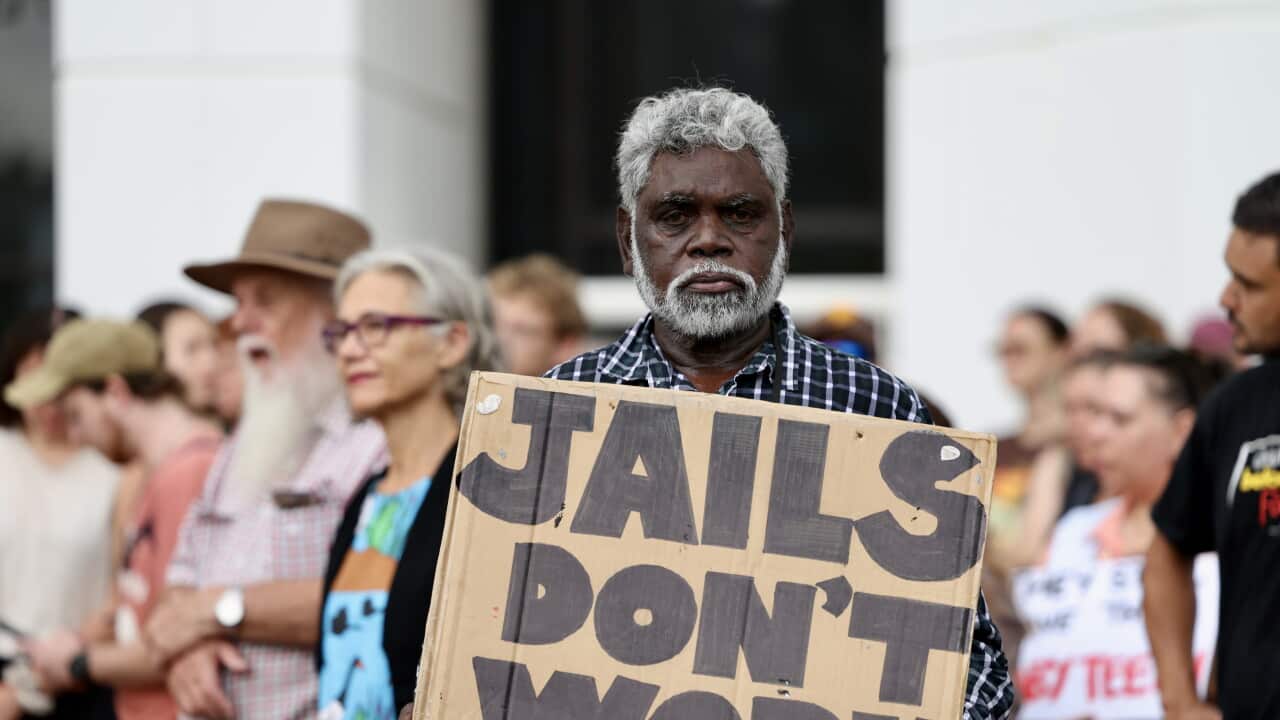
Independent Northern Territory member for Mulka Mark Yingiya Guyula has made extraordinary criticisms of the CLP government over what he described as "incredibly damaging" laws that he says are "steps on the path to killing our people and culture".
Appearing at the Garma Festival, the Djambarrpuyŋu man took aim at government policies including changes to bail laws and youth justice reforms.
He said the laws have caused "harm" to Aboriginal people.
"We have seen two years of punitive laws that lock Aboriginal people up instead of working to address the underlying problems," he said.
"We see guns on buses and in public housing. We see capsicum spray for sale in Darwin."
He also referenced the passage last week of the biggest changes to child protection laws in a generation, which drew widespread backlash from around the country for weakening the Aboriginal child placement principle.
Guyula accused the government of failing to listen to Aboriginal people, Aboriginal organisations and himself as an elected representative.
"Even though I have been sent by my people to be their voice and fix these problems, each time the CLP passes these laws, they take part in a slow genocide of our people.
"Each law is another step on the path to killing our people and culture.
"We want community-led solutions, but they say, 'No, we know what is best for you.'
"Nothing has been done to empower our people or respect our self-determination.
"Nothing has been done to improve health, to improve education, to reduce incarceration and create partnerships that will address underlying issues."
In the middle of his speech Guyula added, in apparent reference to the attendance at his speech, "Everyone's gone now, don't want to listen," before returning to his prepared remarks.
The NT government's sweeping changes to child protection laws have remained one of the dominant issues at this year's Garma Festival, with Aboriginal leaders warning the reforms threaten to further erode Indigenous families and communities.
Indigenous Children's Commissioner Sue-Anne Hunter, one of the laws' most outspoken critics, said the legislation undermined fundamental rights by weakening protections designed to keep Aboriginal children connected to their families and culture.
"We can't talk about connection to culture without talking about connection to family," she said.
"It is our right and the right of the child, and no government can change that."
Chief Minister Lia Finocchiaro, who made her first appearance at a Garma Festival on Friday, has rejected criticism of the reforms.
"The greatest right of any child is to be safe, and now that is enshrined in legislation being implemented across the NT and will be the front and centrepiece when we're dealing with care and protection issues here in the NT," she said.
The reforms have also renewed calls for greater federal intervention in the Territory, where Canberra retains constitutional powers that exceed those it holds over the states.
Guyula said he had travelled to Canberra last month to meet with ministers and their staff in an effort to pressure the Commonwealth to act.
"Throughout this time of racist laws and policies that target Aboriginal people, the federal government has refused to intervene," he said.
"But we desperately need federal government support, now more than ever."
Federal Indigenous Australians Minister Malarndirri McCarthy indicated the Commonwealth was considering stronger measures to pressure jurisdictions that continue to fall behind on Closing the Gap commitments, particularly following the Productivity Commission's latest report showing worsening outcomes in incarceration and out-of-home care.
"There are some jurisdictions that are not easy to work with," she told NITV.
"It is very tough, especially when you do see the rise in incarceration and out of home care. So I will also be looking at other ways in which we can apply the pressure that's required and to go harder."