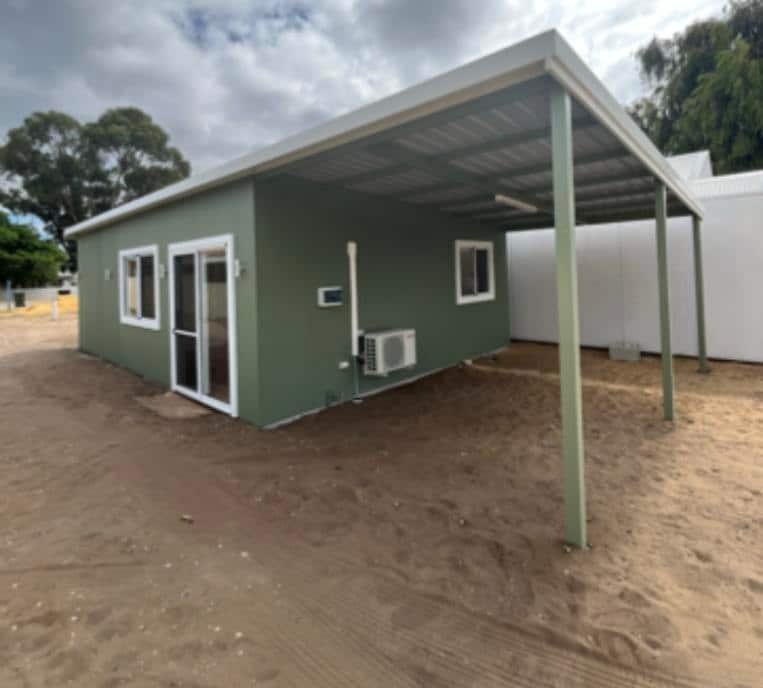
Earlier this year, Jessica Graham and her 13-year-old son Mayson got the keys to their new home.
It is 55 square metres - just enough room for 34-year-old Graham and her son to have their own bedrooms and some living space.
But the Goori woman says having a place of her own has changed her life.
Having been on the rental 'merry go-round' since she moved out of home at the age of 16, this time was different.
"You just get settled into your house, and the next thing you know, you're being told that you're being moved out because the owner wants to sell,” Graham tells NITV.
She said the constant need to move and lack of control over this was "mentally, a lot."
As an Indigenous homeowner, Graham is in the minority.
About 42 per cent of Aboriginal and Torres Strait Islander people own their homes outright or via a mortgage (as of 2021 according to the Australian Bureau of Statistics) while the rate of home ownership among non-Indigenous Australians is 68 per cent.
The Foundation for Indigenous Sustainable Health (FISH) helped Graham get into a home of her own.
The national organisation grew out of the recognition of housing's key role in community health.
"It is a socio-economic determinant of wellbeing, so it has impacts in health, education and other lifelong outcomes," said FISH's chief executive Mark Anderson.
"Elders tell us life is one indivisible whole, you can’t do wrong in one area and not affect another, if the earth gets sick, we get sick, if you don’t have housing, housing affects health, both physical and mental."
A report released in February by the Australian Housing and Urban Research Institute listed "enhancing tenure choices and pathways" as a pillar for policy actions in Indigenous housing.
A result of an inquiry into the topic, it recommended governments promote culturally appropriate home ownership pathways.
Jessica's journey to home ownership
Jessica had rented for about 16 years, and said she and Mayson were forced to move house about every two years.
The last time this happened was about 18 months ago, and with rents increasing and the vacancy rate extremely low, the challenge to secure an affordable rental was too great.
She and her son moved in with her parents.
She knew this arrangement would not work in the long term, so had been speaking with the team at FISH about how she could go about buying her own property.
FISH provides a number of pathways to home ownership, including low deposit loans, low interest loans, rent to buy and shared equity.
Another method is the co-design and build option, which involves home-owners contributing a minimum of 200 hours of 'sweat equity' in the form of physical labour toward the building of their home.
Shared equity model
Graham had looked at the different options before deciding shared equity was the best option for her.
When she was told how much her weekly mortgage repayments would be, she had to ask if there was a mistake.
"It was like, are you being serious?"
It was about 40 per cent of what she had paid for rent in the past.
Shared equity is a financial arrangement where a third party such as the government or a financial institution contributes a percentage of the purchase price to help an individual buy a home, becoming a silent owner of a portion of the home's equity.
Jessica owns a portion of the equity in her home and Indigenous Business Australia (IBA) owns the rest.
Professor Paul Flatau, the director of the Centre for Social Impact at the University of Western Australia, says such arrangements help to get people who may not be on high enough incomes to buy property.
While this means the government or a lender owns a share of the property, Flateau says in reality it is not so different to a mortgage, where the property itself provides collateral to a financial institute.
"You can then continue to increase your own equity and ultimately take over that home or sell," Prof Flatau said.
Prof Flatau said Indigenous ownership rates have increased significantly in the past few decades.
"There is this generational change, and that is coming from a situation where you go back to the early 70s and we still were looking at that transition from having the Stolen Generation [and Aboriginal people having] no rights.
"So, we're coming from that kind of a base and it has been ... a fairly significant movement in terms of Indigenous, business, wealth and home ownership since those those early days."
Prof Flatau said a variety of organisations offered solutions into home ownership for Indigenous Australians.
"We have to point to some very significant positive things that are helping to support the increase in Indigenous home ownership," he said.
"We've seen a very significant growth in Indigenous businesses and business income over that time period and certainly the work of Supply Nation, Indigenous Business Australia, and of course, government policy and the policy of major resource companies, as well as other companies, have been very important in terms of social procurement."
IBA, which owns equity in Graham's home, is a corporate Commonwealth entity that promotes economic self-sufficiency for Aboriginal and Torres Strait Islander peoples.
It's 2024/25 annual report showed that during that year, it assisted 505 customers to buy their first home and approved another 107 people for a shared equity home loan.
Closing the gap
Housing is among the targets listed with the Closing the Gap agreement.
Target nine focuses on secure, appropriate, affordable housing that is aligned with priorities and needs of Indigenous people.
It takes into account standards of housing and includes a focus on reducing overcrowded housing arrangements.
Anderson says too often when Indigenous housing is discussed, social housing was the focus, while home ownership provided stability and the chance to build equity.
"All international research has shown that local housing traps people in poverty," he said.
He explained that to move from social housing a person needed to either save a deposit to buy a house, or move into the rental market.
To afford to buy, people often needed to get a higher paying job but with a higher paying job, those people are often no longer eligible to live in social housing but have not had the opportunity to save enough for a deposit.
"You can’t afford to lose your home because it’s an 11 year waiting list in some states for social housing, so you can’t afford not to have a home for yourself because if you don’t have a home, you can’t work.
"If you then go, well I’ll move into a private rental, that is so expensive now that you end up paying a large chunk of your now well-paid job into a rental, so that you’re not in a position to be able to build a deposit for a home.
"You almost become trapped in the rental cycle or trapped in the social housing cycle and not being able to bring change to your family."
Anderson said his organisation had spoken to Aboriginal individuals who have had to resign or cut back to work part time so as not to earn too much money and also dealt with companies navigating having employees in this position.
For Graham, being able to provide her son with stable housing has already improved her wellbeing.
"We can stay here for as long as we need to. It's a huge, huge weight off my back," she said.
“It's changed my life."