The 13 Yolŋu clans of north-east Arnhem Land's Dilak Council will establish a new Aboriginal land council, marking one of the most significant changes to Indigenous land governance in the Northern Territory since land rights laws were introduced almost 50 years ago.
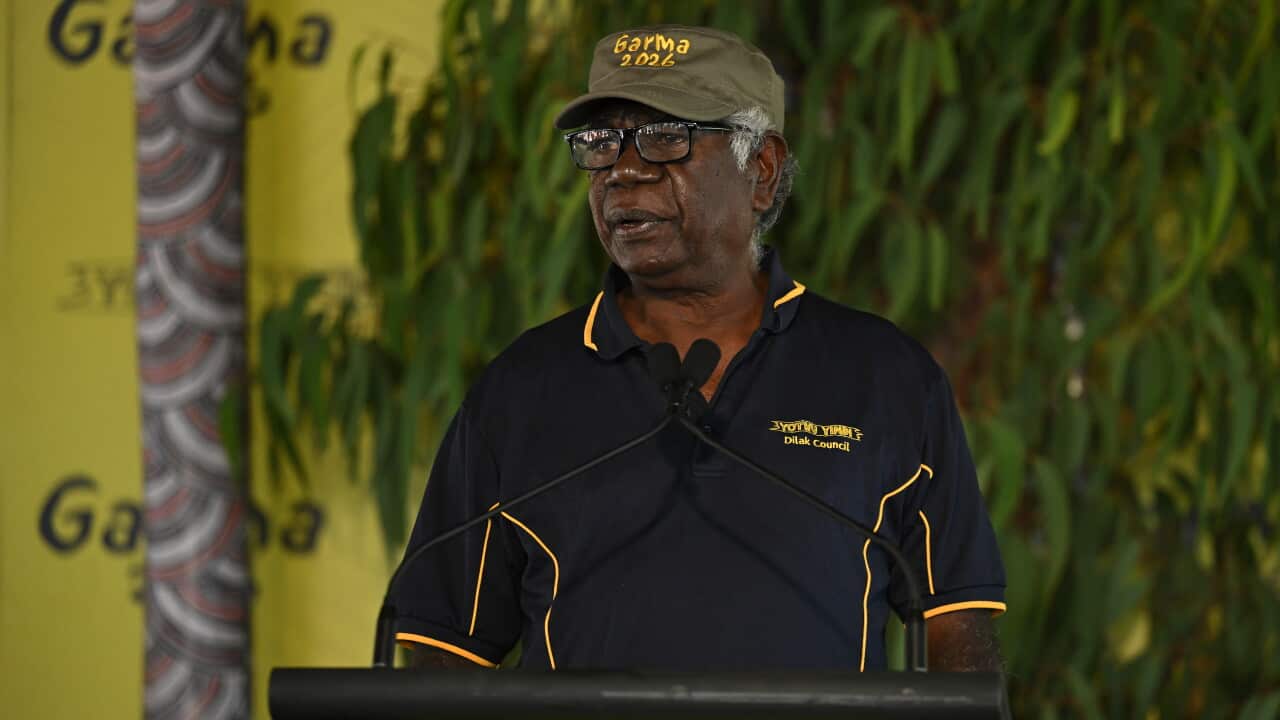
Senior Gumatj leader and Yothu Yindi Foundation chair Djawa Yunupingu announced at the Garma Festival on Saturday that the council would become the Dilak Land Council, creating a standalone body representing the region's Traditional Owners after decades under the Northern Land Council (NLC).
Yunupingu described the creation of the NLC as the realisation of a long-held dream of previous generations of Yolŋu leaders, but said his people "have always looked beyond horizons."
"We are people that believe in the future," he told the Garma audience.
"Like my ancestors, my mind is on the future: future partnerships, future successes, future prosperity, future wealth for Yolŋu, and the whole nation."
Yunupingu said the breadth of Yolŋu enterprises and institutions demonstrated the region was economically ready to stand on its own.
He pointed to the Gumatj and Rirratjingu clan's various economic ventures as evidence of Yolŋu capacity to drive development on their own terms.
That includes mining operations, forestry business and quarries, housing and road construction projects, tourism ventures, ranger programs and education initiatives.
"It is my dream that there will be a five-star resort on this beautiful country," he said.
"We have schools that are teaching our young people. We have a Garma Institute that will be our own university. It will hold our knowledge here. It will teach and inspire and be a jewel of the nation."
He also highlighted the work of Yolŋu ranger groups, saying they possessed unmatched knowledge of country and stood ready to work with Australia's defence forces to protect it.
Announcing the new body, Yunupingu declared: "Land rights is coming home to north-east Arnhem Land."
"There will be a new land council in Arnhem Land, and it will be called the Dilak Land Council, and it will be the power for our future."
Despite the breakaway, Yunupingu thanked the Northern Land Council and its leadership, saying the organisation had strengthened Yolŋu communities over decades.
"The Northern Land Council is the vision of our Elders who knew one day that power would be brought back fully into the hands of the landowners," he said.
"I thank the leaders of the Northern Land Council who have protected us, made us strong, and thank current chairperson Matthew Ryan for his hard work for Yolŋu."
He said the Dilak Land Council would work alongside governments, mining companies and other businesses while maintaining a partnership with the NLC.
"The Dilak Council will give new life to the land and the people," he said.
"It will work with government and mining companies, and any company who wants to do business with us. It will work in partnership with the NLC for the people.
"We will be part of the economic life of this nation whilst never losing what we are and what we stand for."
Yunupingu closed by describing the new land council as a vehicle for future generations, calling on those gathered at Garma to return each year to celebrate Yolŋu success and prosperity.
"We're going to the top of the mountain," he said.
"We will raise our Dilak flag."
NLC Chair acknowledges 'delays' in land tenure arrangements
The creation of the Dilak Land Council would mark the first new such body in 35 years, following the Anindilyakwa Land Council's founding in 1991.
Land councils occupy a unique role in the Northern Territory.
Established under the Aboriginal Land Rights (Northern Territory) Act 1976, they are the statutory bodies that represent Traditional Owners, negotiate with governments and industry over mining and development, protect sacred sites, assist with land claims and manage royalties from projects on Aboriginal land.
The Northern Land Council is the largest of the territory's four land councils, representing Traditional Owners across more than 200,000 square kilometres from the Top End to the Gulf of Carpentaria.
A separate Dilak Land Council would give the 13 Yolngu clans direct responsibility for many of those functions in north-east Arnhem Land, bringing decision-making closer to the Traditional Owners whose country it represents.
Matthew Ryan, chair of the NLC, called the new council a "great opportunity", and invited Dilak to meet for a "serious conversation".
Nonetheless he described the announcement a "shock".
"There were lots of rumours ... but we want to closely with Dilak and the Traditional Owners. Hopefully we can have a better relationship."
There are questions whether delays on land tenure agreements played a role in Dilak breaking away from the NLC.
Ryan said that was partly a legacy of former council administration.
"We'll be speaking to the minister to improve things going forward. There were some parts where there was delays, and we want to improve.
"We acknowledge that."