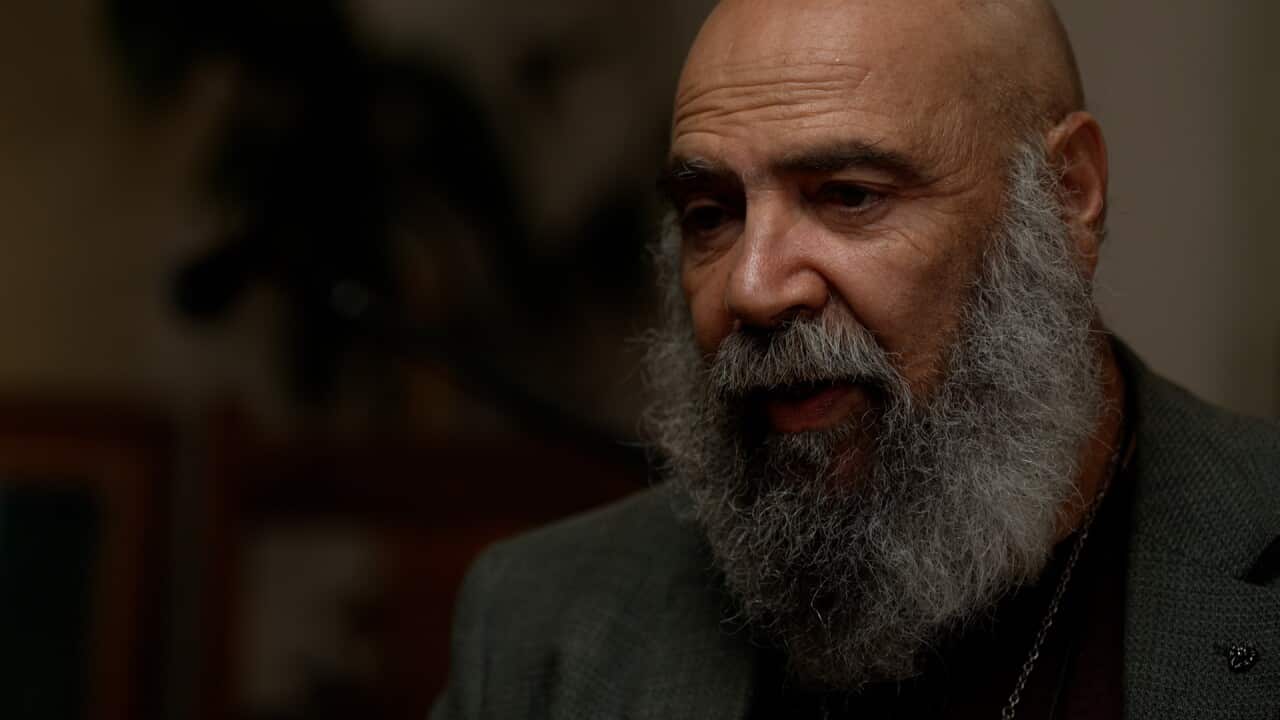
The warmth of Uncle Richard’s home settles in quickly, a welcome shield against the cold pressing in from outside.
He moves easily through the space, pointing out photographs and keepsakes, each one carrying a story. There’s a quiet pride in the way he speaks, the kind that doesn’t need to announce itself.
On the wall, family photos stretch across generations. On the lounge, a set of cushions carries the faces of Richard and his beloved cat, Tedwood Hemmingway. It’s a home full of life, memory, and humour.
By the fireplace, a photograph rests on the mantle—an ANZAC soldier staring back through time. It’s Reg Saunders, Richard’s grandfather.
“That’s Uncle Reg… he became the first Aboriginal commissioned officer,” Richard says. “He fought on the Western Front during the First World War.”
Service runs deep in his family, and in many ways, it shaped his own path.
Army service
Richard followed that lineage into the army himself, joining the First Battalion of the Royal Australian Regiment.
“I made some of the best mates I've ever had—brothers, I would call some of them.”
The decision came from stories passed down—stories of sacrifice and resilience. His Uncle Harry fought and died on the Kokoda Track during the Second World War, in some of the harshest conditions Australian soldiers faced.
Richard didn’t see combat, but his service came with its own battles. Racism and discrimination were constant undercurrents. Rather than confront them head-on, he found a different path—joining the military band as a way to rise through the ranks.
“I played the saxophone, flute and sang,” he recalls with a grin.
“Some of those racist fellas didn’t like being told off by a black fella—but they liked it worse when it was a flute-playing black fella.”
The humour lands easily, but it doesn’t obscure the reality behind it.
The Royal Commission
After leaving the army, Richard’s work took a more confronting turn. He was approached to become a field officer for the Royal Commission into Aboriginal Deaths in Custody.
“I didn’t realise what I’d taken on,” he says. “We didn’t have an office. There was no training.”
The work demanded more than procedure—it demanded presence. Richard became deeply connected with the families of those who had died.
“You knew everything about the person who’d passed. Sometimes the mums would call you their son’s name … and you’d just go along with it. You couldn’t take that little bit of grief away from her. You just had to listen. Really listen.”
One case stayed with him more than most: Malcolm Smith, arrested at seven years old for stealing a bicycle, and who would spend nearly his entire life in custody.
“We grabbed a boy who could have been shaped into a great warrior for humanity … and we crushed him. Our system crushed him before he had a chance.”
The weight of those stories didn’t leave Richard when the commission ended. Instead, they found new expression through art.
He narrated and starred in the 1993 documentary Who Killed Malcolm Smith?, drawn to the parallels between Malcolm’s life and his own.
“The only difference between Malcolm and I … was that I never got caught taking a pushbike.”
Later, the short film No Way to Forget brought those lived experiences to the screen.
“Every story in there happened. Those people had to be honoured. We weren’t a statistic - we were human.”
Lasting memories
Decades on, the impact of the Royal Commission still lingers. As Richard speaks, there’s a shift—his voice tightening, carrying both frustration and grief.
“It was under-resourced and underpowered … They picked you up, chewed you up, sent you into dangerous territory - emotionally, spiritually, physically - and then dumped you.”
Hundreds of recommendations were made. Many remain unfulfilled.
“I think the main reason is moral bankruptcy,” he says plainly. “They put money above lives.”
His words fill the room, heavy with conviction. It’s not anger for its own sake—it’s something deeper, shaped by years of sitting with loss.
“They asked people to trust you … that they’d get justice. I tried really hard. I lost everything. But I didn’t lose as much as the families did.”
He pauses, searching for something harder to articulate.
“You end up discovering things… like seeing the world through a mother’s tears. It’s a bizarre but incredibly beautiful sight—the way a mother loves.”
And then it happens.
Mid-conversation, almost imperceptible at first—his eyes settle on a fixed point on the floor. The room is still, but something has shifted. It’s as if time folds in on itself, and for a fleeting moment, he’s somewhere else entirely.
It’s the kind of moment most people would miss. A quiet fracture in the present. But in it, there’s a depth that words struggle to reach.
We’ve all felt it, in different ways—the sudden pull of memory that arrives unannounced. Sometimes it brings warmth, a softness that lifts the face into a smile. Other times, it carries something heavier. The light dims, the body stills, and for a brief second, the past is no longer past.
Watching Richard, it’s clear which kind this is.
He’s back in those rooms, sitting across from grieving families. Hearing their voices. Feeling the weight of what they carried—and what they entrusted to him.
It lasts no more than a heartbeat.
Then he returns.
The conversation resumes, but something lingers in the air—a quiet understanding of what he’s held onto all these years.
And in that moment, it becomes clear: this burden he carries is not just one of pain, but of care. Of love for the people who shared their stories with him, and for those whose lives were cut short.
It’s heavy, yes—but it’s also human.
And to witness even a glimpse of it feels like a privilege.
You can hear more from Richard Frankland and his work on the Royal Commission into Aboriginal Deaths in Custody on Living Black. Catch up on SBS On Demand. Living Black airs Mondays, 8:30pm on NITV.

Australia's premier Indigenous current affairs program, Living Black provides timely, intelligent and comprehensive coverage of the issues affecting Aboriginal and Torres Strait Islander Australians. Read more about NITV

Have a story or comment? Contact Us