
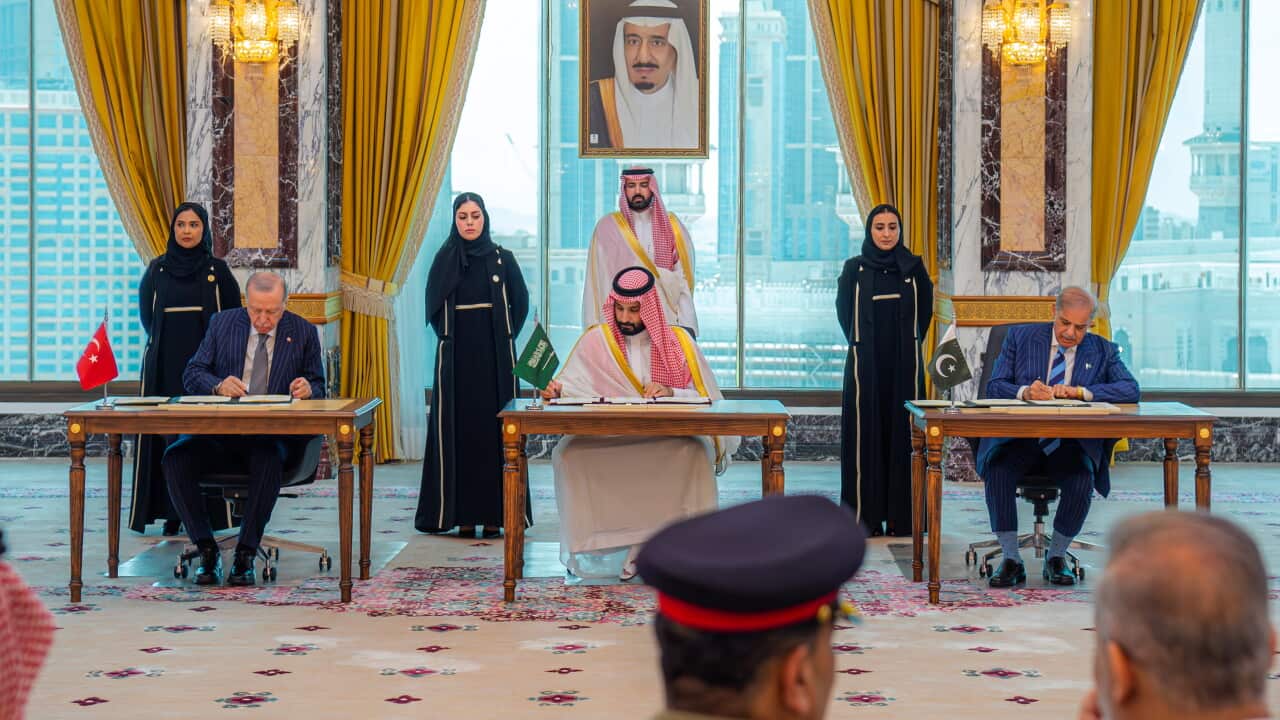

Speaking about the agreement, international affairs expert Amjad Ali Khan explained the significance of the Mecca Agreement between Pakistan, Saudi Arabia and Türkiye, and why it has been described as an “Islamic NATO.”
International affairs expert Amjad Ali Khan said the Mecca Agreement between Pakistan, Saudi Arabia and Türkiye was reached against the backdrop of weaknesses in the regional security architecture of the Middle East, with some describing it as an “Islamic NATO.” He said the three countries are contributing their respective strengths to the agreement, with Pakistan bringing military expertise, Saudi Arabia its financial power and Türkiye its technological capabilities, providing the alliance with a strong foundation.
Khan said the agreement has similarities with NATO’s Article 5, under which an attack on one member is considered an attack on all. However, officials from the three countries have described the pact as purely defensive, with its primary objective being to act as a shield against what they see as Israel’s regional expansionist ambitions. He also mentioned the possibility of Egypt joining the agreement, saying this could extend its reach to Israel’s borders, while maintaining its defensive character.
Addressing concerns from Iran, Khan said that despite longstanding historical and cultural differences between Saudi Arabia and Iran, Pakistan and Türkiye do not have strained relations with Iran. He suggested that Iran could eventually reconcile itself with the new regional security arrangement.





