This audio is voiced by AI and may occasionally mispronounce words.
Share your feedback and help us improve this feature. Read more about how we use AI at SBS here.
Control of Congress isn't the only thing at stake in this year's US midterms.
As the November vote approaches, election experts are closely watching a series of legal and political developments under the Trump administration, warning they could make the process less fair, make it harder for Americans to vote, and set dangerous precedents ahead of the 2028 presidential election.
The midterms carry significant political consequences for US President Donald Trump.
If Democrats regain control of Congress, they are expected to launch investigations into his administration's conduct and make it far more difficult for Republicans to advance their legislative agenda.
Trump has insisted that Democrats will "find a way to impeach me" if they win in November.
News that makes sense
Your trusted source for staying up-to-date with the world around you. Get free daily news updates and analysis, straight to your inbox.
The president's party often loses seats in the midterms, and with Trump's approval rating at all-time lows, history — and the polls — suggest the Democrats have an edge. But an extraordinary campaign by both parties to redraw congressional maps mid-decade may blunt that advantage.
"The degree to which [Trump] is prone to interfere in elections is very worrying," John Hart, a specialist in American government and former head of the Australian National University's political science department, tells SBS News.
"In the past, he's tended to interfere afterwards, after the results have gone against him. But more recently, he's been very active in generating legislative proposals for so-called electoral reform."
Most of them would make it harder to vote rather than easier to vote.
Democrats have voiced concerns that the Trump administration could interfere in the midterms, pointing to his attempts to overturn and undermine the 2020 presidential election result with false claims of widespread fraud.
"There will be an all-out assault on our election process," Democratic House Representative Robert Garcia said last month, adding that Trump would "use everything he can, every lever he has" to target close races.
He said Democrats were preparing with partners and legal organisations across the country to counter any such actions.
Meanwhile, Trump and other Republicans argue their actions and proposals will make the election more secure.
Trump has claimed Democrats can't win without cheating and recently alleged, without evidence, that Democrats were "trying to steal" primary elections in California.
This is playing out against a backdrop of declining trust in the US electoral system and American democracy, both domestically and abroad.
Americans across the political spectrum have become less confident in elections since the 2024 presidential vote, according to a survey earlier this year by the Center for Transparent and Trusted Elections at the University of California San Diego.
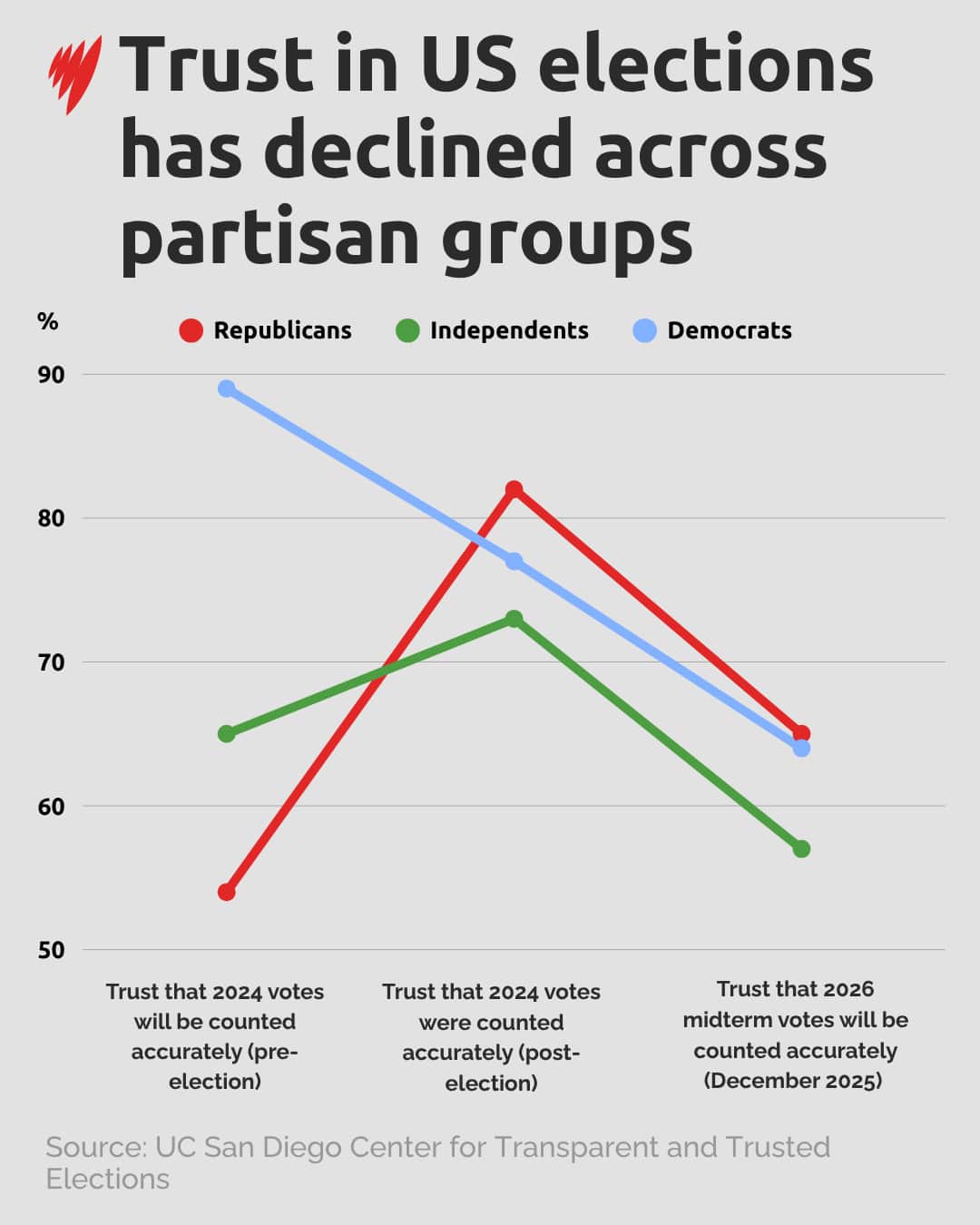
The sources of scepticism differed. For example, Republicans were much more likely to hold concerns about postal voting and noncitizen voting, but distrust about redrawing congressional maps was shared across party lines.
Here's a closer look at some of the ways the Trump administration has sought to alter the election landscape ahead of the midterm vote.
An 'out-of-control' fight over electoral maps
Since last year, a battle has been playing out across the US involving the redrawing of congressional maps for political advantage, a controversial but longstanding practice known as gerrymandering.
Redrawing maps allows a party to divide or expand existing voting districts into new ones that are more likely to favour them.
Typically, legislative districts are revised once every 10 years, following the release of census data.
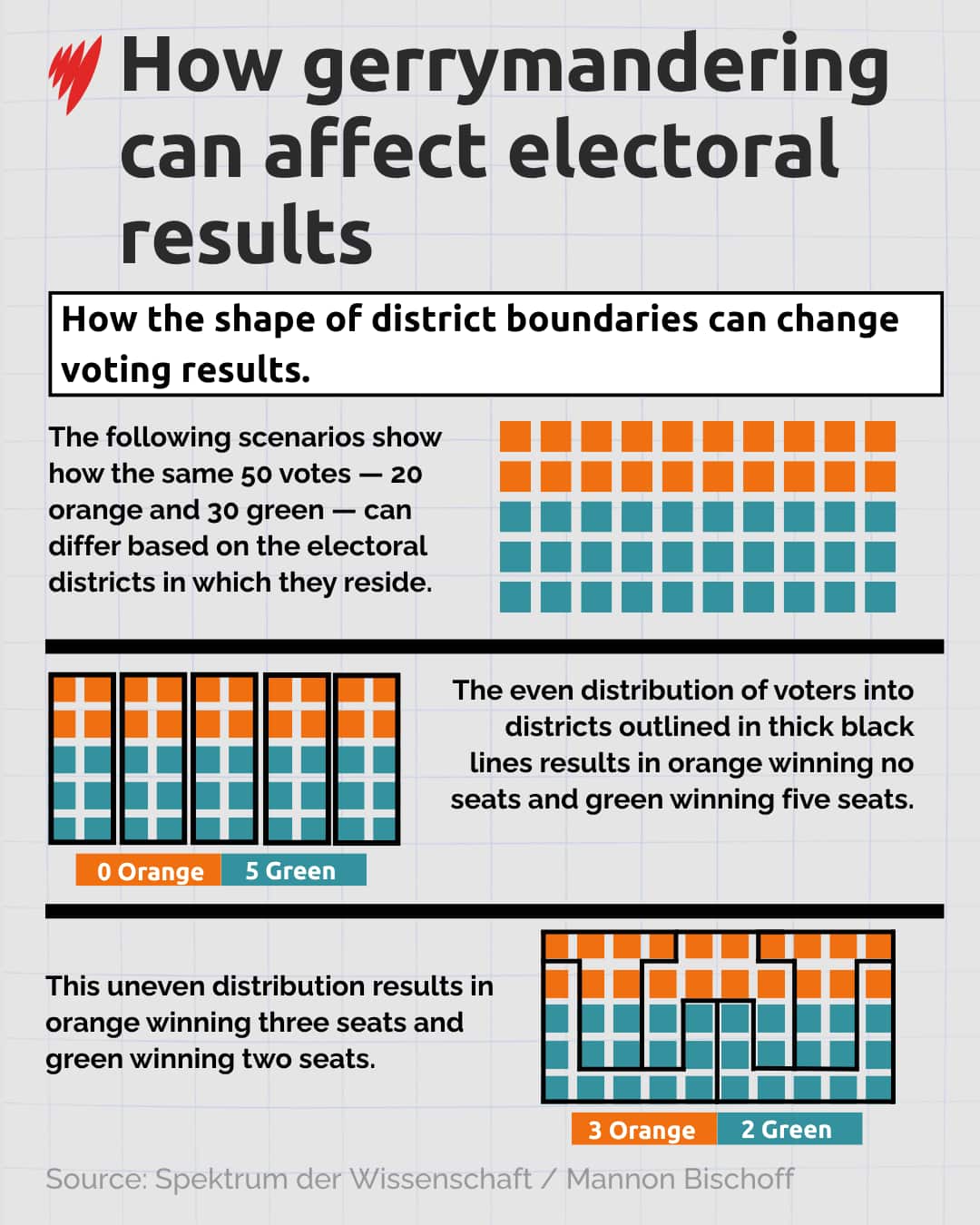
In an unusual turn, not seen in more than a century, the current redistricting surge is occurring mid-decade.
As it stands, 10 states — Alabama, California, Florida, Louisiana, Missouri, North Carolina, Ohio, Tennessee, Texas, and Utah — have drawn new maps since last year.
Before that, only two states had voluntarily redrawn their congressional maps between censuses since 1970.
The wave of changes began after Trump pressed Republicans in Texas to draw up a new congressional map that could give them five House of Representatives seats currently held by Democrats.
Trump was explicit about his intentions, saying Republicans were "entitled to five more seats".
It set off what some commentators called a redistricting "arms race" between both parties.
Democrats have responded by redrawing districts in California in a way that could give them three to five more seats. Elected officials in multiple other states have followed or tried to follow suit.
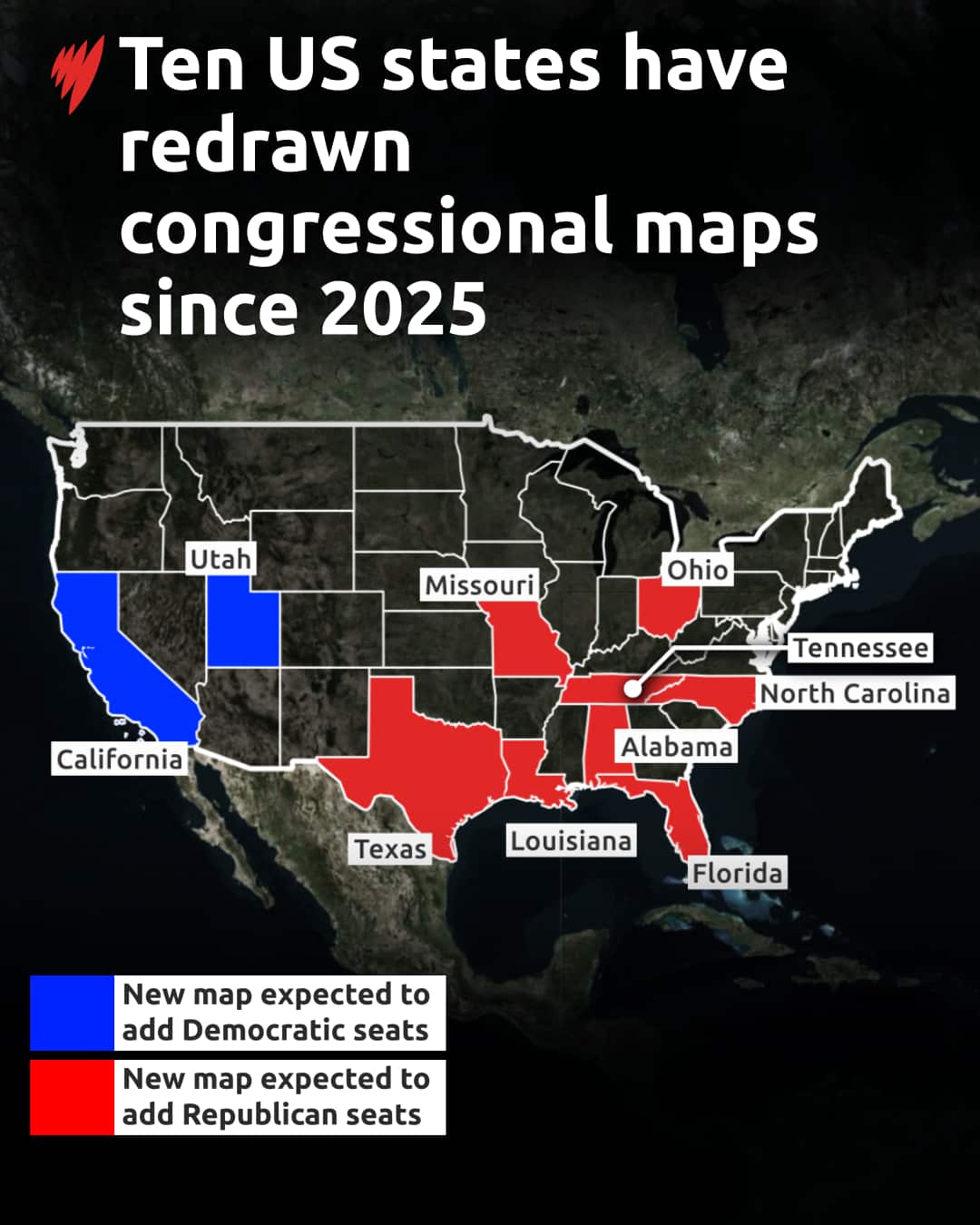
Redrawn maps favour Democrats in only California and Utah, where court interventions struck down a previous Republican-drawn map.
According to a New York Times tally, the overall effect is a possible three to 12 additional House seats for Republicans in the midterms.
"It has gone out of control this year," Hart says.
It will certainly affect the outcome of some elections in some states, but at the moment it isn't predictable exactly how much it's going to impact the election results.
A recent US Supreme Court ruling on the Voting Rights Act further altered the landscape, making it harder to challenge maps that weaken minority voting power and giving states more freedom to draw districts for partisan advantage.
In states such as Louisiana, Alabama and Tennessee, it paved the way for Republicans to break up majority-black voting districts with new maps.
Experts say maps drawn before the midterms could lock in structural advantages that shape US politics for a decade.
Trump's push to change US election rules
Since returning to the White House last year, Trump has sought to alter the way elections are run in the US through several mechanisms, including two sweeping executive orders and a proposed piece of legislation.
The moves have been underscored by his unfounded claims that noncitizen and postal voting are significant threats to election integrity. He has also urged Republicans to "nationalise" and "take over" voting in some places.
His efforts, which critics have described as executive overreach, have faced significant legal challenges.
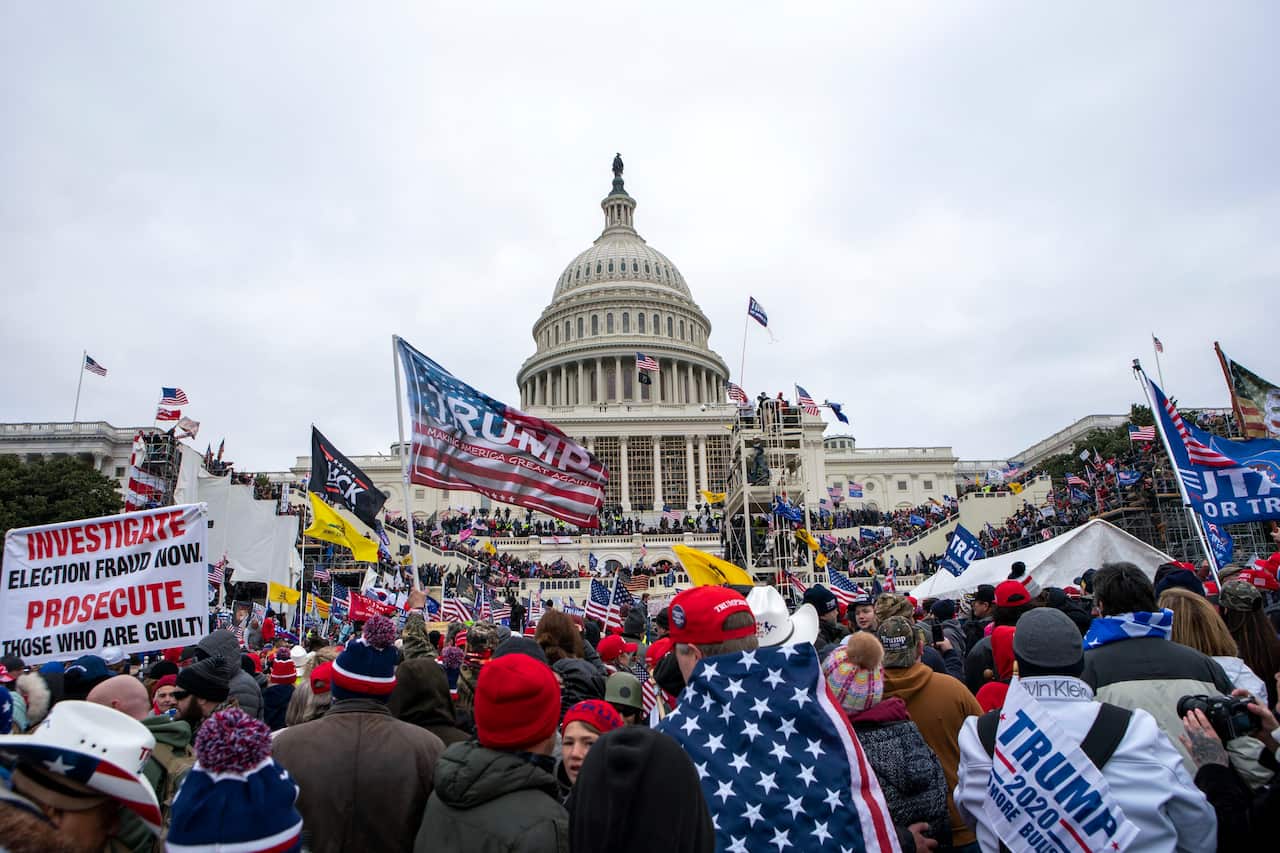
Unlike Australia, where national elections are overseen by the Australian Electoral Commission — an independent federal agency — the US constitution gives the states responsibility for administering federal elections, with each state following its own rules and procedures.
Major changes to federal election laws must be passed by Congress, rather than enacted by the president.
Emily Rodriguez is the elections spokesperson for Protect Democracy, a nonpartisan research and advocacy group in the US.
She tells SBS News the "biggest shift" this election cycle is that the federal government "is now being weaponised against our elections, instead of fulfilling their role of protecting them..."
She argues the Trump administration is pursuing a three-part strategy: first, creating the impression of widespread voter fraud through a "fog of investigations"; second, using those claims to justify tighter voting rules; and if those efforts fail, contesting unfavourable election results.
"When a party fears it can't win at the ballot box but wants to stay in power, it has two options: change its policies to attract more voters, or manipulate the people, the process, or the results. What you're seeing play out in the United States is a disruption of the process," she says.
"It's a pattern that recurs across backsliding democracies: an unpopular leader who still has to face voters doesn't cancel elections outright — that's too obvious — he tilts the field enough that a close race breaks his way and builds a pretext to dispute it if it doesn't."
However, Rodriguez says there is also "encouraging news" that "structural defences are holding", with courts blocking federal overreach and states resisting some federal demands.
In a statement to SBS News, White House spokesperson Abigail Jackson said: "President Trump is committed to ensuring that Americans have full confidence in the administration of elections, and that includes totally accurate and up-to-date voter rolls free of errors and unlawfully registered non-citizen voters."
She argued that federal election laws authorise the US justice department to ensure states comply with voter roll requirements, and said Trump would continue pushing election reforms, including stricter voter ID requirements and limits on no-excuse mail-in voting.
Executive orders seeking to tighten voter access
In March last year, Trump signed an executive order that sought to tighten voting and registration rules, introducing a requirement for voters to prove citizenship before voting and cracking down on mail-in voting, arguing that ballots not received by election day should be rejected even if posted on time. Federal courts have since blocked or struck down most of that order.
Instances of noncitizens voting in the US are extremely rare.
The conservative Heritage Foundation, which has close ties to the Trump administration, has identified just 99 cases of suspected noncitizen voting since 2000.
Meanwhile, analysis from the Brennan Center for Justice, another US think tank, found just 30 incidents of suspected noncitizen voting in the 2016 election, representing about 0.0001 per cent of votes cast.
"The policies aren't addressing a real problem, but they are creating real ones," Rodriguez says.
"Documentary proof-of-citizenship requirements would affect millions of eligible Americans — women who changed their names after marriage and don't have updated birth certificates, elderly rural voters, people with disabilities who can't easily get to a government office."
A 2023 survey by the Brennan Center found more than 21 million eligible US voters do not have proof of citizenship documents, such as a passport or birth certificate, readily available.
In March, Trump issued a second order, directing the Department of Homeland Security (DHS) to use Americans' personal information from federal databases to compile state-by-state lists of confirmed US citizens and send them to state election officials to verify voter rolls.
The order also sought to bar the US Postal Service from sending mail ballots to voters who were not included on federally maintained lists.
Both provisions were blocked last month by a federal judge, who ruled that the constitution does not grant the president any specific powers over elections.
The majority-conservative Supreme Court also dealt Trump a blow, ruling last week that states are free to count mail-in ballots that arrive after the election as long as they were cast on time.
The court has effectively been acting as a "referee" on federal government moves, according to Harry Melkonian, a lawyer and honorary associate at the United States Studies Centre who specialises in US constitutional issues.
"I think part of the problem is that the Supreme Court decisions … almost sometimes seem like a hit or miss, which makes it worthwhile for the administration to keep pushing things," he tells SBS News.
Because sometimes they get away with it, and sometimes they don't.
The Trump administration has also used other federal agencies, including the justice department and FBI, to seek election records, voter registration data or other election materials in multiple states, arguing the efforts are needed to investigate voter fraud and protect election integrity.
Voter citizenship check tool knocked down in court
Last year, the Trump administration revamped and expanded access to a government tool used to verify citizenship and immigration status called SAVE (Systematic Alien Verification for Entitlements), making it easier for state and local election officials to check voter rolls using immigration records and Social Security numbers.
Voting rights advocates argued SAVE can contain incomplete or outdated records, raising the risk that eligible voters could be prevented from voting.
"It produces significant false positives," Rodriguez says.
"Voters wrongly flagged must then prove their eligibility or lose their right to vote."
While such a reform could effectively restrict voting among both Republican and Democrat supporters, Rodriguez argues the move is strategic.
"Rules like documentary proof-of-citizenship and mail-voting restrictions shrink and shape the electorate in this administration's favour. The burden may fall on some of the president's own supporters too, but the bet is that it falls harder on his opponents."
A federal judge blocked the expanded version of the system last week, saying the government had "trampled on the privacy rights of American citizens in a manner that threatens the sacred right to vote".
Trump's signature elections bill
Since large portions of his executive orders have been blocked by the courts, Trump has intensified his push to pass the SAVE (Safeguard American Voter Eligibility) Act, his signature elections bill, which had stalled in the Senate after several Republicans opposed it.
The bill seeks to impose strict voter ID rules, including proof of citizenship at time of registration, audits of voter rolls, restrictions to mail-in voting and criminal penalties for election officials who register applicants without the appropriate documentation.
Trump, who votes by mail himself, has long claimed falsely that mail-in voting is rife with fraud.
Nearly one in three Americans voted by mail in the 2024 general election, according to the States United Democracy Center.
While Democrats were more likely to vote by mail than Republicans (26 per cent of registered Democrats compared with 18 per cent of Republicans in states that track party registration), millions of voters from both major parties used the method.
While Trump's bill is stuck in Congress, multiple Republican-led state legislatures have enacted or proposed laws that mimic parts of the proposal.
Fears of immigration agents at polling sites
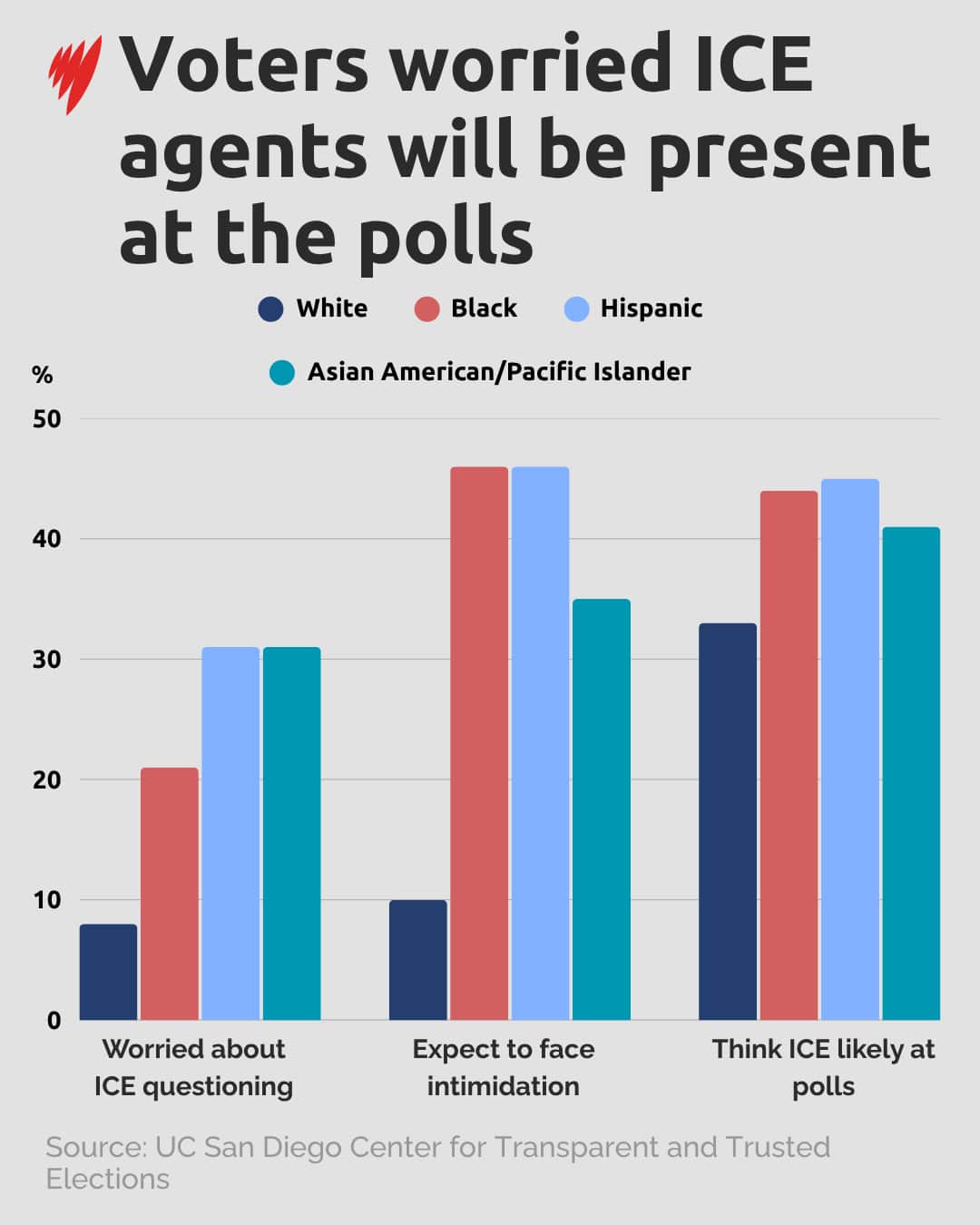
Trump has not ruled out sending federal agents to polling sites at the midterms, a move that civil rights groups say would amount to an illegal voter intimidation tactic.
"I'd do anything necessary to make sure we have honest elections," Trump told reporters in May, after he was asked whether he would send the National Guard or Immigration and Customs Enforcement (ICE).
DHS and Trump administration officials have offered conflicting messages on whether ICE officers might be deployed to polling places. While some have said there are no plans to do so, others have defended the idea.
A DHS spokesperson tells SBS News: "Elections exist for the American people, not illegal aliens, to choose their leaders."
The spokesperson pointed to comments from DHS secretary Markwayne Mullin earlier this year, saying he didn't understand the concern about immigration enforcement at polling places.
"If you're not a citizen, you shouldn't be voting anyway, so technically there shouldn't be illegals at the polling spot," Mullin said.
"The only reason why my officers would be there is if there was a specific threat for them to be there, not for intimidation."
Critics say placing ICE agents near polling places could intimidate eligible voters who fear scrutiny or harassment — particularly those from immigrant communities — and discourage them from voting.
What it could mean for the next election
Buoyed by recent Supreme Court rulings, the redistricting surge is expected to continue ahead of the 2028 presidential election.
There are nine more states where Republicans currently control the redistricting process and could still feasibly implement a boundary change before the presidential election. Democrats could do the same in just four by comparison.
After Trump repeatedly floated the idea of a third term last year, his supporters speculated there could be loopholes in the constitution to allow him to serve beyond 2028.
But legal experts say there's virtually no viable path for that to happen, and discussion of those claims has died down this year.
Rodriguez says she'll be watching to see what precedents are set during this election cycle, and whether states expand legal avenues to hold federal officials accountable for constitutional violations.
The honest assessment is that the outcome of 2026 will shape what is attempted in 2028 more than almost any other factor.
"A midterm in which the results are accepted and the democratic process holds will raise the cost of future subversion attempts. A midterm in which the results are successfully contested or the process significantly disrupted, will lower it."
For the latest from SBS News, download our app and subscribe to our newsletter.







