
As the deadline approaches for United States President Donald Trump's ultimatum before further expanding attacks to Iranian infrastructure, the US and Israel have carried out a new wave of attacks on Iran, while Iran responded with missile fire against Israel and its Gulf Arab neighbours.
Meanwhile, local media have reported that US-Israel airstrikes had "completely destroyed" a synagogue in Tehran, while the Israeli military warned Iranians to avoid taking trains, likely signalling a new target for airstrikes.
Iran has so far rejected proposals for a 45-day ceasefire, while Trump said on Monday he is "not at all" concerned about committing possible war crimes as he again threatened to destroy Iranian infrastructure, including power plants and bridges, if Iran does not meet his Tuesday 8pm EST (Wednesday 10am AEST) deadline to reopen the Strait of Hormuz.
United Nations Secretary-General António Guterres warned the US that attacking civilian infrastructure is banned under international law, his spokesperson said Monday.
Iran has so far rejected a US proposal brokered by Pakistan for an immediate ceasefire and the lifting of its effective blockade of the strait, followed by talks on a broader peace settlement within 15 to 20 days, according to a source aware of the plan.
News that makes sense
Your trusted source for staying up-to-date with the world around you. Get free daily news updates and analysis, straight to your inbox.
However, in what could be a sign of progress, the Iranian ambassador to Pakistan said "positive and productive endeavours" by Pakistan to mediate an end to the war were "approaching a critical, sensitive stage".
Tehran synagogue 'completely destroyed'
As Trump's deadline approaches, Iran's Mehr news agency and the Shargh newspaper reported on Tuesday that Israeli airstrikes had "completely destroyed" a synagogue in Tehran.
"According to preliminary information, the Rafi-Nia Synagogue ... was completely destroyed in this morning's attacks," Shargh wrote.
Video from the site posted by Iran's Tasnim News Agency — which is associated with Iran's Islamic Revolutionary Guard Corps (IRGC) — showed rescuers moving around and what looked like a book of Hebrew scripture in the rubble.
Homayoun Sameh, who represents the Jewish community in Iran's parliament, was quoted in state media as saying: "The Zionist regime did not spare the community during Jewish holidays and attacked one of our ancient and holy synagogues."
"The synagogue building was completely destroyed and our Torah scrolls were left under the rubble," he added.
Israel's military had no immediate comment, according to the Reuters news agency.
Judaism is one of Iran's legally recognised minority religions, and the country has a small Jewish community, although many members fled in the aftermath of the 1979 Islamic revolution.
There are no publicly available official numbers, but there are thought to be a few thousand Jewish people in Iran.
Shargh called the synagogue "one of the most important places for Khorasan Jews to gather and celebrate", referring to the northeastern province of Iran.
Shia Islam is the majority religion in Iran, but the constitution recognises Sunni Islam, Zoroastrianism, Judaism and Christianity as minority sects, with each represented in parliament.
'Your presence puts your life at risk'
Likely signalling a new target for their airstrikes, the Israeli military warned Iranians in Farsi on Tuesday to avoid taking trains until at least 9pm local time.
"Your presence puts your life at risk," the warning posted on X read.
Iran has shut off access to the internet for weeks, making it difficult for the average Iranians to see these warnings.
However, Farsi-language satellite news networks abroad report them, allowing the information to make its way back into the Islamic Republic.
Following the warning, train travel to and from Iran's second city of Mashhad was cancelled until further notice on Tuesday, local media reported, citing the governor of the city.
Meanwhile, several fatalities from US-Israeli airstrikes overnight into Tuesday were reported.
At least nine people were killed in the city of Shahriar, while in the city of Pardis, at least six people were killed in a strike, Iranian media reported.
Two people were killed in a US-Israeli attack on a rail bridge in the central Iranian city of Kashan, a regional official told state media on Tuesday.
The Israeli military said it had completed a broad wave of strikes targeting "infrastructure sites" across Iran on Tuesday, without providing details of what the sites were.
"A short while ago, the IDF completed a wide-scale wave of strikes targeting dozens of infrastructure sites belonging to the Iranian terror regime in several areas across Iran," the military said in a statement.
More than 1,900 people have been killed in Iran since the war began, but the government has not updated the toll for days.
Iranian officials issue a call to arms
As airstrikes against Iran continue, an Iranian official has issued a video message calling on the country's youth to form "human chains" around power plants in the country ahead of Trump's threat of expanded strikes.
Alireza Rahimi, identified by Iranian state television as the secretary of the Supreme Council of Youth and Adolescents, issued the video call in a newscast early on Tuesday.
"I invite all young people, athletes, artists, students and university students and their professors," he said, telling them to gather on "Tuesday at 2pm around the power plants that are our national assets and capital, [and] regardless of any taste or political viewpoint, belong to the future of Iran and to the Iranian youth".
"We will stand hand in hand to say: Attacking public infrastructure is a war crime," he said.
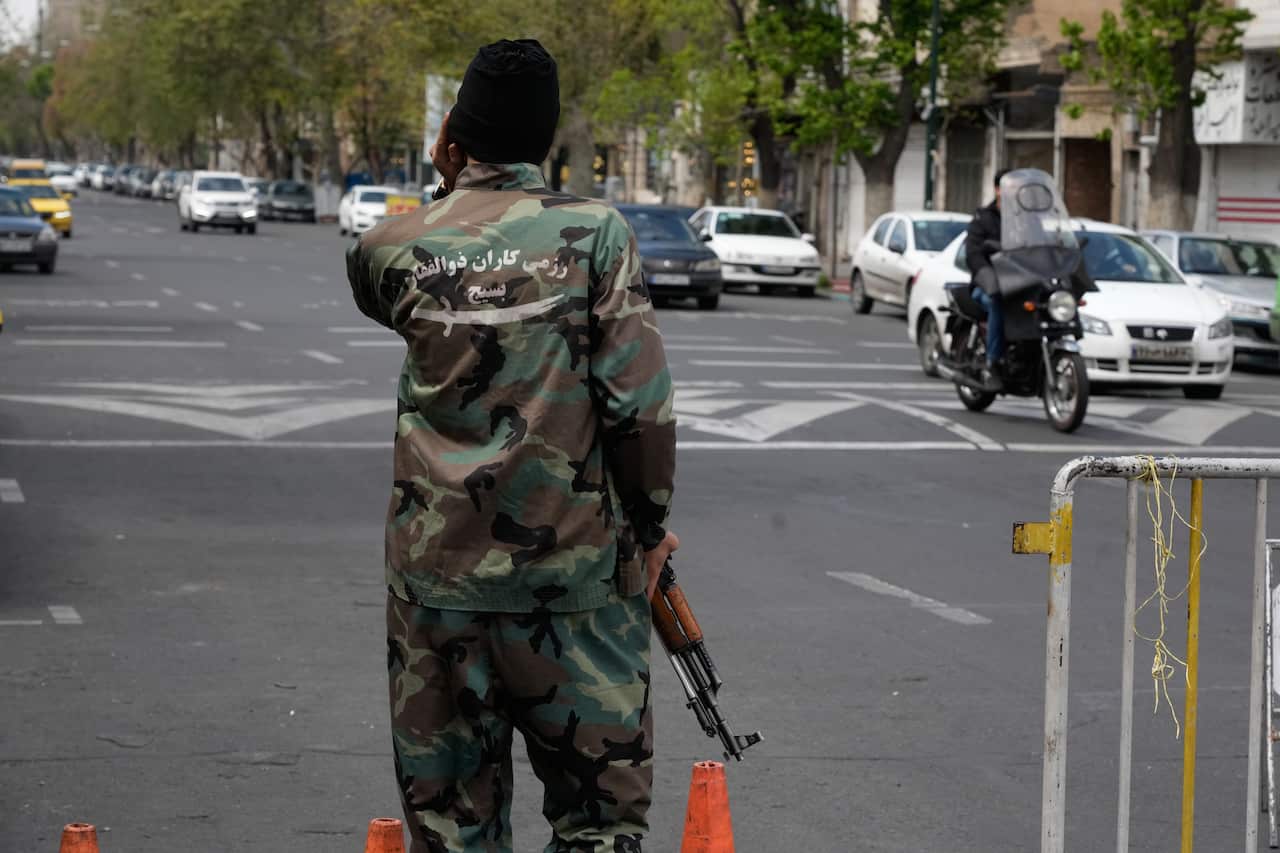
Meanwhile, an IRGC general has urged Iranian parents to send their children to man checkpoints.
"Mums, dads, take your kids' hands and go out on the streets," General Hossein Yekta, previously identified as leading plainclothes units of the all-volunteer Basij force, said during a broadcast on an Iranian state television channel.
"Do you want your kid to become a real man? Let him feel like a hero standing right at the heart of the battlefield ... send your kids to man checkpoints at night; they become men!" he said.
Basij checkpoints have been repeatedly targeted in airstrikes, and the Basij has been accepting children as young as 12 to man them. Amnesty International has warned that some underage recruits are being given firearms, calling their recruitment a war crime.
Meanwhile, Iranian state television on Tuesday claimed 14 million people had volunteered to fight for the country if there is a ground invasion by the US and Israel.
The claimed number, which included no other information, doubles a 2 April claim by the Iranian parliament's speaker, Mohammad Bagher Qalibaf, who said seven million Iranians had volunteered.
State media and text message campaigns have urged people to volunteer, and the government has also called on retired soldiers to express their interest in fighting.
Iran, which is home to some 90 million people, conducted a bloody crackdown on nationwide demonstrations in January that killed thousands and saw tens of thousands detained.
On 5 April, the Mizan news outlet of Iran's judiciary said that the state had executed two men convicted of attempting to storm a military facility and access an armoury during the unrest in January, according to a Reuters report.
The men were among a group of four in the same case who faced execution, according to rights group Amnesty International, with Iran executing an 18-year-old convicted in the same case.
In a recent report, Amnesty said 11 men faced a risk of imminent execution for participation in the protests.
Missile debris reportedly falls near Saudi energy infrastructure
Iran has also continued to launch airstrikes at Gulf countries allied to the US, which have so far avoided directly joining the war for fear of further escalation.
Saudi Arabia said early Tuesday that seven ballistic missiles from Iran targeted the kingdom's oil-rich Eastern Province, with "debris from the missiles" crashing into the ground near energy facilities.
The brief statement from Major General Turki al-Malki, a spokesperson for the Saudi military, did not elaborate on the extent of the damage on the ground, though he said an "assessment is underway".
It wasn't immediately clear which energy facilities had been impacted.
The kingdom has come under attack from hundreds of Iranian missiles and drones since the US and Israel launched the war on Iran on 28 February, most of which were intercepted, authorities have said.
Bahrain, Saudi Arabia and the United Arab Emirates issued simultaneous public safety alerts on Tuesday, while the bridge that connects Saudi Arabia to Bahrain was briefly closed as a precautionary measure following warning alerts.
The King Fahd Causeway, a key bridge linking Saudi Arabia to the island kingdom of Bahrain, closed early on Tuesday over threats from Iranian attacks.
Vehicle movements had been "suspended as a precautionary measure" over Iranian attacks targeting Saudi Arabia's Eastern Province, the authority said.
The 25-kilometre bridge is the only connection by road for Bahrain, home to the US Navy's 5th Fleet, to the Arabian Peninsula.
While there has been no formal threat against the King Fahd Causeway, some hard-liners within Iran have identified it as a possible target.
Since the war started, more than two dozen people have been killed by Iranian attacks in Gulf Arab states and the occupied West Bank, while 23 have been reported dead in Israel, and 13 US service members have been killed.
For the latest from SBS News, download our app and subscribe to our newsletter.







