
This audio is voiced by AI and may occasionally mispronounce words.
Share your feedback and help us improve this feature. Read more about how we use AI at SBS here.
This article contains content some readers may find distressing.
Zuhria Al Hattab survived the night the sky fell on her grandmother's house in northern Gaza.
She survived the journey south — hands raised, white flag up — along a corridor the Israeli military had designated a 'safe route', until the bombs started raining again.
"The whole road was blood and martyrs and body parts, severed heads, severed hands," she tells SBS News of the aftermath of Israel's bombardment during the daytime truce.
"I was crying the whole way … but we had to keep walking continuously without stopping, not looking right or left."
News that makes sense
Your trusted source for staying up-to-date with the world around you. Get free daily news updates and analysis, straight to your inbox.
Al Hattab and her wounded brother, Mohammed, survived the journey out — a $10,000 passage through Rafah into Egypt, brokered by her sister, already safe in Australia.
They reached Perth in 2024. But most of the relatives her sister had applied to bring to Australia — including their father and younger brothers — never made it out.
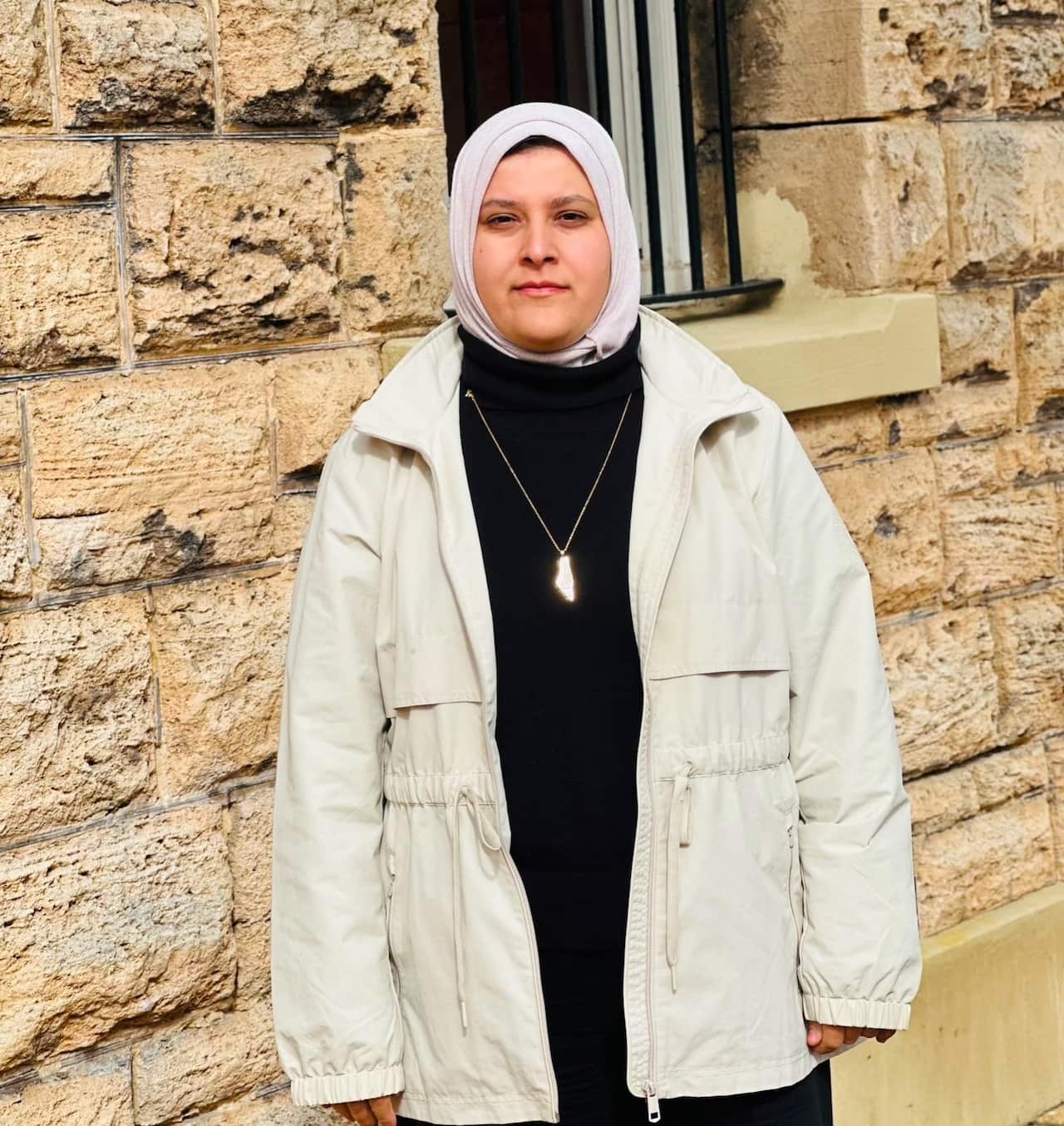
More than two years later, the 34-year-old primary school teacher is still struggling to rebuild her life. She now finds herself caught in a political reckoning over whether people like her should be allowed to stay.
For many Palestinians who escaped Gaza and made it to Australia, the journey to safety did not mark the end of upheaval. It was the beginning of a different kind of uncertainty.
The cohort in the crosshairs
Al Hattab holds a Temporary Humanitarian Concern visa, subclass 786, offered to Palestinians who fled to Australia after the conflict in Gaza escalated in October 2023.
The three-year visa — issued only on a case-by-case basis following mandatory health, character, and security checks — is the second step of the Australian government's Temporary Humanitarian Stay program.
It allows her to work, study and access Medicare, but expires in early 2028. Unlike the version offered to Ukrainians in the aftermath of Russia's invasion, it provides no pathway to permanent residency.
She is one of around 1,700 Palestinians who have arrived from Gaza, mostly on initial 12-month visitor visas — a cohort prioritised based on prior travel to Australia or strong family connections.
The federal government has issued about 3,000 visitor visas in total to Palestinians since October 2023. However, like Al Hattab's relatives, hundreds of visa holders have been unable to leave Gaza, with Israel's siege and the closure of the strip's land crossings preventing their departure.
SBS News has spoken to others who have since secured permanent residency through separate migration pathways, but they say they still have little power to help family members left behind.
The Gaza cohort in Australia has become the leading edge of a tougher immigration argument from the Opposition.
Outlining the first instalment of the Coalition's long-awaited immigration crackdown in April, Liberal leader Angus Taylor singled out the group, calling them high-risk and "entirely" in need of reassessment "with far greater scrutiny".
In the speech delivered at the Menzies Research Centre, attended by former prime minister John Howard — long associated with a hardline stance on immigration and border control — Taylor cast the Gaza arrivals as a symptom of what he called a "naive" immigration system.
"We must dispense with the naive thinking that has dominated our immigration policy for too long," he said in April.
"Our nation has paid the price for believing that anyone, from anywhere, will embrace our way of life."
From that, he drew three pillars: putting Australian values first, shutting the door on those who "abuse the immigration system", and "showing a red light to radicals". The reassessment of the Gaza cohort, he suggested, was where that tougher approach would begin.
Told of Taylor's comments for the first time, Al Hattab could scarcely take them in. The idea that her place in Australia might be reopened for negotiation seemed, to her, almost unimaginable.
"Oh my God, we can't go back ever, because there is no house," she says, her voice catching as she speaks.
There is nothing there. Now, Gaza is not safe. It's not a safe place.
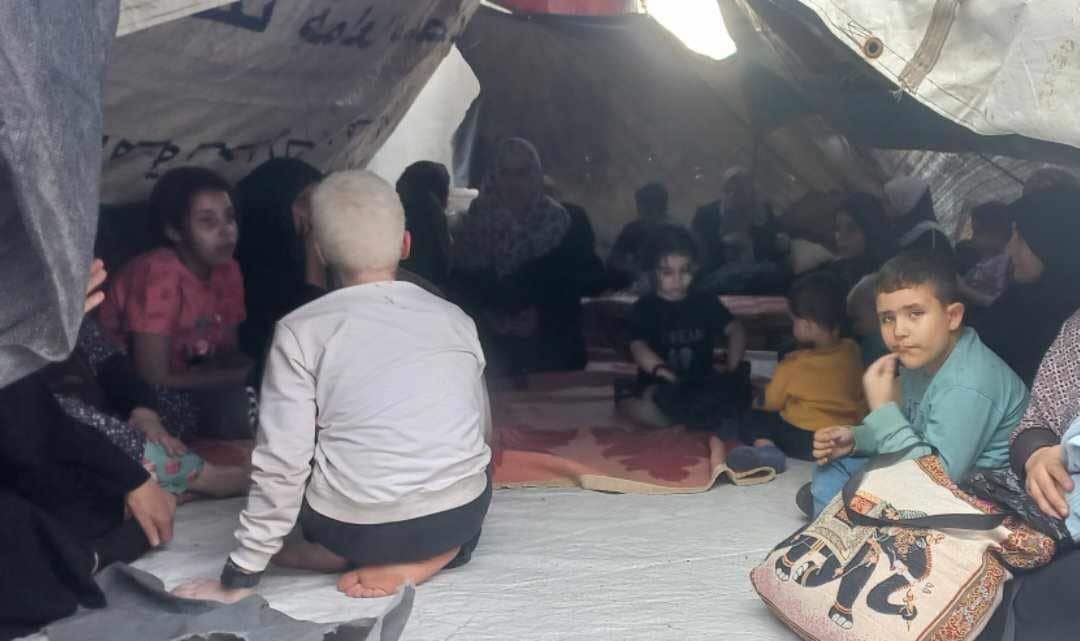
In Gaza, her remaining 16-member family is surviving on little: a porous tent, scarce drinking water and festering illness.
"If we go back — oh my God, there is no place to stay there," she says.
To the suggestion that people like her could pose a risk to the country that took her in, her answer is plain.
"We are civilians. We are all civilians.
"We don't do anything bad."
A wider framework under strain
The Gaza arrivals are only one flashpoint in a system being squeezed from several directions at once.
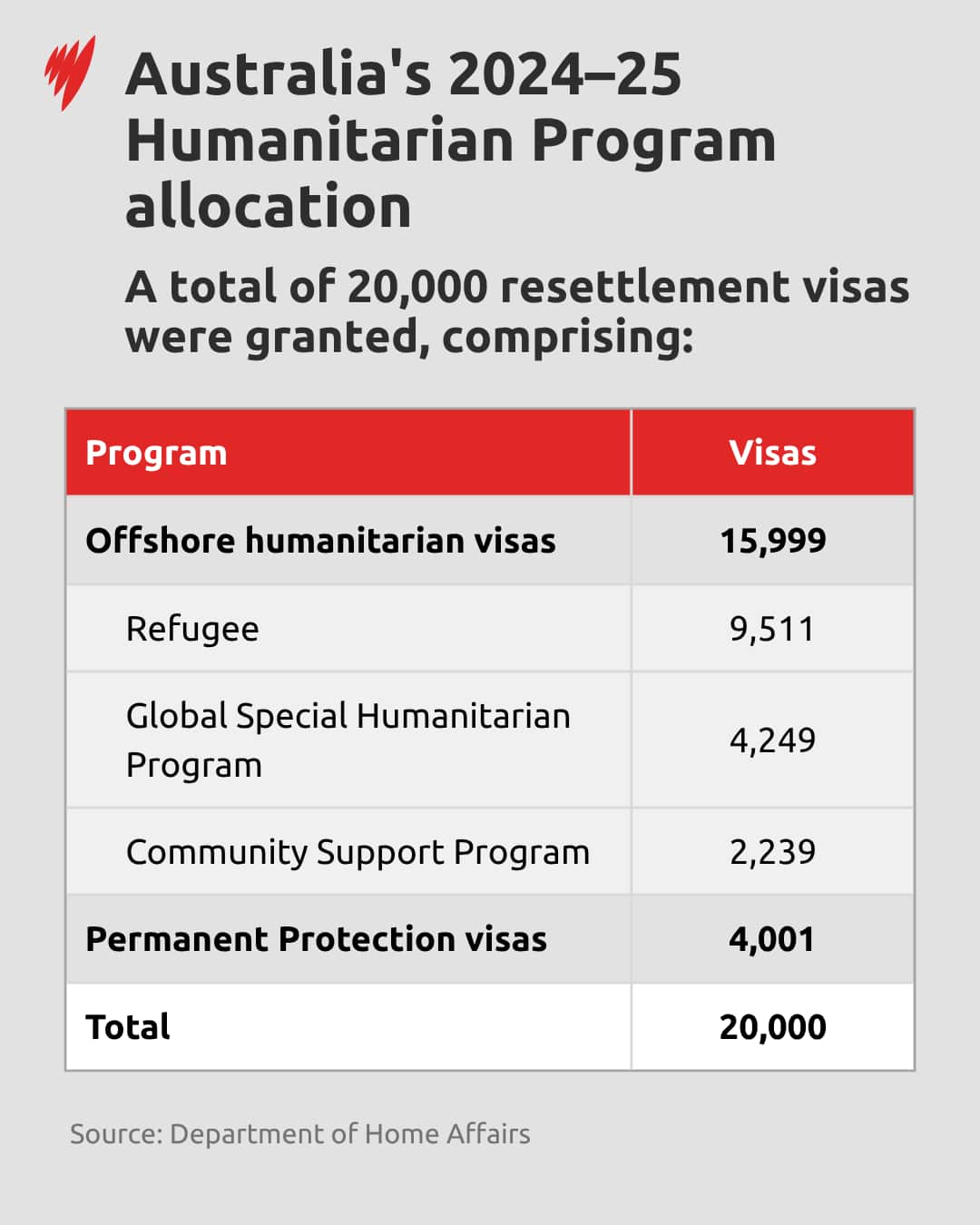
At the centre of that system is Australia's Humanitarian Program — the 20,000-place annual allocation that serves as the country's main avenue for offering refugees a permanent home.
In the decade to mid-2024, the program accounted for 6.6 per cent of Australia's net overseas migration.
Refugees can reach Australia by other means — through skilled-work or family visas, community sponsorship, or, in rare cases, ministerial intervention — but these largely sit outside the capped humanitarian intake, leaving the 20,000 places as the main measure of Australia's annual refugee commitment.
The offering is split three ways: refugees referred from overseas by the United Nations refugee agency on the basis of protection need, refugees sponsored by communities already in Australia, and people granted permanent protection onshore after being found to have refugee status. Because all three streams compete for the same pool of places, growth in one category can reduce availability in another.
Now the program — and the wider asylum framework it sits within — faces pressure not only from the Opposition, but over its future size.
Sources present at a ministerial roundtable earlier this year told SBS News that Assistant Immigration Minister Julian Hill, who hosted it, reportedly indicated the annual intake would hold at 20,000 places for 2026–27, but could fall to 13,750 the following financial year — a cut of more than a quarter.
Such a reduction would mark a sharp retreat from Labor's own ambitions. The party's 2023 national platform committed to gradually lifting the Humanitarian Program to 27,000 annual places.
The Department of Home Affairs did not confirm the figure reportedly discussed at the roundtable. In a statement to SBS News, a spokesperson said the program had been "maintained at this level through 2024–25 and 2025–26" and that the government "will maintain the program at 20,000 places in 2026–27".
Asked about future years, the spokesperson said: "Settings for future program years remain a matter for government."
The million milestone
Behind the program sits one of the more remarkable threads in Australia's modern history.
Since the end of World War Two, the country has granted one million permanent humanitarian visas — a milestone built on bipartisan support, with every government since 1947, Coalition and Labor alike, backing refugee resettlement.
Australian delegates helped draft the 1951 Refugee Convention, and the country's signature brought it into force in 1954.
The Refugee Council of Australia (RCOA) says that history is a source of great pride.
"People who were refugees have come to Australia from nearly every corner of the world and contributed to all aspects of our nation's life," its director of policy and research, Rebecca Eckard, tells SBS News.
"Today, millions of Australians have a direct connection to the refugee program personally or through their parents, grandparents or great-grandparents."
However, Eckard warns the program is as precarious as it is celebrated — and that its weakness is structural. Onshore protection is folded into the same 20,000-place cap as resettlement from overseas, forcing the two to draw from one pool — and last year, about 4,000 places, roughly a fifth of the program, went to people granted protection after arriving in Australia.
That arrangement also creates a bottleneck. As the financial year ends and the cap fills, grants slow to a crawl: in June 2025, monthly protection grants fell to 89, down from an average of 359 in the months before.
By global standards, the program is small. More than 42.5 million people are refugees worldwide, according to the UN Refugee Agency, and fewer than 0.2 per cent are expected to be resettled anywhere this year.
It has also shrunk from its own past. According to RCOA, Australia's humanitarian intake peaked above 89,000 visas in 1949–50. It rose past 21,000 twice more: during the Fraser government's resettlement of Indochinese refugees, and under the Coalition's additional Syrian and Iraqi intake in 2016–17.
That is the context in which Eckard frames any cut as a withdrawal at the worst possible moment.
"Australia's Humanitarian Program is a vital lifeline," she says.
We should be doing everything we can as a country to find ways to grow this lifeline at a time of unprecedented need.
For those still waiting, Eckard says resettlement is often the only safe option left — offering "hope and practical alternatives" to people who might otherwise risk dangerous journeys in search of safety.
Successive governments, however, have argued that maintaining a capped program helps preserve public confidence in the refugee system and ensures settlement services can keep pace with arrivals.
Why a Labor government that once spoke of lifting the program towards 27,000 places would reportedly be considering a reduction is a question Abul Rizvi, a former deputy secretary of the Department of Immigration, traces to three pressures.
The first is fiscal. The onshore program, Rizvi says, is "a significant negative" on the budget, "whereas most other permanent visas have a positive budget impact".
The second is scale. At 20,000 places, the program is at its largest in decades and delivering proper settlement services for an intake that size is difficult.
The third is political arithmetic. The government, he says, "desperately needs to find a way to clear the massive backlog of partner visas without increasing overall permanent visas" — and trimming the humanitarian program would help make room.
A decade in the waiting room
The pressures Rizvi describes are budgetary and administrative. For the people caught inside the system, though, the cost of a stalled program is measured differently — in years.
Sidiqa Faqihi was a teenager when her family fled Afghanistan, her father telling his children it was for their safety and a future they could not have at home.
The Faqihis are Hazara, a mostly Shia ethnic and religious minority that has faced more than a century of persecution in Afghanistan.
Many rights groups and scholars have described the treatment of Hazaras as genocidal, citing mass killings, systemic discrimination and exclusion from public life. There has not yet been an international court ruling that has made a legal determination of genocide in relation to the Hazara community.
In Afghanistan, Faqihi's father had campaigned for Hazara rights. It was dangerous work, and in the end, it was what forced the family to leave everything behind.

In 2013, the Faqihis flew to Indonesia and registered with the UN Refugee Agency, expecting to wait at most 2 years before resettlement.
They waited nearly a decade.
Indonesia has never signed the UN Refugee Convention, and offers those seeking protection no right to work, study or settle.
The then-19-year-old Faqihi had pictured enrolling at university within her first week of arriving. She instead found herself in what she describes as an "escape room" with no way out.
"Any door you knock, you end up with another disappointment," she tells SBS News.
"Years of my life where I could not only have a place to call home, get [an] education, use opportunities, but contribute to social and economic growth."
The reason the wait stretched so long lay in a shift unfolding around her.
For years, Indonesia had been treated as a transit country: a place asylum seekers passed through, registering with the UN before being resettled onwards, most often to Australia.
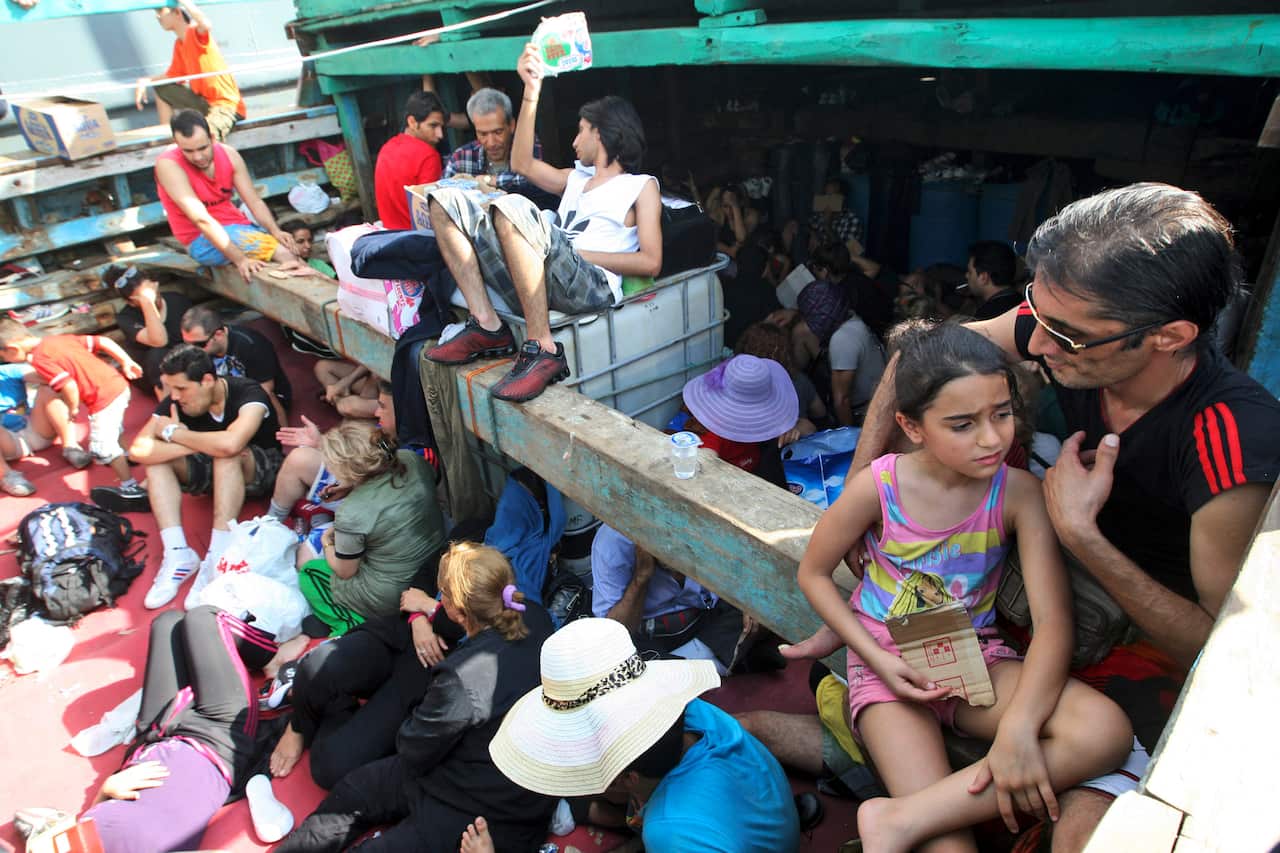
Tens of thousands made the next leg by boat — more than 50,000 reached Australia by sea between 2009 and 2013, and hundreds — by most estimates, more than a thousand — died trying.
The boats became the central question of Australian politics. In 2013, a Labor government declared that anyone arriving by sea would never be resettled in Australia, then lost the election weeks later to a Coalition promising to "stop the boats".
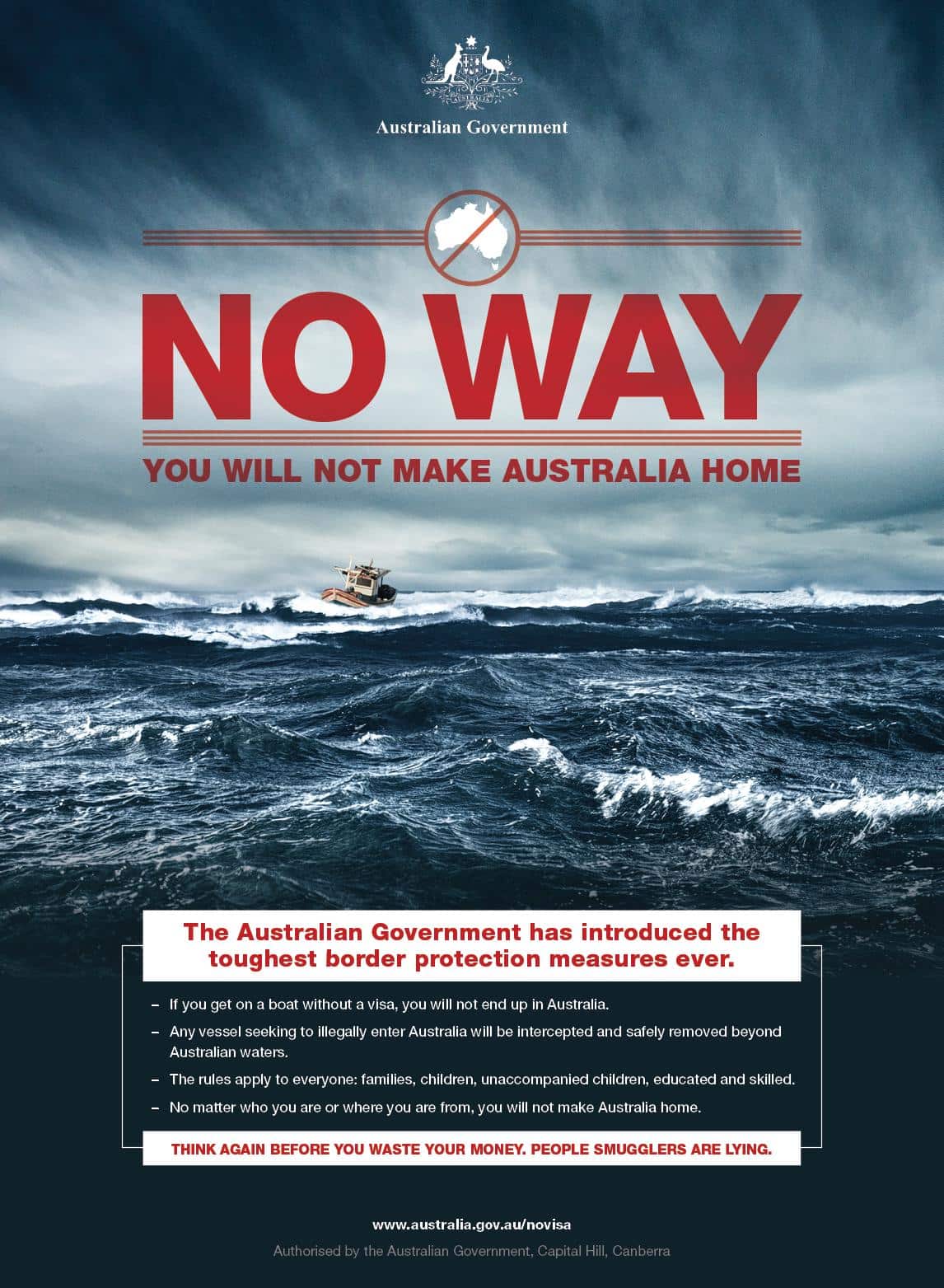
Within days of taking office that September, the new government, led by Tony Abbott, launched Operation Sovereign Borders, a military-led campaign to turn boats back towards their point of departure.
Its message was broadcast widely across the Asia–Pacific: a poster of a vessel on a churning sea, stamped with the words: "No Way. You Will Not Make Australia Home."
The materials were aimed at asylum seekers travelling through the region, including a large number of Hazaras from Afghanistan using the Indonesia route at the time — people like the Faqihis.
In November 2014, the door closed almost entirely. The then-immigration minister Scott Morrison announced that anyone who registered with the UN Refugee Agency in Indonesia on or after 1 July that year would no longer be eligible for resettlement in Australia — a move he described as "taking the sugar off the table".
Australia, which had once resettled more refugees from Indonesia than any other country, all but stopped: fewer than 100 in the years since.
The Faqihis had registered in 2013, just inside the line — a matter of months that would decide the next nine years of their lives.
Several rights groups, including RCOA, are urging for the 2014 ban to be lifted, so refugees stranded in Indonesia — some for more than a decade — face the same protection considerations as those anywhere else.
A door in Faqihi's labyrinth finally opened in 2022. Australia resettled her entire family — her parents and six siblings — permanently, in Melbourne.
For the first time since she was a child, she says, Australia had given her "not only a place to call my permanent home, but somewhere that I can live with safety, stability and dignity".
Now 31, Faqihi has completed a diploma in community services and works at the RCOA, coordinating a program that collects the stories of refugees.
"This program is very close to my heart," she says, reflecting on what she acknowledges as a rare, full-circle moment.
She is clear about what the years of waiting nearly cost her.
My life would have looked very different.
"Living with constant uncertainty, fear and mental distress."
Before the welcome was certain
Mark D'Souza arrived in Australia in the same season the country stopped turning people like him away.
He was about 20 in 1972, at university in Uganda, when Idi Amin, then Uganda's military dictator, announced that God had come to him in a dream and instructed him to expel the country's Asians.
More than 50,000, including the D'Souzas, were given three months to leave. His family had come from India when he was two, into a Uganda then full of opportunity.
"We were pretty shocked. There was no forewarning," he tells SBS News.
Asians were ordered to carry red identity cards, which D'Souza still keeps.
"It reminds you of what was happening in Germany during the time of the Jews," he says, referencing the persecution Jews faced under the Nazi regime in the 1930s and 1940s.
As the violence spread and friends began to vanish, his father resolved to get the family out.
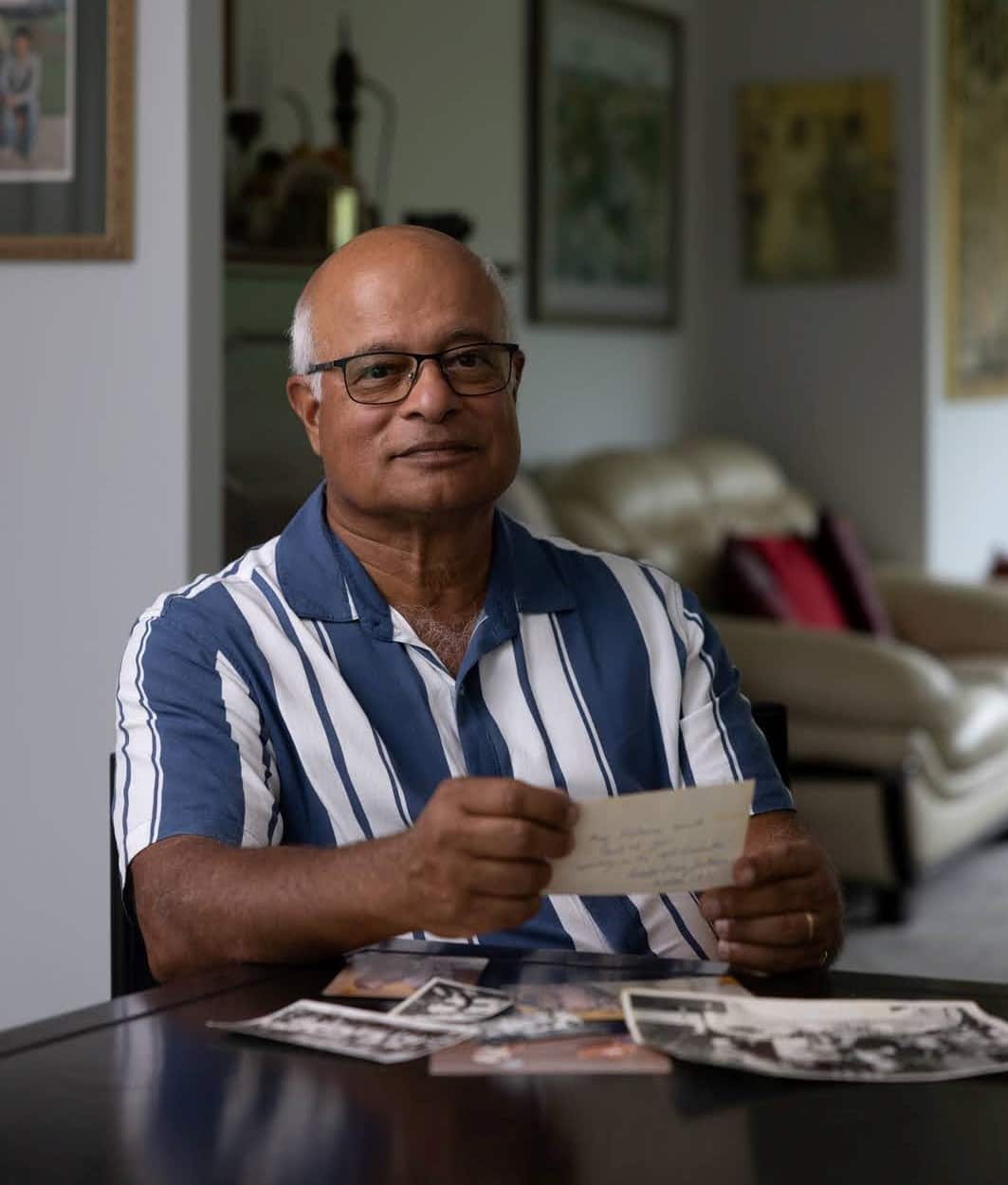
The question was where they could go. Canada took thousands of those expelled, Britain took tens of thousands more, but Australia took comparatively few. A family friend — a London-trained agriculture lecturer — was rejected on the grounds that his skills were not needed.
To D'Souza, the reason was unmistakable: the White Australia policy, a system of discriminatory laws that had governed entry to the country since federation.
The Immigration Restriction Act 1901 was among the first laws of the new Commonwealth, designed to keep Australia white and British.
It did not say so outright — Britain disapproved of explicit racial wording — and instead relied on a 50-word dictation test, administered in any European language chosen by officials, and after 1905 in "any prescribed language". A migrant Australia wished to exclude was tested in a tongue he could not know and inevitably failed.
For more than half a century, the test held the door shut against almost all non-European migrants.
By 1972, it was collapsing. The Whitlam government, elected that December, moved to strip the remaining racial criteria from migration law.
Weeks before the family was due to fly to Britain, the Australian embassy relaxed its rules and began granting visas to Asians. The D'Souzas were recognised as refugees and, by his account, caught one of the last flights out.
The welcome D'Souza had been warned against never came. Officials met the family at the airport and drove them to a migrant hostel. They received unemployment benefits, medical cover, and, he says, kindness.
D'Souza finished his degree, became a financial controller, and bought a home.
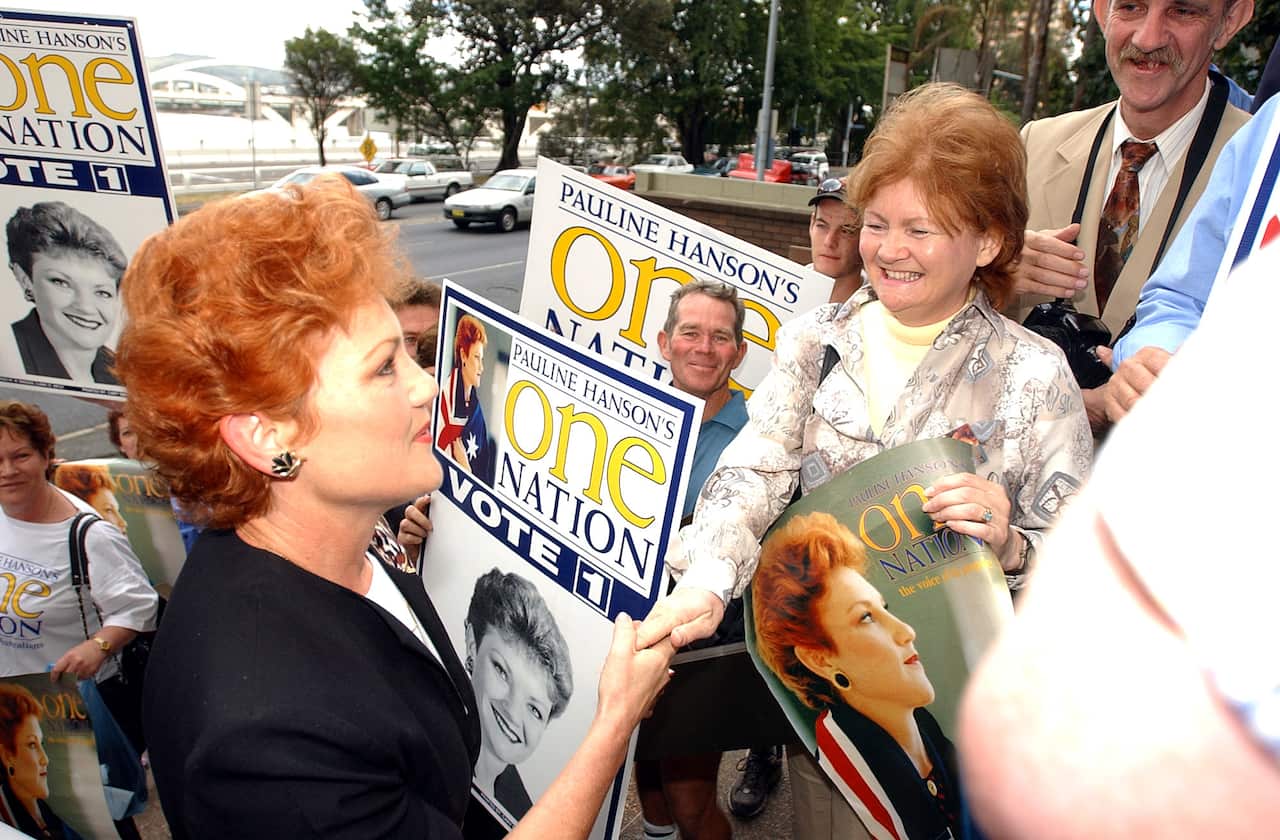
He has watched the country test the same questions since. In 1996, he heard new MP Pauline Hanson tell parliament that Australia was "in danger of being swamped by Asians" and waited for then-prime minister Howard to repudiate her. That never came.
Decades on, in the Sydney suburb where the now 73-year-old has settled in retirement, residents fought to stop a mosque being built.
He hears today's debate — the talk of values, of who belongs — and finds it familiar.
It does concern me that we're going to see this happening again.
"To see governments now changing their policy and the values they had, all for the sake of votes — it is sad."
Still waiting
At the heart of Australia's immigration framework sits a question that has never really changed: who gets to stay, and who is left waiting.
Palestinian Zuhria Al Hattab has reached safety, but not permanency.
Of the 18 visas her sister in Australia applied for, only five were granted. Al Hattab and her brother Mohammed — separated from the rest of the family the night the bombing scattered them from their grandmother's house — were among the names approved, and the two who made it out.
The other three visas, granted to her father and brothers who remain in Gaza, expired before they could be used. Her sister has reapplied but has not received a response from the department.
Her mother is not waiting with them. She died in an earlier cycle of violence, years before this one.
In Perth, Al Hattab is studying English so she can retrain as a teacher's aide. She is grateful and says so plainly — not for status or comfort, but for the most ordinary things: that here, she can find food, drink clean water, sleep through the night.
"This is simple things for all people — to get food, to sleep well.
This is what we were wishing for in Gaza. Nothing more.
Then the message she keeps returning to:
"We are civilians. We just want to live in peace."
For the latest from SBS News, download our app and subscribe to our newsletter.







