This article contains references to gender-based violence.
Watch Dateline's latest episode, Peru's Love Cheats, now on SBS On Demand.
In downtown Lima, Peru's capital city, Sergio (not his real name) looks at a cheque for US$20,000 that will finalise his divorce. He never expected to end up in this position — or that a private detective agency would be crucial to it.
News that makes sense
Your trusted source for staying up-to-date with the world around you. Get free daily news updates and analysis, straight to your inbox.
In 2024, after 14 years with his wife, and with two young children, he arrived home from work to find his belongings in the street.
"You always think that [your marriage will last forever]," the 37-year-old told Dateline.
"I think that's why you get married, not only in my country, but in many countries in Latin America. It's about giving everything, and when I say everything, I mean everything."
Sergio doesn't want to use his real name due to the stigma associated with divorce in Peru, which he says could impact his career.
He says after talks to repair his relationship failed, he contacted divorce lawyers. Reviewing his case, they immediately suggested the unthinkable was to blame: that his wife had been unfaithful.
"I didn't believe it. Not from her, because she's from a small town, with many traditions and a strong Christian culture. I even met her in a religious prayer group," Sergio said.
To get to the truth and facilitate divorce proceedings, Sergio says his lawyers recommended something unusual: that he hire private detectives to investigate. It didn't take them long to prove his fears were true, giving him photos, videos and audio recordings that established the affair.
"The evidence was sufficient to declare it infidelity," Sergio said.
"One of the hardest things was that I recognised the (man's) voice and it was my best friend."
Peru's female love detectives
Sergio is among a growing number of Peruvians turning to private detectives to investigate their partners for suspected infidelity, as divorce rates in this deeply Catholic country steadily rise.
Australia has 'no fault' divorce, meaning neither party has to prove wrongdoing to end a marriage. In Peru, if infidelity is established, it can impact the division of a couple's assets, as well as custody of children. It's also a valid ground for filing an annulment or divorce case
Historically, adultery was considered a crime in Peru. Legislation dating back to the 1920s allowed for people to be sentenced for up to six months in prison if they were found to be unfaithful. In 1991, it was removed from the criminal code, but is still considered grounds for divorce
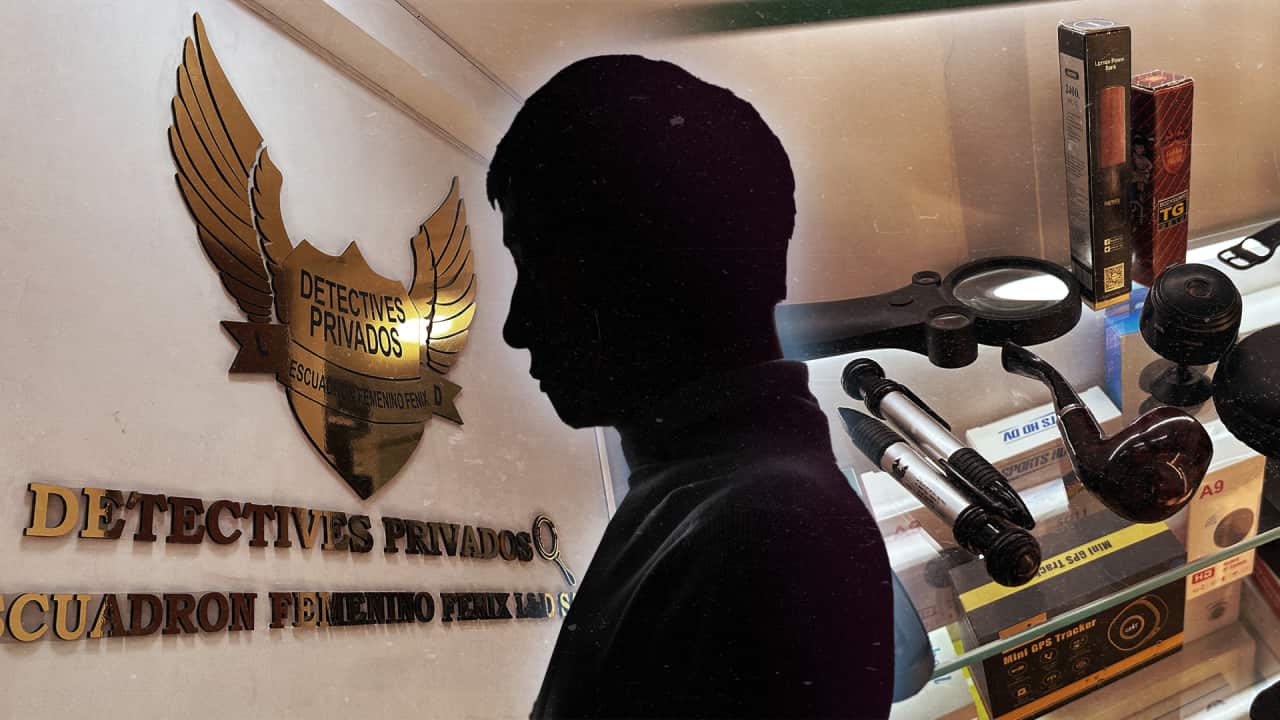
In a nondescript building in Lima, behind a security gate and cameras, Liz Rodriguez runs The Female Fenix (Phoenix) Squad — a private detective agency that advertises as experts in exposing cheaters in the act.

Rodriguez says nearly 90 per cent of her squad's cases centre on infidelity.
"We have between seven and eight new cases per week and sometimes every day," Rodriguez said.
A lawyer and registered private investigator, she works with a team of around 20 field agents, mostly women, who go undercover to conduct surveillance and monitor their client's spouses to gather evidence of infidelity.
The team uses hidden cameras and audio recording devices, as well as disguises; anything from simple wigs and caps to occupational uniforms such as a Lima City municipal worker, mechanic, nurse or doctor.

"Each team has four people, including two patrol cars, a motorcycle officer, three or four female investigators who can follow the person into places like workplaces, nightclubs, hotels or restaurants," Rodriguez explained.
She said demand for her squad's services — and other agencies like them — has grown considerably in recent years in line with the rate of divorce in Peru.
"Most people get married and within a year they're already wanting a divorce, looking for reasons, and one of those reasons is infidelity or dishonourable conduct," she said.
A husband or wife can sue for damages (psychological pain and suffering) against the offending spouse and the third party involved.
"That's why we're in high demand," Rodriguez said.
"It helps the person know the truth and gives them solid evidence for a legal process."
She described her work as "a community service".
Rise in infidelity and divorce
A traditionally Catholic country, Peru is in a state of flux, marked by decades of political and social upheaval.
In February, the nation's interim president Jose Jeri was ousted after just four months in the job, becoming the latest in a list of Peruvian presidents to be removed from office before completing their terms. This follows the removal of former president Dina Boluarte in October last year which triggered widespread protests.
This institutional instability extends into relationships and dating.
In 2025, the country registered 10,136 divorces, 13 per cent more than in 2024, according to the latest figures released by the Peruvian National Superintendency of Public Registries.
The government says infidelity is among the main causes.
The widespread use of mobile devices, social media and apps has also generated new forms of communication that are being leveraged by people who decide to cheat on their partners.
Stigma associated with infidelity can make it hard to get accurate statistics, but a 2023 online survey conducted by data gathering platform Statista suggests more than 70 per cent of Peruvian men and 60 per cent of Peruvian women have been unfaithful to their partner, whether online or in person.
Liz Rodriguez from the Fenix Squad also attributes the country's high rate of infidelity to shifts in gender equality, with Peruvian women achieving greater access to education and employment in recent years.
She says around 70 per cent of infidelity cases investigated by the Female Fenix Squad are brought by male clients who are concerned about potentially cheating wives.
"Women in Peru are more independent, more empowered. So, if they see something they don't like, they decide to divorce or commit infidelity; they also have more opportunities to do so. And they also have access to social media, right? So all of that contributes," Rodriguez said.
The 'peasant patrols' policing infidelity
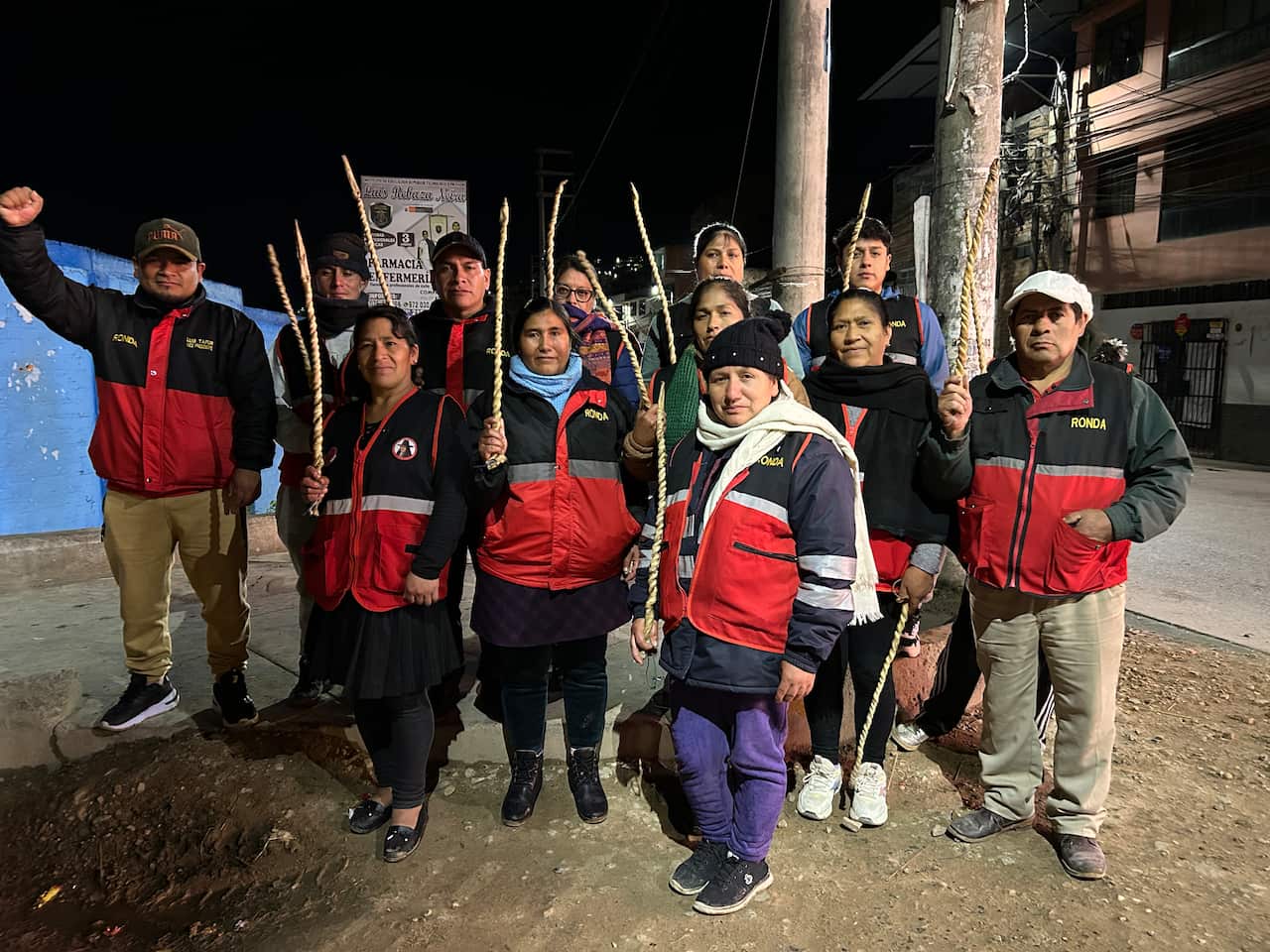
Despite infidelity being increasingly accepted in the capital city, it's a different story in Peru's northern highlands. Here, it remains a punishable offence, enforced by indigenous 'peasant patrols', or 'rondas campesinas', autonomous groups initially formed in the 1970s, legally recognised by Peru's government.
In Cajamarca, a city of around 300,000 people, the ronda campesina regularly issue public whippings against cheaters. In late 2025, a video of one such punishment went viral.
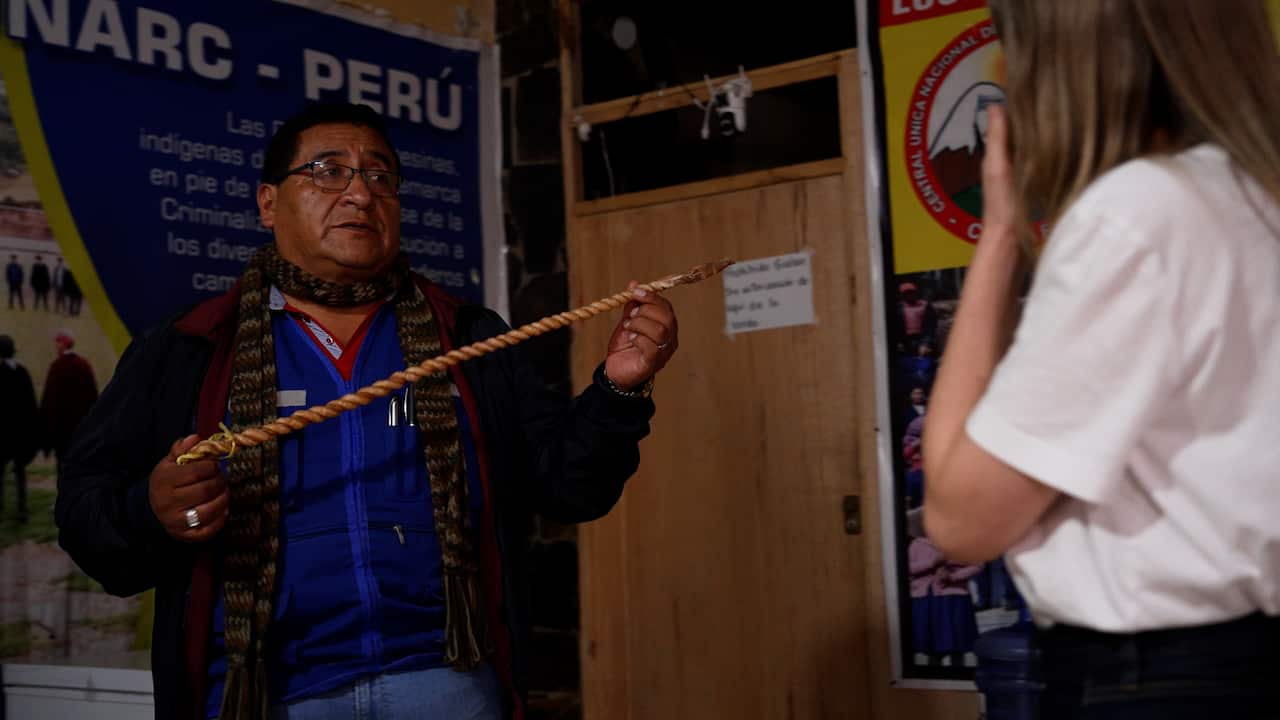
The peasant patrol's traditional whip, known as 'la vinza', is made from a bull's penis that is dried, soaked, then braided.
"It hurts a lot. It even ... breaks the skin," said Fernando Chuquilin Ramos, the leader of Cajamarca's patrol.
Peasant patrols are legally authorised to resolve local disputes and issue justice, often in the absence of state police.
Ramos said that if unfaithful spouses aren't punished by the ronderos, they can face beatings from their families instead.
"To appease the spouse's anger, they must be punished ... here in the community patrol, transgressions are punished. We don't let them slide."
Ramos says infidelity is devastating his community, often contributing to the country's soaring rates of domestic violence and femicide.
"From our point of view, seeing the reality, it's more serious than people think. Because it can end in death," Ramos said.
"What happens as a result, if the woman is unfaithful? Sometimes the husband goes as far as beating her and killing her. There was a case here in Cajamarca where a man found out about the cheating. He found his wife in a nightclub, I think. He beat her to death with bricks in the street. Now he's been sentenced."
Since 2015, at least 1,345 women have been killed by their partners or family in Peru, with 154 cases of femicide registered in 2024 alone, according to the National Institute of Statistics and Informatics (INEI). This is equivalent to a rate of one femicide for every 100,000 women.
Around 37 per cent of femicide cases in Peru reportedly stem from jealousy, according to a 2024 study by the INEI, followed by family violence at 17.5 per cent, and refusal to return to or continue a relationship at 12.9 per cent.
Ramos says women can also be the perpetrator of violence too.
"That happened in the province of Chota. She cut off his penis. Now the woman's [serving] life in prison," he said.
Exposing cheaters on TV
Back in the capital Lima, others are using less traditional means to confront infidelity, instead by bringing it to the nation's attention.
Every night, 62-year-old journalist, presenter and entertainer, Magaly Medina, fronts the show Magaly Teve. This popular entertainment and celebrity gossip show broadcasts paparazzi-style exposes of celebrity cheaters — catching anyone from football stars to presidents.

Known as 'ampays' — or 'gotchas' — they're made by her team of videographers, nicknamed magpies, who catch cheating couples red-handed, drawing millions of viewers.
"[Magaly Teve] is like an act of rebellion against the way I was brought up," explained Medina.
She hopes to make infidelity less taboo while holding men to account.
"I was taught by my mother: 'It doesn't matter what your father does. He can have many women. But I am the cathedral and the others are the little parishes'. That was a very common saying among our grandmothers and mothers."
"For me, as a modern woman, that seems humiliating for any woman, knowing that your husband has other women in his life, and doing nothing about it."
If you or someone you know is impacted by family and domestic violence, call 1800RESPECT on 1800 737 732, text 0458 737 732, or visit 1800RESPECT.org.au. In an emergency, call 000.
The Men’s Referral Service, operated by No to Violence, can be contacted on 1300 766 491.

Dateline is an award-winning Australian, international documentary series airing for over 40 years. Each week Dateline scours the globe to bring you a world of daring stories. Read more about Dateline

Have a story or comment? Contact Us







