RBA Shadow Board backs rate hike amid above-target inflation
Australia's RBA Shadow Board has recommended lifting the cash rate to 3.85 per cent, while assigning a 74 per cent probability that a hike was warranted.
It said on Sunday that inflation remained too high, with annual CPI at 3.8 per cent and trimmed-mean inflation at 3.3 per cent, keeping price pressures above target.
With the labour market still tight and household spending holding up, the board judged monetary settings insufficiently restrictive.
The board warned that without further monetary tightening, inflation risked "continuing to rise and becoming entrenched".
The shadow board — a group of economists gathered by the Australian National University's Centre for Applied Macroeconomic Analysis — has been running since 2011 and aims to provide the RBA with recommendations.
It is an independent initiative and has no formal affiliation with the RBA.
— Gabrielle Katanasho
Treasurer denies government spending is driving inflation
Recent data showed the RBA's preferred measure of inflation, the quarterly trimmed mean, is running at 3.4 per cent — well above the central bank's 2.5 per cent target point.
"That uptick in that data was primarily holiday spending, but it was also the withdrawal of the energy rebates," Treasurer Jim Chalmers told ABC radio on Tuesday.
"There were some persistent pressures there in housing and there were some weather-related factors as well. But overall, we know that inflation is higher than we would like."
Chalmers refused to pre-empt the Reserve Bank's decision on interest rates, but he said he took responsibility for all parts of his role as treasurer.
"I'm not part of their discussions on the broader point about inflation, we have acknowledged … that inflation is higher than anyone would like."
— AAP
Inflation being driven by housing scarcity, property economist warns
Housing Industry Association chief economist Tim Reardon said monetary policy had been asked to carry the burden of controlling inflation that was increasingly being driven by housing shortages rather than excess demand.
He said housing costs had become the most persistent contributor to inflation, while higher interest rates — the primary tool used by the Reserve Bank of Australia (RBA) — directly restricted the supply of new homes.
"Monetary policy and fiscal policy need to be coordinated and working together, and that is the problem we have in housing inflation at present," Reardon told SBS News.
He argued governments had relied on housing as a major source of revenue, lifting costs and constraining supply, while further tightening by the RBA risked compounding the problem.
"Doubling down with tighter monetary policy will make that worse," he added.
Reardon said the solution lay in easing fiscal constraints and accelerating housing delivery rather than forcing the RBA to slow the broader economy.
— Gabrielle Katanasho
How could it affect your borrowing power?
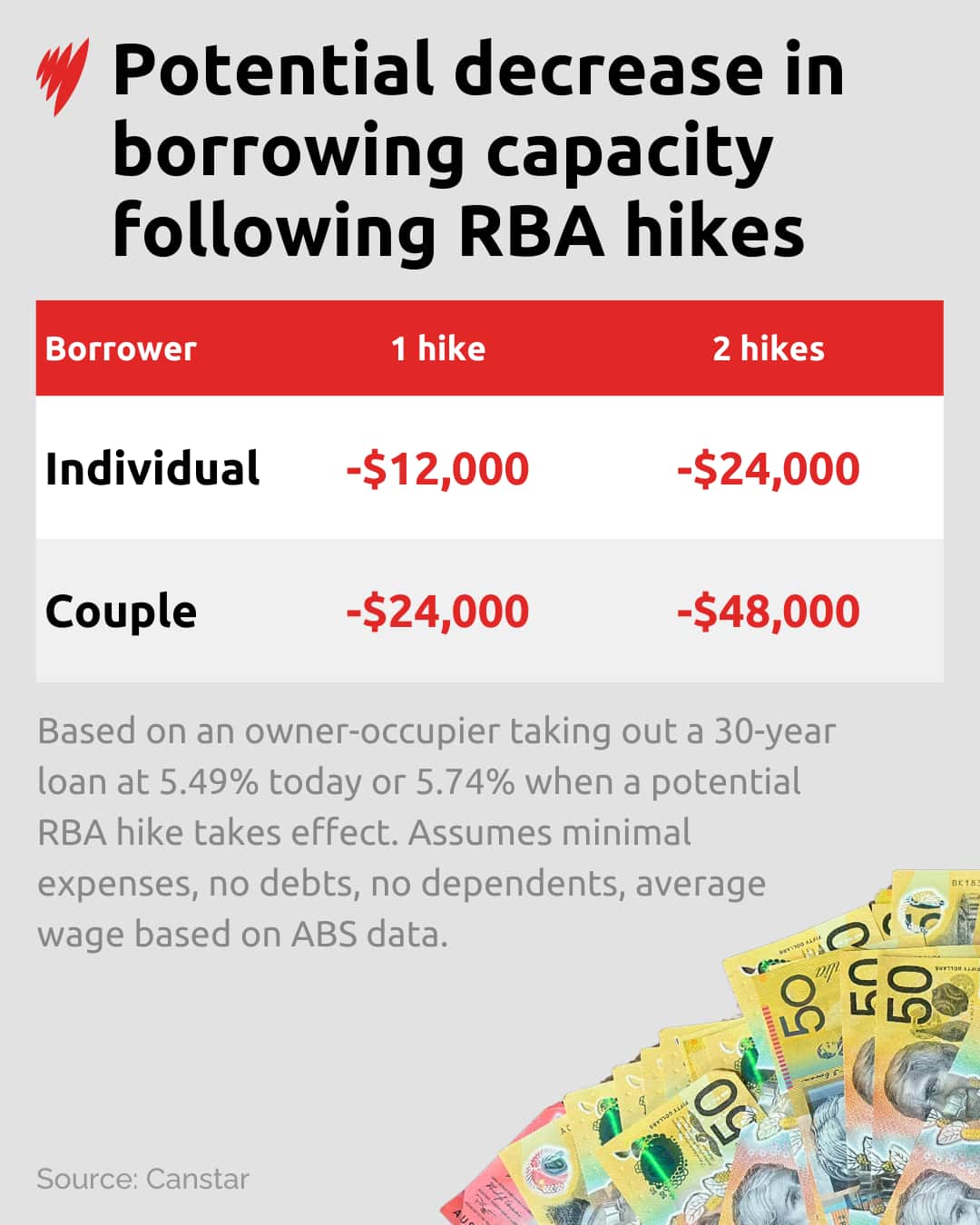
Canstar modelling also illustrated how higher rates would reduce borrowing capacity for new buyers.
One hike could see a $24,000 reduction in borrowing capacity for a couple, while two increases could double that figure.
— Josie Harvey
How much will a rate hike cost you?
Analysis by financial comparison site Canstar shows that a 0.25 percentage point rate hike would lift minimum monthly repayments across a wide range of mortgage sizes, increasing pressure on household budgets already strained by elevated living costs.
For example, an owner-occupier with a $600,000 mortgage and 25 years remaining would see their minimum monthly repayments rise by $90, assuming banks pass it on to their variable customers.
For a mortgage of $1 million, minimum monthly repayments would rise by $150, bringing the repayment to $6,303 a month.

— Josie Harvey, Gabrielle Katanasho
Welcome to our coverage of the RBA rates decision
Good afternoon, and welcome to our live blog. We'll be bringing you updates and context around the Reserve Bank of Australia's (RBA) announcement on the official cash rate.
The RBA is set to announce its decision at 2.30pm AEDT after its first board meeting of the year. A press conference will follow at 3.30pm.
All of Australia’s 'big four' banks, as well as economists from major banks and consultancies, are forecasting a hike.
Financial markets are pricing in roughly a 70 per cent chance of a 0.25 percentage point increase.
However, some believe there's a case for the board to hold the cash rate at its current level.
A rate hike would make the RBA the first major central bank to do so following a series of cuts as inflation eased in the wake of the COVID-19 pandemic.
— Josie Harvey, Gabrielle Katanasho







