
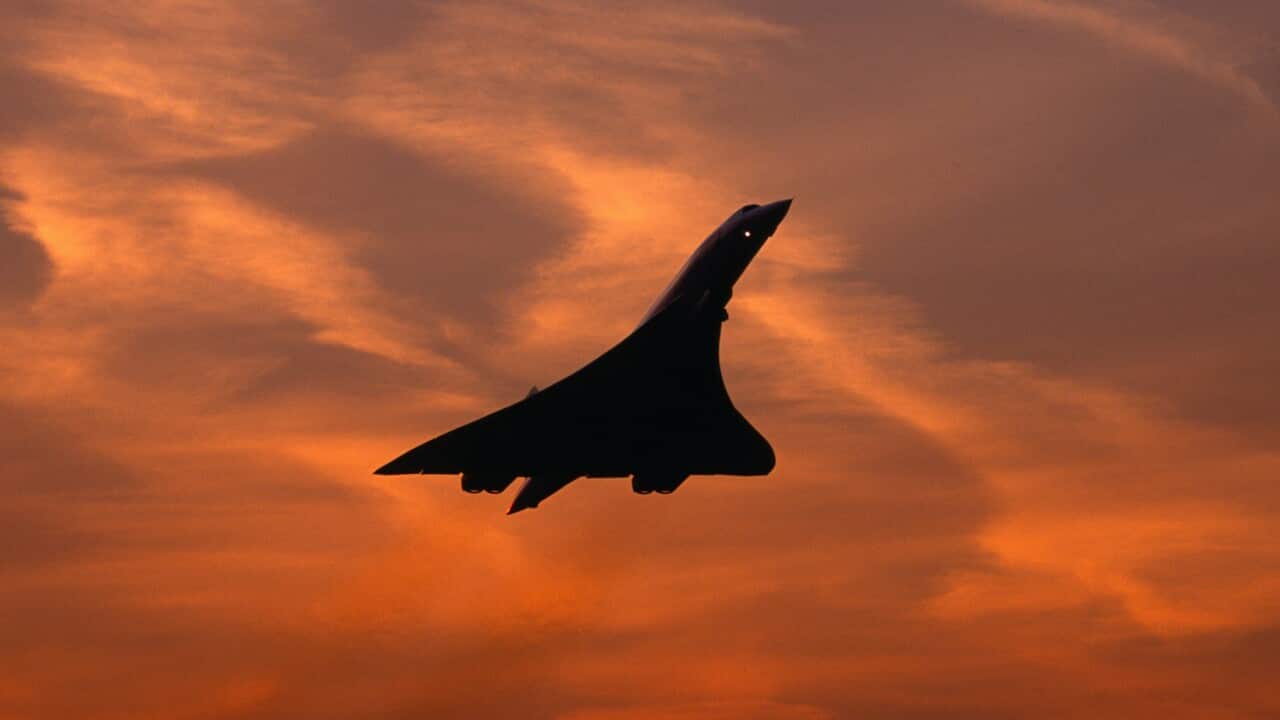

The world’s first supersonic passenger plane, Concorde, made its maiden commercial flight 50 years ago this month on 21 January 1976. Its delta-wing design and drooping nose made it instantly recognisable, and although it went out of service in 2003, it is still remembered to this day.
Listen to Australian and world news and follow trending topics with SBS News Podcasts.
TRANSCRIPT
Concorde's occasional visit to Australia made headline news.
This report was from Channel Nine's John Collis in 1985, who watched Concorde set off on a record-breaking trip from Sydney to London.
“She received the all clear and huge jets roaring bulleted down the runway. Concorde soared rapidly to 5,000 feet, turned left through 180 degrees and set necks craning again as she swept above the harbour in a farewell salute to Sydney. She should be on the ground at Heathrow just 17 hours after takeoff, meaning yet another record for Concorde. Because no one has bothered to claim a new record for the Sydney to London flight since 1938, it still stands at 130 hours.”
While there were ambitious plans, consistent, profitable commercial routes to Australia were never established.
It was Just nine years earlier, in January 1976, that Concorde made its maiden commercial flight.
Newsreel commentators waxed lyrical about the revolutionary aircraft.
“Concorde's paper dart appearance promises performance and it keeps its promise. It's twice the plane in more than looks. It can fly twice as fast and twice as high as other airliners and can cut journeys in half. “
Concorde combined raw power with a sleek elegance that made it unlike any passenger aircraft before or since.
It was the aircraft that carried royalty, celebrities and business leaders across the Atlantic at unheard-of speed.
Developed through a joint project between Britain and France in the 1960s by the British Aircraft Corporation and Sud Aviation, later Aérospatiale, Concorde was designed to cruise at more than twice the speed of sound and at altitudes of nearly 60,000 feet, on the edge of space, far above conventional airliners.
Peter Archer is the chairman of Duxford Aviation Society in Britain.
“Concorde design, it was in 1962, both the French and British governments had people working on it. They couldn't afford to do it separately so it came in a combined operation and over the next seven years, British designers and French designers and engineers all worked together. And it was pretty remarkable because they didn't have a lot of computing power, not like we have today. And one lot were working in metric system and the other lot in imperial, and they were building it in two factories but they all joined together and it worked.”
Air France and British Airways wanted to fly Concorde to the US on the lucrative trans-Atlantic route.
But American authorities were reluctant, citing sonic booms and environmental impact, banning Concorde because it was the world's noisiest plane - though many believed the ban was really because the plane had not been built by a US manufacturer.
The Europeans argued that the ban was discriminatory and detrimental to Concorde’s operations - and in August 1977, the US Supreme Court agreed and the ban was lifted.
“The famous nose scents a victory that a few weeks ago seemed defeat. With the skies clear to New York for supersonic flight, it's felt the rest of the world will go Concorde.”
There was no getting away from the fact that Concorde looked beautiful but was, indeed very noisy.
Former chief engineer John Britton says, however, the engines were revolutionary.
“One of the first things I started working on at that time, so we're talking about 1968, we were building the prototypes, so I was actually working on the engine. The engine we called the power plant because it's the engine (controls) the air intake and then the primary and the secondary nozzle. So there's three main bits of it. And the whole of it goes to make up the power plant.”
Concorde only ever had one crash - but it grounded the supersonic jet forever.
On the 25th of July 2000, a piece of metal dropped from a Continental Airlines DC10 on to the runway at Charles De Gaulle airport in Paris.
Air France Flight 4590 ran over the debris, causing a tyre to explode and disintegrate. Tyre fragments, launched upwards at great speed damaged parts of the landing gear and ruptured a fuel tank.
The images of Concorde with flames streaming behind it in the seconds before it crashed were hard to forget.
All nine crew and one hundred passengers on board were killed, as well as four people on the ground.
John Britton again.
“The next morning we were on the crash site in Gonesse and that was a terrible experience because all our training and experience was aimed at keeping aircraft in perfect airworthiness condition and that is my responsibility. I held the airworthiness signature to the CAA in the UK for our work share of the Concorde fleet. And so to be confronted with something that we thought we would never see that was a Concorde crash was absolutely terrible and it was a real low point in our career.”
The entire fleet was grounded and later returned to service after extensive and costly safety modifications, including strengthened fuel tanks and reinforced tyres.
Flights resumed after 18 months, but passenger numbers never fully recovered, and maintenance requirements increased significantly.
In 2003, both British Airways and Air France permanently retired Concorde, citing rising costs, ageing aircraft and declining demand.
John Britton says for those who worked on it, Concorde remains unmatched.
“My son says, ‘How am I going to tell the grandchildren that their grandpa flew to New York in three hours 20 minutes and it takes us if we want to go to Disneyland in Florida it’s going to take us eight hours to get there?’ And the answer to that is Concorde.”