
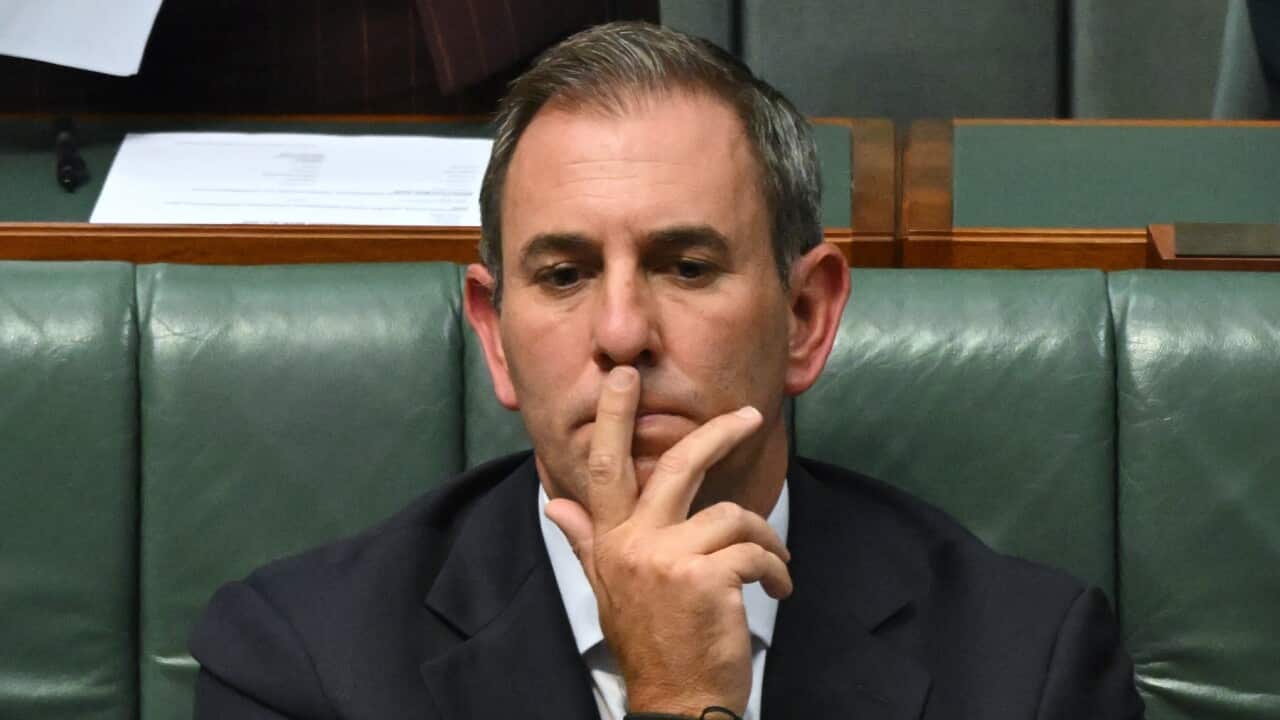

Following the latest interest rate rise, the Federal Government is facing renewed pressure from unions and economists to reform the 50 per cent Capital Gains Tax ((CGT)) discount, which critics label a "tax avoidance scheme" favouring the wealthiest Australians. While the Treasurer maintains a focus on housing supply, proponents of the reform argue that winding back these concessions could reclaim $20 billion in annual revenue and ease the cost-of-living crisis for the nation’s workforce.
Listen to Australian and world news and follow trending topics with SBS News Podcasts.
TRANSCRIPT:
Treasurer Jim Chalmers responding to questions on potential changes to concessions around the Capital Gains Tax:
"Well, the news about the capital gains tax comes from a committee that the greens and the Liberals set up in the Senate. We've made it very clear that we consider there to be inter-generational issues in housing, but our focus there is on building more homes, on supply, and our focus on tax is about cutting income taxes and introducing a standard deduction and legislating better targeted super concessions and lifting the low income super tax offset, and doing the work that we've commissioned on multinational taxes. And so we haven't changed our policy on capital gains, that committee work is ongoing."
This follows the 0.25 per cent interest rate hike announced yesterday by the Reserve Bank of Australia.
The government is facing a renewed wave of pressure to reform the tax, with Australian Council of Trade Union's President Michele O’Neil leading a growing chorus of voices who argue that capital gains concessions must be addressed to provide cost-of-living relief for Australian workers.
"Too many workers can no longer afford to live near where they work, and a growing number of workers will never be able to save enough for a deposit. At the same time, accelerating rents and house prices are outpacing the money people can save each week. The way the capital gains tax operates has become a tax avoidance scheme, with most of the benefit going to the richest 1% of Australians. To make things worse, the discount is effectively paid for by working people who pay much higher rates of tax in line with their personal income. Our tax system shouldn't reward wealth more than work."
So what is the capital gains tax discount and and why is it back in the public conversation?
With 2.2 million Australians owning at least one investment property, senior economist Matt Grundoff from the Australia institute explains how it works.
"The capital gains tax discount is a fifty percent discount, or half of any capital gain is only taxed. that means, if you earn, say, three hundred thousand dollars by selling a house for more than you bought it, only half of that capital gain, $150,000, would be subject to tax, the other half would be tax free."
It isn't a separate tax you pay the moment you sell something; rather, the profit is usually added to your total income for the year and taxed at your standard income tax rate.
Dr Tim Thornton from the school of Political Economy says that capital gains tax reform is essential.
He says that if interest rate hikes are forcing a closer look at government budgets, then any resulting spending cuts must be distributed more equitably.
"An obvious way to do this would be to restrict tax concessions on capital gains and negative gearing. This would reduce the income of investors rather than mortgage holders. Such tax concessions should really only be permitted in instances where investors are constructing new housing stock rather than just bidding up the price of old bricks and mortar. Now, if that idea sounds a bit too pie in the sky for anybody, it's worth recalling that this idea was ALP policy up until July 2021, and was really only abandoned because they lost their nerve, rather than because they thought it was in any way bad policy."
However, leading Australian Economist Chris Richardson says the mismatch between high demand and low supply is always the primary driver of inflation.
He suggests that while reforming capital gains concessions is a noble pursuit, the core of the housing and inflation crisis remains a fundamental shortage of housing supply.
According to his modelling, changing concessions to the CGT would only reduce housing prices by between 1 and 4 per cent.
"Economists around the world are talking about abundance that you know, we need to get better at producing stuff, and housing in Australia is a beautiful example of that. For some decades now, housing policies in Australia could be summarised as the word no, no, you can't do that. No, you can't build here. No, you can't build like that, and even where it is, a Yes, all right, you can build it. But it's with all these rules and restrictions that means what gets built is a stunningly expensive thing, and that, of course, gets you gets passed on to people."
Economist Chris Richardson says orthodox, or neoclassic, economic theory argues that capital gains concessions are necessary to prevent investors from being taxed on phantom gains.
They are gains caused purely by inflation over several decades.
However, he says there's a foundational assumption in economics: the idea that the rich save and the poor spend.
Using this logic, the wealthy serve as the primary engine for national savings.
"Governments should be Robin Hood. They should tax the rich to spend on the poor, but the rich save and the poor don't save. You know, in relative terms, it's easier for the rich to save, it's hard for the poor to save. And so when governments do what they should do, tax the rich, spend on the poor, you lower the amount of saving in in the economy, and that means we don't set enough aside for the future."
However Dr Tim Thornton says given the numbers surrounding the latest rate increase, this argument is not convincing.
"Some have argued changing the capital gains tax would not be effective in reducing overall spending because the wealthy, who are the main beneficiaries of the currently unreformed capital gains tax and negative gears don't spend a very high proportion of their income anyway. I don't find this argument persuasive for several reasons, most obviously because these tax concessions result in $20 billion a year in foregone government revenue. So by removing these concessions, the government could remove up to $20 billion of spending from the economy. Now this is no small thing, particularly if one recalls Chris Richardson's estimate that a $7 billion change in government spending is equivalent to a 25 basis point interest rate movement."
Economist Matt Grundoff says the capital gains tax concessions encourage speculators into the market which pushes up the price of housing, making it harder for first home buyers to get into the market.
He says the only time in which the capital gains tax concessions should be used is to invest in new builds.
"To be clear, at the moment, more than 80% of all houses that are sold as investment properties are second hand houses, houses that already exist, so only a minority are new houses. But if those new houses are encouraging new buildings to be built, then perhaps we could restrict the capital gains tax discount to just new builds."