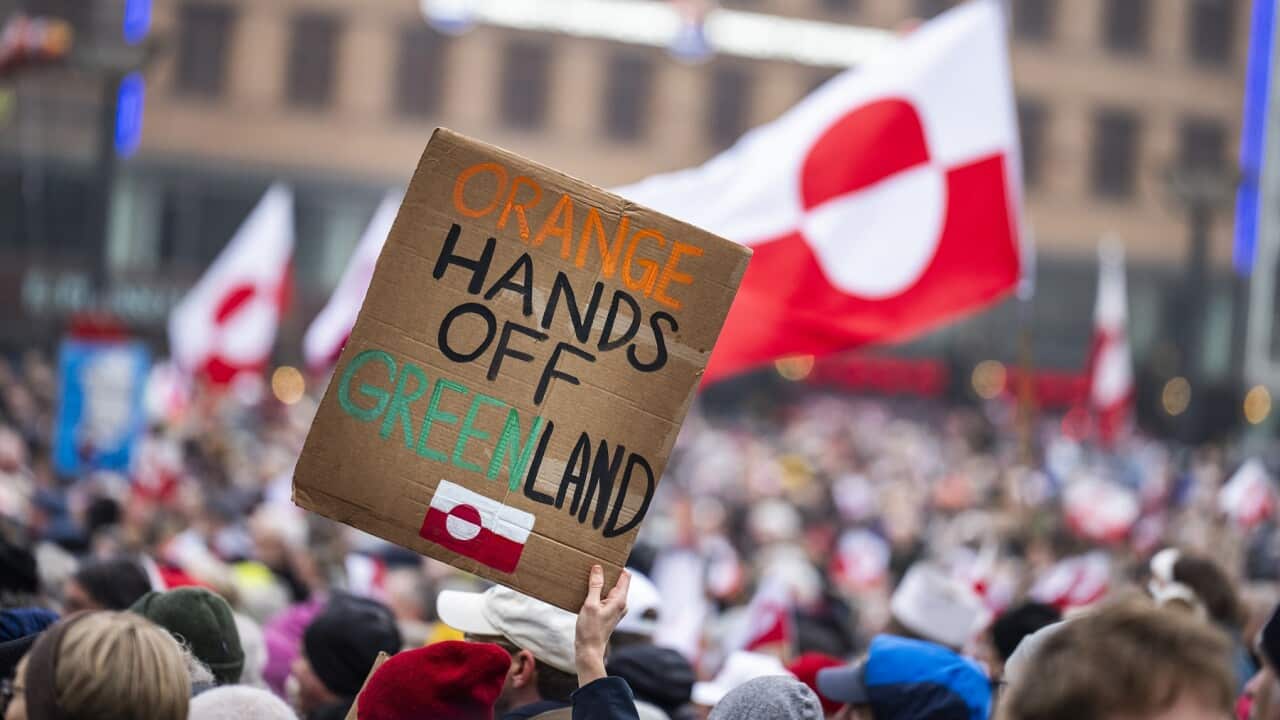

European leaders have condemned threats levelled by the United States to impose new tariffs on countries who don't cooperate with US ambitions to take over Greenland. US President Donald Trump has continued with his plans to acquire control of the Arctic island, prompting warnings about the future of NATO and transatlantic ties.
Listen to Australian and world news and follow trending topics with SBS News Podcasts.
TRANSCRIPT:
In an emergency meeting called in Brussels, European leaders gathered to devise a response to escalating threats from the United States over Greenland.
The meeting was called after US President Donald Trump threatened to impose new tariffs of up to 25 per cent on European countries unless they supported his plans to incorporate Greenland into US territory.
"And, I may do that for Greenland too. I may put a tariff on countries if they don't go along with Greenland, because we need Greenland for national security. So I may do that."
Mr Trump vowed to implement the increasing tariffs on EU members Denmark, Sweden, France, Germany, the Netherlands and Finland, as well as Britain and Norway.
Set to start at 10 per cent on February 1, the increasing tariffs would rise to 25 per cent by June 1, until a deal is reached for the purchase of Greenland.
All eight countries, which are already subject to US tariffs of 10 and 15 per cent, decried the threats, with one minister calling it blackmail.
Danish Foreign Minister Lars Lokke Rasmussen, says Denmark will continue to focus on diplomacy, referring to an agreement Denmark, Greenland and the US made last week to set up a working group.
“We will not give up on that. I mean, I have an agreement with the American vice president (JD Vance). It was reconfirmed after we have listened to the press spokesperson. So we will stay on track unless the US decides differently. But then, at the same time, of course, we need the European Union to respond."
The European Union reached a deal with the US in July for most EU exports to face a 15 per cent tariff.
While it is unclear how these threats would affect that deal, French media are reporting that President Emmanuel Macron is calling on leaders to activate the EU’s anti-coercion measures.
The anti-coercion law, which has never been used, would enable the bloc to impose punitive economic measures on a country seeking to force policy change.
Rasmus Søndergaard, a senior researcher at the Danish Institute for International Studies, says it may be Europe's best option.
"The economic weapon is the best option Europe has. So tariffs directed back at Trump, if they're smart, probably directed at Trump's allies, tech people in Silicon Valley, find a way to try and hit the people that are Trump's support base rather than some of the demographics of the states that are already against Trump in this matter. That of course can be difficult. But we'll see. The EU has the ability to really strike back with force if they want to, and it will hurt European economies (and) it will hurt American economies."
Warning that transatlantic ties are at risk, European leaders say they stand united against the US threats.
The Trump administration argues that Greenland is needed for US national security, that Denmark would be unable to defend Greenland if Russia or China were to invade.
US Treasury Secretary Scott Bessent says securing Greenland would serve the interests of hemispheric security.
"If there were an attack on Greenland, from Russia, from some other area, we would get dragged in. So better now, peace through strength, make it part of the United States, and there will not be a conflict because the United States right now, we are the hottest country in the world, we are the strongest country in the world."
But Denmark is a member of NATO.
In response to the escalating rhetoric, Denmark and several of its European NATO allies recently sent small numbers of military personnel to Greenland for an exercise, to which the US was also invited.
Norway's Foreign Minister, Espen Barth Eide, says European leaders are ready to bolster the security of Greenland.
"The very essence of NATO is to protect the sovereign integrity and territorial integrity of its member states, so that's what it's all about. And that's again, rooted in the collective right of self defence in the UN Charter. And I want to reiterate what also Lokke said that we have two messages that we shared with all the countries we mentioned in this - not only the eight, but all the European countries and Canada - that, on the one hand, we stand with the Kingdom of Denmark in defence of its sovereignty. But we are also ready to do more together with America and with all our allies in the Arctic, and that's exactly why we are stepping up our presence in Greenland, because if there are security concerns, we can meet them jointly."
Since the US military operation against Venezuela saw the capture of its leader, Nicolas Maduro, Donald Trump's stance on Greenland has hardened.
Asked if he would pull the United States out of NATO if they refuse to assist a US takeover of Greenland, Mr Trump didn't rule it out.
"Wait and see. NATO has been dealing with us on Greenland. We need Greenland for national security very badly. If we don't have it, we have a big hole in national security, especially when it comes to what we're doing in terms of the Golden Dome and all of the other things. We have a lot of, a lot of investments in military. We have got the strongest military in the world, and it's only getting stronger. And you saw that with Venezuela. You saw that with the attack on Iran, with the knocking out their nuclear capabilities, potentially. So, yeah, we're going to — we're talking to NATO."
The European Council says it will call a summit of EU leaders in the coming days, following the Brussels meeting.
European Commission President Ursula von der Leyen says Greenland can count on Europe for support.
“What is clear is that Greenland can count on us politically, economically, and financially. And when it comes to its security, the discussions on Arctic security are first and foremost a core issue of NATO. But I also want to emphasise that it is the Arctic and Arctic security, both topics, are core topics for the European Union and matter enormously for us."